eNews
AI goes to class as MSDE, Google Cloud pilot smart skills framework

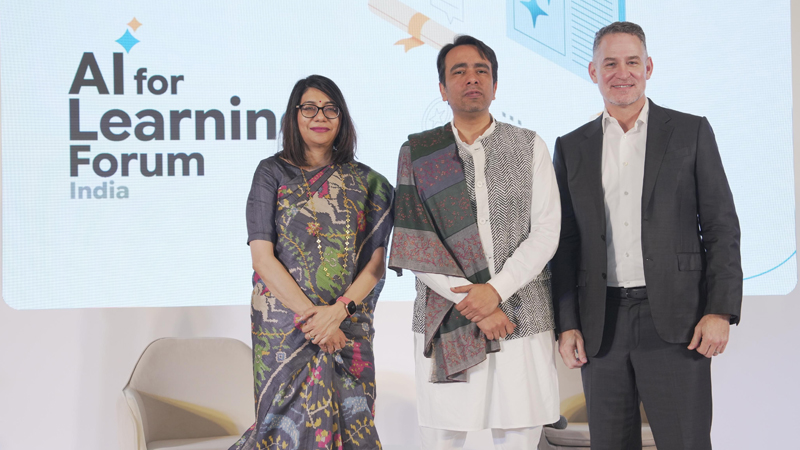
MUMBAI: If skills are the engine of Viksit Bharat, artificial intelligence is being fitted firmly under the bonnet. The Ministry of Skill Development and Entrepreneurship has announced a collaboration with Google Cloud and Chaudhary Charan Singh University to build a national framework for modernising India’s vocational and higher education ecosystem using cloud and AI technologies.
Unveiled at Google’s AI for Learning Forum in Delhi, the initiative positions CCSU, Meerut as a national pilot institution that will test how AI can be embedded into everyday teaching, administration and skill development. The announcement was made in the presence of Jayant Chaudhary, alongside senior officials from the Ministries of Skill Development and Education.
At the heart of the pilot is the use of Google Cloud’s Gemini Enterprise platform to address real-world challenges faced by universities. These include automating administrative workflows, improving staff efficiency, supporting research, and enabling personalised learning through AI tutors and skill-gap analysis. The aim is to make learning more adaptive, efficient and aligned with evolving workforce needs.
The programme is designed to act as an equaliser. By enabling vernacular language support and personalised AI-driven mentorship, it seeks to extend access to high-quality learning tools to students in regional institutions who are often constrained by geography, language or resources. Faculty members will also be supported with AI tools to design curriculum content, simulations and multilingual teaching aids tailored to different learning speeds.
Beyond classrooms, the initiative focuses on operational reform. Intelligent document processing and automated workflows are expected to reduce administrative load, allowing institutions to function more efficiently while improving service delivery to students.
Crucially, the CCSU pilot will feed into a larger ambition. Insights from the project will be used by MSDE to develop a National Best Practice Framework that can guide more than 50,000 colleges and over 1,200 universities in adopting AI responsibly and self-certifying as “AI-enabled universities”.
As a designated Centre of Excellence, CCSU will also host knowledge-sharing sessions to demonstrate how AI can be scaled across India’s diverse education landscape. The goal is clear: ensure that future-ready skills are not confined to elite campuses, but become part of the everyday learning experience for students across the country.