English Entertainment
‘Friends’ bids a graceful farewell

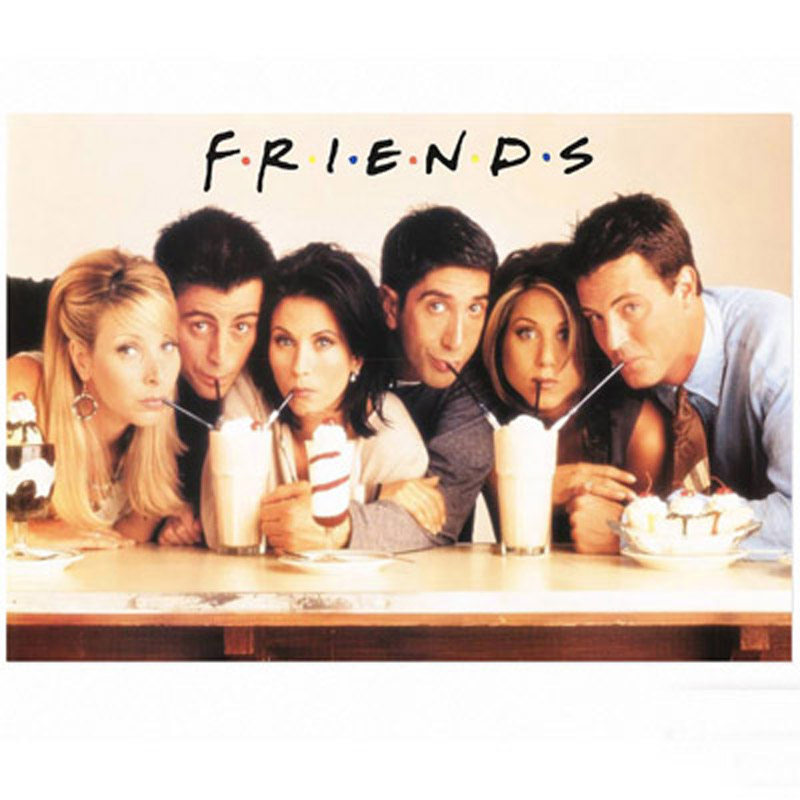
MUMBAI: As the saying goes, all good things must come to an end. Even Friends. One of the shows that gave a major boost to the sitcom genre, Friends has closed the books after charming the world for ten years.
Yesterday, the final episode aired on NBC.
The happy news for fans was that Ross and Rachel played by David Schwimmer and Jennifer Aniston got back together. In the final scene the six friends gave up their key to Monica and Chandler’s apartment.

NBC estimates that around 45 million people saw the final episode. However, those who missed out need not fret. The DVD of the season will be out in a few days with plenty of juicy extras.
One of NBC’s publicity stunts was in New York. The finale was beamed on a big screen in Times Square. It got an audience of around 3,000.
Still, the 45-million projected figure is nowhere near the record set by M-A-S-H in 1983. Its 2 1/2-hour send-off that was seen by nearly 106 million viewers still stands as the most watched US telecast ever. The last Cheers episode was seen by 80.4 million people in 1993 and Seinfeld had 76.2 million for its 1998 conclusion.
The final episode had been filmed in January under a heavy veil of secrecy. The broadcaster did an excellent job in making sure that the story was kept under wraps. It charged advertisers $ 2 million per 30 second spot for the finale.
At the end of the show Monica and Chandler have a pleasant surprise when she delivers twins. Phoebe, played by Lisa Kudrow, was already married, and Joey headed west to get serious about his acting career. In fact Matt LeBlanc who plays the character will have his own show. Joey has the unenviable and perhaps impossible task of trying to sustain the enthusiasm and global following that Friends was able to build.
The question now is what happens to the sitcom genre. Sex And The City wrapped up on HBO recently. Frasier comes to a close next week. Ray Romano is also hesistant about returning to CBS’ Everybody Loves Raymond after the current season.
Compounding the problem is a Newsweek report which bluntly puts forth the suggestion that the sitcom is dying. New shows like Its All Relative and Two and a Half Men could be considered as mere variations on Everybody Loves Raymond. There does not seem to be any effort to go past the stereotypes of the American family. Executives are apparently fixated on the notion of merely having the audience laugh every three seconds.
What the networks seem to be missing sight of is the fact that in 1994 the concept of a show like Friends was unique. There wasn’t a show at that time on the airwaves which focussed on 20 -year-olds living single in Manhattan In fact at that time it had been felt be network executives that another character would be needed like an older character or a cop on the beat or the guy who owns the coffee shop who gives the friends advice.
If the Newsweek prediction does come true, it will be real pity. For now though, one can only live on the hope that somewhere out there the next great sitcom is waiting to be born.






English Entertainment
Warner Bros. Discovery shareholders approve Paramount deal
Investors wave through a $111 billion megamerger but deliver a stinging, if toothless, rebuke over half-a-billion-dollar goodbye packages
NEW YORK: The shareholders said yes to the deal. They said no to the cheque. At a virtual special meeting on Thursday that lasted barely ten minutes, Warner Bros. Discovery investors voted overwhelmingly to approve Paramount Skydance’s $111 billion acquisition of the company — and then turned around and voted against the lavish exit pay packages lined up for chief executive David Zaslav and his fellow outgoing executives.
Not that it will make much difference. The compensation vote is purely advisory and non-binding. The Warner Bros. Discovery board can, and almost certainly will, pay out as planned.
But the symbolism stings. It is the second consecutive year that WBD shareholders have voted against the executive compensation packages, and this time they had good reason. Zaslav’s exit deal is, by any measure, extraordinary. Under the terms filed with the Securities and Exchange Commission, he is set to receive $34.2 million in cash severance, $517.2 million in equity in the combined company, and $44,195 in continued health coverage — a total of at least $550 million. On top of that, Warner Bros. Discovery has agreed to reimburse Zaslav up to $335 million for taxes assessed by the Internal Revenue Service on his accelerated stock vesting, though the company says that figure will decline depending on when the deal closes. As of March 11, Zaslav also held $115.85 million in vested WBD stock awards — and last month sold a further $114 million worth of WBD shares.
Shareholder advisory firm ISS recommended voting against the compensation measure, citing “problematic” tax reimbursements to Zaslav and the full vesting of his stock awards.
Zaslav will be bound by a two-year non-competition covenant and a two-year non-solicitation of customers and employees after the deal closes.
His lieutenants are not walking away empty-handed either. J.B. Perrette, chief executive and president of global streaming and games, is in line for $142 million, comprising $18.2 million in cash severance and $123.9 million in equity. Bruce Campbell, chief revenue and strategy officer, will receive an estimated $121.5 million, including $18.8 million in severance and $102.7 million in equity. Chief financial officer Gunnar Wiedenfels is set for $120 million, made up of $6.6 million in cash severance and $113.1 million in equity. Gerhard Zeiler, president of international, will get $82.6 million, including $11.9 million in severance and $70.7 million in equity.
The deal itself, clinched in February after Netflix declined to raise its bid for Warner Bros., still needs regulatory clearance from the Justice Department and European authorities. Several state attorneys general are also weighing legal action to block it.
Senator Elizabeth Warren, Democrat of Massachusetts, was unsparing. “The Paramount-Warner Bros. merger isn’t a done deal,” she said after the shareholder vote. “State attorneys general across the country are stepping up to stop this antitrust disaster. We need to keep up this fight.”
If it does go through, the combined entity would be a formidable beast, bringing together Paramount Skydance’s stable — CBS, CBS News, Paramount Pictures, Paramount+, BET, MTV and Nickelodeon — with WBD’s portfolio of HBO, Max, Warner Bros. film and TV studios, DC, CNN, TBS, TNT, HGTV and Discovery+. Paramount has said it expects $6 billion in cost savings from the merger, which is Wall Street shorthand for mass layoffs on a significant scale.
The ten-minute meeting was presided over by chairman Samuel Di Piazza Jr., with Zaslav, Campbell, Wiedenfels and chief communications officer Robert Gibbs in virtual attendance. Di Piazza was bullish. “We appreciate the support and confidence our stockholders have placed in us to unlock the full value of our world-class entertainment portfolio,” he said. “With Paramount, we look forward to creating an exceptional combined company that will expand consumer choice and benefit the global creative talent community.”
Zaslav echoed the sentiment. “Over the past four years, our teams have transformed Warner Bros. Discovery and returned the company to industry leadership,” he said. “Today’s stockholder approval is another key milestone toward completing this historic transaction that will deliver exceptional value to our stockholders.”
Paramount Skydance struck a similar note. “Shareholder approval marks another important milestone towards completing our acquisition of Warner Bros. Discovery,” it said in a statement, adding that it looked forward to “closing the transaction in the coming months.”
The shareholders have spoken on the merger. On the pay, they were ignored before the vote was even counted.