News Broadcasting
Many issues covered, little by way of solutions at CETMA seminar on CAS

Do the amendments being sought in the Cable TV (Networks) regulation Act, 1995 address the issue of subscriber management system? Will there be a penalty for under-declaration of subscriber base by cable operators? Who will invest in the upgradation of head-ends when conditional access is implemented? What should be the business model in a post-CAS era? What should be the ideal technical specifications – open architecture or proprietary technology?
There were more questions and concerns than answers and solutions. That, in a nutshell, was the outcome of a seminar on conditional access systems (CAS) and pay TV channels that had been organised by the Consumer Electronics & TV Manufacturers’ Association (CETMA) in Delhi today.
After the seminar, a chief executive of a joint venture cable distribution company admitted in private that “too may issues and concerns were voiced with almost no solutions offered.”

If Shantanu Aditya, head of Sony Entertainment TV Discovery Pvt Ltd, a cable distribution company, felt that the amendments which have been proposed in the Cable TV (Networks) regulation Act, 1995, would not help India leapfrog where technology is concerned and also does not address the issue of under-reporting by cable operators, Vikki Choudhry, an independent cable operator in Delhi was of the opinion that the broadcasters, most of the time, do not take into account the problems of cable operators which include financial ones too. “In such a scenario, CAS is a good thing for the whole industry as it will bring about some transparency,” he added.
However, the three major concerns, which CETMA will apprise the government of after collating facts from the seminar, amongst others, are the following:
1. The cost factor: higher duties on set top boxes (STBs) which at present total up to about 58.6 per cent, must be reduced drastically. According to Rajeev Karwal, senior vice-president (consumer electronics) of Philips India Ltd, “If the government really wishes to popularise CAS through STBs, then the various duties on STBs need to be reduced.”
2. Safeguard against unauthorised re-distribution of pay channels after CAS is implemented. Explained Sanjiv Kainth, general manager, digital products, Thomson Multimedia India Pvt. Ltd: “The government has to ensure that after CAS is implemented, nobody illegally redistributes pay channels. This is very important as it will defeat the whole purpose of CAS.”
3. The analog vs digital STB issue: With confusion prevailing in the Indian market whether India should go in for anlaog or digital STBs, Thomson’s Kainth said that various lobbies be damned as market forces, based on economic factors of the region serviced by cable operators will decide whether it will be analog or digital STBs. “As I see it, in all probability, it will be a mix of both with cable operators servicing more affluent areas having the option to go in for digital STBs,” he added. But differing with Kainth on this issue was Aditya who felt that analog STBs would be a “step backward.”
K. Jayaraman, managing director of Hathaway & Datacom Cable, felt that CAS may address the issue of piracy which results in loss of revenue for everybody, but added that some pilot projects undertaken by his company has shown that digital STBs don’t seem to work very well in India.
But it was Thomson’s Kainth, airing CETMA’s overall view, who came out with a splendid presentation on CAS and pay channels which covered the whole gamut of issues from investments to the business models to the technical specifications.
According to Kainth, investment between Rs 25 million to Rs 100 million would be needed in a headend that is distributing 40-odd digital channels and “ultimately it would be the cable operator who owns the subscriber and the subscribers themselves who will have to bear a major share of the investment pie.” A point of view also voiced by Dayanidhi Maran, chief executive of the Sun-owned Sumangali Cable Vision cable distribution company.
Sunil Khanna, chief executive of Zee Turner Pvt. Ltd, referred to the idea of “headend in the sky” which will drastically reduce the cost of physical implementation of CAS throughout the country in various phases.
Head in the sky concept involves forming a platform of broadcasters who uplink from a common place where all the signals are encrypted after the various channel signals are passed through a box and then uplinked again in that format. The cable operator then downlinks the encrypted bunch of signals, mixes the free to air channels and re-distributes to consumers according to their needs.
But, countered, a senior executive from a hardware manufacturing firm, headend-in-the-sky concept sounds very good theoretically, but will remain a fantasy as in this case the broadcasters have to decide first to come together which looks a remote possibility.
Then, of course, consumer activist and columnist Pushpa Girimaji, presenting the consumers’ viewpoint said that CAS is fine but the way everything has been framed it seems to limit the consumer’s options rather make it flexible.
“The Bill on CAS takes away the people’s right of choice and gives the power to the government to decide what they should see. It curtails consumers choice and nobody should decide how many channels people should see (or not see),” Girimaji said while referring to the CAS and the basic tier of free to air channels being proposed by the government.


News Broadcasting
Kamlesh Singh receives Haldi Ghati Award from MMCF
India Today Group editor honoured for three decades of journalism at Udaipur ceremony.
MUMBAI- Kamlesh Singh just turned a lifetime of sharp words into a shiny shield because when journalism wakes up a society, even the Maharana of Mewar wants to pin a medal on it.
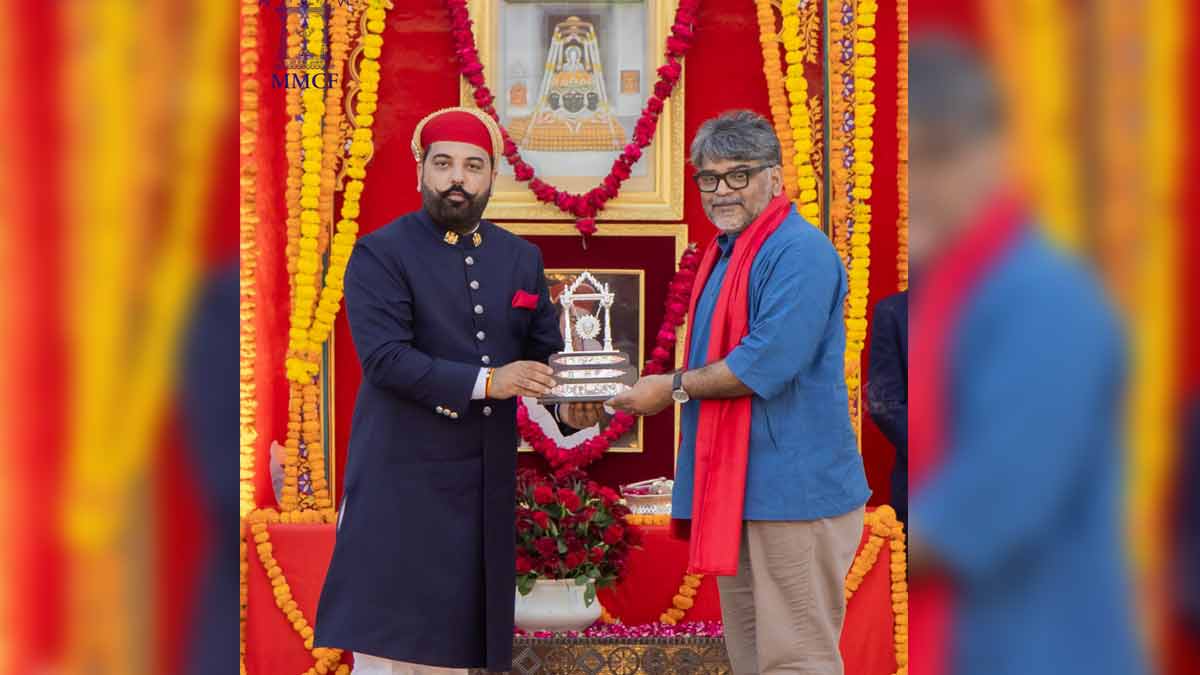
The Maharana of Mewar Charitable Foundation (MMCF) conferred its prestigious Haldi Ghati Award on Kamlesh Singh, a senior editor at the India Today Group, during a ceremony in Udaipur on 15 March 2026. The national award, instituted in 1981-82, recognises “work of permanent value that initiates an awakening in society through the medium of journalism.”
Singh, who leads several editorial initiatives including Aaj Tak Radio, the Teen Taal community and The Lallantop, was presented the honour by Lakshyaraj Singh Mewar, Managing Trustee of MMCF. The citation highlighted his three decades of contributions to Indian media, innovations in digital journalism, mentoring young reporters, and his popular podcast persona “Tau” on Teen Taal, which fosters thoughtful public discourse.
The Haldi Ghati Award, named after the historic Battle of Haldighati symbolising valour and resilience, is one of four national awards given annually by MMCF. Past recipients include Tavleen Singh, Piyush Pandey and Raj Chengappa.
Other honourees this year included Padma Vibhushan Pt Hari Prasad Chaurasia, Vedamurti Devvrat Rekhe, Treeman of India Marimuthu Yoganathan, Vir Chakra Capt Rizwan Malik, and US-based researcher Molly Emma Aitken, who received the Colonel James Tod Award for contributions to understanding Mewar’s spirit and values.
In an era where headlines often shout louder than substance, the MMCF quietly reminded everyone that real journalism isn’t about noise, it’s about the quiet, persistent work that stirs society awake, one thoughtful story at a time.







