GECs
Downlink Policy: Chandra has reservations


MUMBAI: The government may come out with a downlinking policy soon but Zee Telefilms chairman Subhash Chandra has reservations on whether it would be a complete mechanism in regulating content on television channels.
“The proposed downlinking policy is still discriminatory and is a compromise. Who, for instance, will monitor it? Only a post mortem is possible. No preventive measure can be taken,” Chandra said on Friday. He was speaking on “Regulate the industry – Is TV content going overboard?” at the third of a series of interactions between the television industry and media, organised by Tam Media Research and Press Club, Mumbai.
Making uplinking from India mandatory would be a more effective mechanism to control foreign channels. Broadcasters like Star and Sony uplink from outside the country.

Incidentally, the downlinking policy, which is awaiting Cabinet nod, is expected to give the government control over channels beaming into India, but uplinking from abroad. The channels will have to register themselves in India, and set up an India office. The government wants to tackle issues such as adult content.
Stressing on the need to regulate the TV industry, Chandra said the Cable Television Networks (Regulation) Act was not clear in defining “adult content” as in the West. In Europe, for instance, there were seven categories of adult channels. Under a conditional access system (CAS) environment, such content would have given the viewers a choice as they could use the parental lock. “But the trouble is that broadcasters are not together with some even lobbying against CAS.
And it is very easy for foreign broadcasters to say that the Indian laws are not applicable to them,” he said.
Zee Telefilms has suggested to the information and broadcasting ministry (I&B) that each programme be codified like in films so that the family could decide whether to watch it. They could then completely block it with their own code number,” he added.
The regulation is such that broadcasters can “turn and twist” to get around with it. “We have been asking for a separate regulator rather than having the Telecom Regulatory Authority of India for it,” Chandra said, remarking on the need to regulate the broadcast industry.
Speaking on the occasion, senior advocate Mukesh Vashi accused TV channels of violating the Cinematography and Cable TV Acts. Drawing instances where several channels were screening obscene acts, he stressed on the need for a regulatory board to regulate contenton TV. “Though the law is there, no regulatory authority is available. A regulatory body is urgently needed,” Vashi said.
Tam CEO LV Krishnan believed technology could also be used to intervene and regulate adult content. “It is mainly the music channels which are showing such content,” he said.







GECs
Samsung TV Plus launches Kings of Comedy channel
New free FAST channel brings iconic Hindi comedy shows to millions of Samsung Smart TV owners.
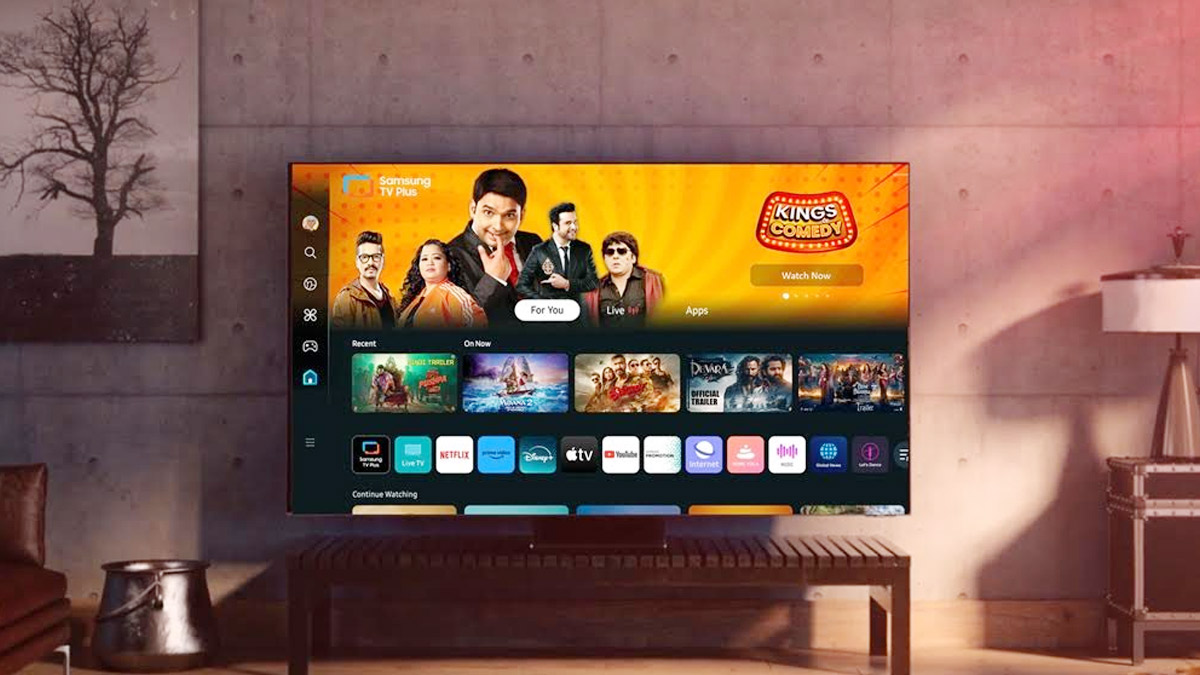
MUMBAI: Samsung TV Plus has just turned up the laughter volume and it’s completely free. The leading free ad-supported streaming television (FAST) service in India has launched Kings of Comedy, a premium comedy channel featuring some of the country’s most beloved primetime shows. Available exclusively on Samsung TV Plus, the channel delivers back-to-back hits including Comedy Nights with Kapil, Khatra Khatra Khatra, and Comedy Nights Bachao, with no login or subscription required.
The launch marks a milestone for free streaming in India, offering audiences a dedicated comedy destination directly from their Samsung TV home screen. It arrives as Samsung TV Plus India celebrates its 5th anniversary, during which the service has grown its monthly active users by 42 per cent and more than doubled its total viewing hours. The platform now offers over 180 free channels across 14 languages.
Samsung TV Plus India general manager and head of business development Kunal Mehta said, “Comedy is the heartbeat of Hindi entertainment, and Kings of Comedy brings together the shows Indians already love, completely free on their Samsung TV. Our focus remains the same take the content people know and make it effortless to access.”
Globally, Samsung TV Plus has surpassed 100 million monthly active users across more than 4,500 channels, solidifying its position as one of the world’s leading free streaming services.
Kings of Comedy is now available on all compatible Samsung Smart TVs. For viewers seeking non-stop laughter without any cost, this new channel delivers a royal treat proving that sometimes the best entertainment really does come with no strings (or subscriptions) attached.