News Broadcasting
CNN’s Call to Earth explores the crucial connection between cities and wilderness

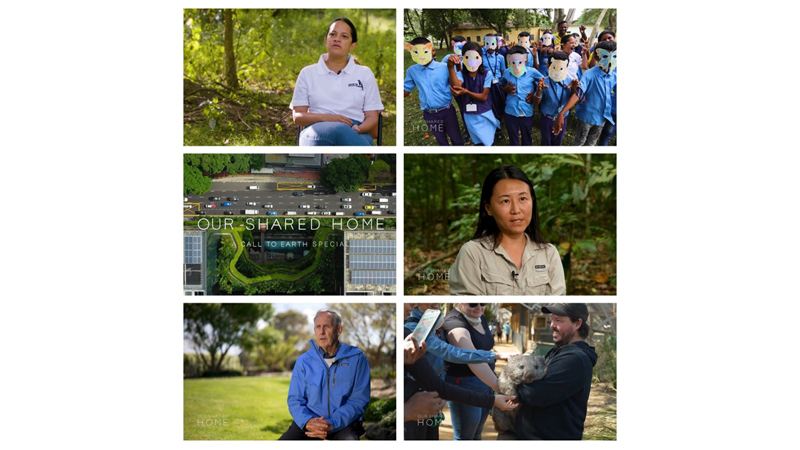
Mumbai: The conflict between people and the planet’s dwindling wildlife over food, resources, and space for living, is as present in the heart of our cities as it is in remote rainforests, and in the depths of our oceans. In a special half-hour show, CNN’s Call to Earth highlights this crucial connection between cities and wilderness, showing how people living in urban areas can have a huge impact on both wild environments around the world and the hidden wilderness within our cities.
Earlier this year, India surpassed China as the world’s most populous nation. Despite having only five per cent of its terrain reserved for nature, the country is also home to the highest number of tigers and Asian elephants in the world. Every year there are thousands of cases where communities and large mammals clash and the result is damage, injury, and often death on both sides. Conservation biologist and Rolex Laureate Dr. Krithi Karanth said that one of the biggest challenges is trying to get people living near national parks to care for wildlife that threatens their very existence, “You have large, charismatic megafauna living next to really high densities of people. They’re going to come to raid crops, or they’re going to come and get livestock.”
As the executive director of the centre for wildlife studies (CWS) Dr. Karanth has spent the past two decades helping rural communities access a program that gives them compensation for their losses. It’s a pragmatic approach that has greatly reduced hostility towards wildlife in rural communities. She said, “Initially the worry was, ‘would people call?’ And people started to call. And they realised that 100% of the time, our amazing CWS team show up. It doesn’t solve the problem, but at least it helps assuage people so they don’t retaliate out of anger and frustration against, particularly, large animals.”

As part of her research, Dr. Karanth has travelled to 3000 villages in key conflict areas, looking for ways to lessen the impact of wild species on rural communities. She speaks about her experiences, “I walk away with simple admiration for these guys, because they’re getting hit over and over and over again, and yet, they understand that they have to figure out a way to share space with wildlife.”
Singapore, one of the fastest-developing cities on earth, has increased its natural cover to almost half its land area over the past 30 years. Despite that, exponential human population growth still exerts pressure on its natural resources. The city is home to the Raffles’ banded langur, one of the top 25 most endangered primates in the world. Just a few hundred survive in the wild. Primatologist Dr. Andie Ang has made it her life’s mission to save them, “It is really hard to actually balance between development and also nature conservation. But I’m pretty hopeful because we have transformed to a place where we recognise the importance to keep those habitats protected so that we can co-exist with our wild neighbours.”
According to Dr. Ang, one of the biggest threats that the langurs face is habitat fragmentation. The city’s green bridges provide animals with a passageway from one safe haven to another, but keeping the forests intact is key to the survival of the species. Ryan Lee, director of Wildlife Management at NParks, talks about the project, “We have been installing wildlife bridges to try to extend the natural habitat beyond the boundaries of our nature reserves. And it has been proven to reduce the number of road-kills and also improve the way [primates] move around Singapore.”
Finally, the programme visits Tasmania, home to ancient ecosystems and to a new generation of conservationists determined to preserve the island’s ecology and natural resources. As the University of Tasmania expands, it is doing so around the habitat of its long-term residents: the little penguins. The university is helping local conservationists to turn its carparks into habitats complete with native plants and man-made penguin burrows. Perviz Marker, a volunteer at the Friends of Burnie Penguins, talks about the work, “Some colonies in the south-east of Tasmania have disappeared. Some colonies here have got less. But a lot of them are maintaining their numbers because there’s been a lot of coast care and community involvement.”
As Tasmania moves towards a more sustainable future, a shift to clean energy production is threatening to have a huge impact on the island’s natural habitats. Environmentalist Bob Brown discusses the dilemma, “We’re in a double dilemma. And they’re two sides of the one coin. The mass extinction of species which is ratcheting up due to our destruction of nature. And the warming of the planet, which is ratcheting up due to our burning of fossil fuels and forests.” He continues, “ We still have natural areas that are intact both in the oceans and on land. It’s ours to keep. And it’s got to be done in this generation. No future generation can come back and undo what we are doing.”
Robbins Island off Tasmania’s north coast is one of the windiest places on earth and may soon become the home of one of the biggest wind farms in the world. Despite the prospect of supercharging the country’s energy grid with clean power, environmentalists fear the wind farm could destroy the habitat of precious species including the Tasmanian Devil. Greg Irons, Director of Tasmania’s first and only wildlife rescue centre, describes the unique habitat of the area, “We’re like this Noah’s Ark of Australian wildlife, sort of the last stand for a number of species that once roamed all over Australia and now are only in Tasmania.”
Call to Earth: Our Shared Home is part of CNN’s third annual Call to Earth Day, celebrating a planet worth protecting. Partnering with schools, individuals and organisations across the world, CNN will use its global presence for a day of action to raise awareness of environmental issues and to engage with conservation education.
Register for Call to Earth Day Event:
Call to Earth: Our Shared Home airs on CNN International at the following times:
Tuesday 28 November 2023 at 05:30 BST and 11:30 BST.