News Headline
If transponder space unavailable on Insat-4B, Sun might opt for Measat3


MUMBAI: A day after the unfortunate failure of the GSLV-F02 launch rocket carrying the Insat-4C communication satellite, it is not just India’s space establishment that has been forced to relook its plans.
For Kalanithi Maran’s southern broadcast network Sun Group, the mishap could well mean that the launch of its direct-to-home (DTH) service sees a change of satellite operator. Sun TV had booked seven high-power Ku-band transponders, six for DTH and one for DSNG (digital satellite news gathering), of the total 12 carried by the Indian Space Research Organisation’s Insat-4C.
The big question now is this: If Isro is not able to provide Ku-band transponder space for his DTH venture Sun Direct, will Maran opt for an alternative satellite like Malaysia’s soon-to-be-launched Measat-3?

Maran already has a running relationship with Measat’s parent company Astro, having stitched a deal last year for a $25 million joint venture to originate, aggregate and distribute television programming and channels for a global audience. Measat Broadcast Network Systems is a subsidiary of Astro company which has a 20-year exclusive licence for DTH transmission in Malaysia.
Measat has scheduled a September launch for the Measat-3 satellite. The satellite will be shot into space atop a Proton rocket from the Baikonur Cosmodrome in Kazakhstan. Measat-3 will have 24 Ku-band transponders and has been designed to provide capability for data services and DTH applications in Malaysia, Indonesia, India and China.
Maran, however, says he has got intimation from Isro that he will be provided with Ku-band transponders at the earliest. “Isro has assured us of providing alternate transponders to meet our DTH requirements. We have not made any request to Isro for taking space on Measat-3. We were, in any case, looking at a time frame between October-November,” the Sun Group promoter tells Indiantelevision.com.
Has Maran been told which satellite will provide him the Ku-band transponders? “We will know from Isro in three to four days,” he says.
For DTH providers who want to operate from foreign satellites, Isro will have to provide the approval and lease it out for them. Dish TV, for instance, is on NSS-6 with Isro’s backing as required by regulatory norms.
For Isro’s commercial arm Antrix Corporation, hiring of foreign transponder space for a short time could be a possibility. There is a precedence of this having happened in the past.
According to a report in Hindu Businessline, when Insat-2D failed, Isro bought transponder space on an Arabsat satellite. Isro has also provided temporary leases on Thaicom, GE-Americom, and even now on NSS, Businessline reported.
At the moment though, Isro has not received any fresh proposal from Maran’s DTH company, Sun Direct TV, to lease out a satellite for them. Says Isro contract management and legal services director SB Iyer, “Sun has not asked us for a foreign satellite yet. The failure of Insat-4C is a brief setback which has put us behind 4-6 months. But we are recasting our programme by which we can accelerate the Ku-band capacity growth. We may be putting up larger satellites to boost the capacity.”
So will Sun get space on Insat-4B, which is meant for Doordarshan’s DTH service like DD Direct Plus? “We haven’t taken any decision yet. DD, which is on NSS-6, has a low requirement,” says Iyer. Sun has asked up to eight transponders for its DTH service.
Even if Sun gets Insat-4B, the launch of the satellite is expected to take place early next year. The commercial operations can, thus, commence only by the first quarter of next fiscal. “We have the flexibility to accommodate Sun. It is too early to comment on the steps we are going to take,” says Iyer.




NEW DELHI: Hamdard Laboratories gathered a cross-section of India’s achievers in New Delhi on Friday, handing out the Hakeem Abdul Hameed Excellence Awards to figures who have left their mark across healthcare, education, sport, public service and the arts.
The ceremony, attended by minister of state for defence Sanjay Seth and senior officials from the ministry of Ayush, celebrated individuals whose work blends professional success with a sense of public purpose. It was as much a roll call of achievement as it was a reminder that influence is not measured only in profits or podiums, but in people reached and lives improved.
Among the headline awardees was Alakh Pandey, founder and chief executive of PhysicsWallah, recognised for turning affordable digital learning into a mass movement. On the sporting front, Arjuna Awardee and kabaddi player Sakshi Puniya was honoured for her contribution to the game and for pushing women’s participation onto bigger stages.
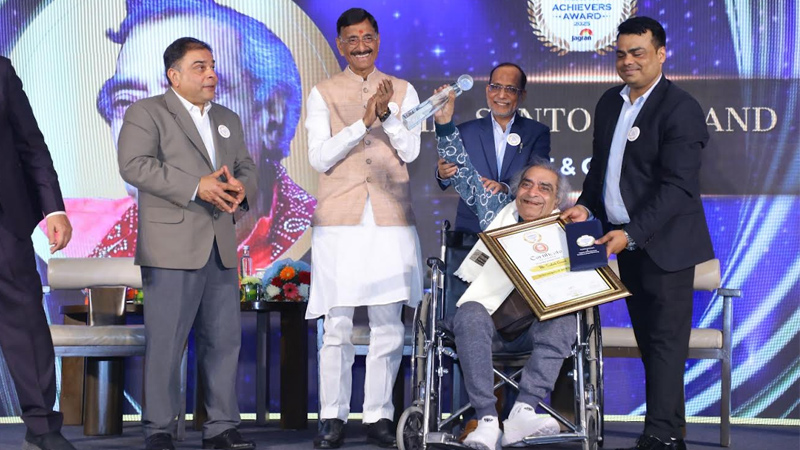
The cultural spotlight fell on veteran lyricist and poet Santosh Anand, whose songs have echoed across generations of Hindi cinema. At 97, Anand accepted the honour with characteristic humility, reflecting on a life shaped by perseverance and hope.
Healthcare honours spanned both modern and traditional systems. Manoj N. Nesari was recognised for strengthening Ayurveda’s place in national and global health frameworks. Padma shri Mohammed Abdul Waheed was honoured for his research-backed work in Unani medicine, while padma shri Mohsin Wali received recognition for his long-standing contribution to patient-centred care.
Education and social development also featured prominently. Padma shri Zahir Ishaq Kazi was honoured for decades of work in education, while former Meghalaya superintendent of Police T. C. Chacko was recognised for public service. Goonj founder Anshu Gupta received an award for his dignity-centred rural development initiatives, and the Hunar Shakti Foundation was honoured for empowering women and young girls through skill development.
The Lifetime Achievement Award went to former IAS officer Shailaja Chandra for her long career in public healthcare and governance, particularly in the traditional systems under Ayush.
Speaking at the event, Hamdard chairman Abdul Majeed said the awards were a tribute to those who combine excellence with empathy. “These awardees reflect Hakeem Sahib’s belief that healthcare, education and public service must ultimately serve humanity,” he said.
Minister Seth struck a forward-looking note, saying India’s young population gives the country a unique opportunity to become a global destination for learning, health and wellness by 2047.
The ceremony also featured the trailer launch of Unani Ki Kahaani, an upcoming documentary starring actor Jim Sarbh, set to premiere on Discovery on 11 February.
Instituted in memory of Unani scholar and educationist Hakeem Abdul Hameed, the awards have grown into a national platform that celebrates those building a more inclusive and resilient India. For one evening at least, the spotlight was not just on success, but on service with substance.







