eNews
Vishvas.news launches ‘Sach Ke Sathi Seniors’ against online misinformation
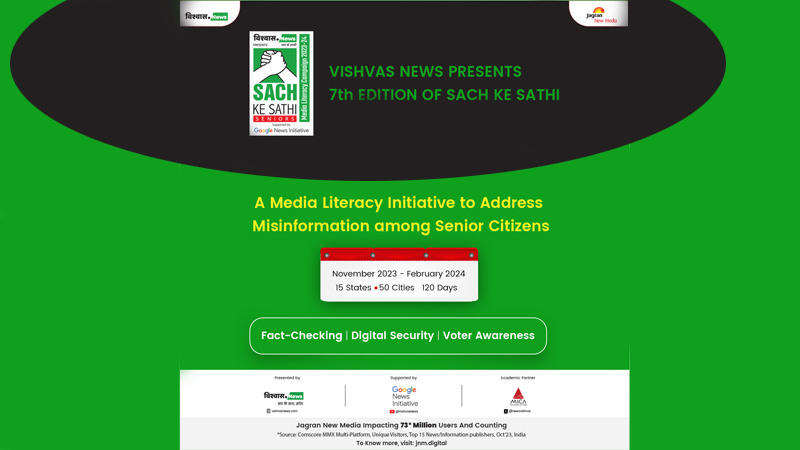
Mumbai: Jagran New Media’s internationally awarded and trusted fact-checking wing, Vishvasnews.com, launches “Sach Ke Sathi: Seniors”, a media literacy campaign to help senior citizens learn how to detect online misinformation, protect themselves from deepfakes and access trustworthy news and information.
SKS Seniors – the seventh edition of Jagran New Media’s flagship media literacy effort Sach Ke Sathi – has been launched by Vishvasnews.com in collaboration with MICA as its Academic Partner, and is supported by the Google News Initiative. Two other fact-checkers – Fact Crescendo, and News Meter have also joined hands with SKS Seniors as its language partners to take the initiative forward in local languages. The campaign focuses on imparting media literacy training to senior citizens, who are more vulnerable to false information and aims to impart skills to better navigate the digital information landscape.
SKS Seniors will go live in 50 cities, covering 15 states in seven languages and will host 70 training sessions – 40 on-ground and 30 online. In addition to this, SKS will also launch a first-of-its-kind micro-learning video course on media literacy and promote media literacy through its print editions.
Commenting on the launch, Jagran New Media CEO Bharat Gupta said, “The collaboration between Vishvasnews.com, Google News Initiative (GNI), the fact-checking community, and MICA fulfils our objective to address the critical issue of media literacy specifically within the senior demographic, with a focus on digital safety and fact-checking. Built upon shared synergy, the 7th edition of Sach ke Sathi will enable us to collectively prioritize the advancement of media literacy among seniors and create a robust foundation for a digitally literate society. It has been our endeavour at Jagran New Media to follow the principles of diversity, equity, and inclusion (DEI) that underline our dedication to this important cause.”
Jagran New Media editor-in-chief Rajesh Upadhyay added, “We are thrilled to continue another chapter of Sach Ke Sathi and elevate the initiative’s standards by tailoring the approach to address many unique challenges faced by senior citizens in the age of misinformation, like limited digital literacy and fact-checking skills. The main focus is on providing senior citizens with essential tools and knowledge for awareness of digital safety and misinformation/disinformation through various training done by the fact-checking community and our academic partner, MICA. A well-devised communication and outreach plan has been implemented to ensure that the programme effectively reaches its intended audience, with a range of measurement approaches to assess the programme’s impact at various stages.”
Google News Lab lead in India Surabhi Malik said, “Sach ke Sathi Seniors is a much-needed collaborative media literacy effort that will empower senior citizens with critical thinking skills, help them detect misinformation and also prepare them to tackle deep fakes. Mis and disinformation is a serious problem that clogs the information pipeline and prevents the flow of trustworthy & authoritative information, which is all the more crucial during elections. We are proud to support this collaborative initiative that will help participants better assess the credibility of information available online.”
MICA associate professor, Head of Media and Entertainment Management Area and Centre for Media and Entertainment Studies (CMES) Santosh K Patra added, “As the academic partner of Sach Ke Saathi Seniors, we see it as an opportunity to address the issue of digital information literacy with Vishvas News. We have designed a curriculum by adopting an interactive and learner-centric pedagogy that not only imparts knowledge but also fosters critical thinking skills to tackle the challenges of fake news, misinformation, disinformation and misinformation which is prevalent like a menace in our society today.”
Sach Ke Sathi was launched in 2019 by Vishvasnews.com and Jagran New Media with a mission to combat the spread of misinformation and disinformation. SKS won Wan-Ifra’s Best Trust Initiative Silver Award in 2023 and IAMAI’s 2022 Bronze for best content campaign.
The previous six editions dealt with crucial subjects such as Health Fact Check, Bihar Elections, Yes for Vaccine, Assembly Elections 2022, FactsUp, and more. Over the years, Sach ke Sathi has achieved significant success in raising awareness about the societal effects of misinformation and fake news, as well as providing the tools and training needed to identify misinformation at a larger level.

eNews
How short, addictive story videos quietly colonised the Indian smartphone
A landmark Meta-Ormax study of 2,000 viewers reveals a format that is growing fast, paying slowly and consumed almost entirely in secret
CALIFORNIA, MUMBAI: India has a new entertainment habit, and it arrived without anyone really noticing. Micro dramas, those short, cliffhanger-driven episodic stories built for the smartphone screen, have quietly embedded themselves into the daily routines of millions of Indians, discovered not by design but by algorithmic accident, watched not in living rooms but in bedrooms, on commutes and in the five minutes before sleep.
That, in essence, is the finding of a sweeping new audience study released by Meta and media insights firm Ormax Media at Meta’s inaugural Marketing Summit: Micro-Drama Edition. Titled “Micro Dramas: The India Story” and based on 2,000 personal interviews and 50 depth interviews conducted between November 2025 and January 2026 across 14 states, it is the most comprehensive study of the category in India to date, and its findings are striking.
Sixty-five per cent of viewers discovered micro dramas within the last year. Of those, 89 per cent stumbled upon the format through social media feeds, primarily Instagram and Facebook, without ever searching for it. The algorithm did the heavy lifting. Discovery, as the report puts it bluntly, is algorithm-led, not intent-led.
The typical viewer journey begins with accidental exposure while scrolling, moves through a cliffhanger-driven incompletion hook that makes stopping feel unfinished, and is reinforced by algorithmic repetition until habitual consumption sets in. Only then, when a platform asks for an app download or a payment, does the viewer pause. Trust, not content quality, determines what happens next, and many simply return to the free feed rather than pay. It is a funnel with a wide mouth and a narrow neck.
The numbers on consumption tell their own story. Viewers spend a median of 3.5 hours per week watching micro dramas, spread across seven to eight sessions of roughly 30 minutes each, peaking sharply between 8pm and midnight. Daytime viewing is snackable and low-commitment, squeezed into morning commutes, work breaks and coffee pauses. Night-time is where the format truly lives: private, uninterrupted and, for many viewers, socially invisible. Ninety per cent watch alone, compared to just 43 per cent for long-form OTT content. Half the audience watches during their commute, well above the 37 per cent figure for streaming platforms, a direct reflection of the format’s low time investment advantage.
The audience itself breaks into three segments. Incidental viewers, comprising 39 per cent of the total, are passive consumers who stumble in and rarely seek content actively. Intent-building viewers, the largest group at 43 per cent, are beginning to form habits and seek out episodes but remain cautious. High-intent viewers, just 18 per cent, are the ones who download apps, tolerate ads and occasionally pay: skewing male, younger and urban.
What audiences want from the content is revealing. The top three genres are romance at 72 per cent, family drama at 64 per cent and comedy at 63 per cent, precisely the same top three as Hindi general entertainment television. The format rewards emotional familiarity over complexity. Romance in particular thrives because it demands low cognitive investment, needs no elaborate world-building and plays naturally into the private, pre-sleep viewing window where inhibitions lower and emotional intimacy feels safe.
The most-recalled shows, led by Kuku TV titles such as The Lady Boss Returns, The Billionaire Husband and Kiss My Luck, share a common narrative DNA: rich-poor conflict, hidden identities, power imbalances, melodrama and cliffhangers that make stopping feel physically uncomfortable. Predictability, the research warns, is fatal. Each episode must re-earn attention from scratch.
The terminology question is telling. Despite the industry’s embrace of the phrase “micro drama,” viewers have not adopted it. They call the content “short story videos,” “short dramas,” “reels with stories” or simply “serials.” One respondent from Chennai said bluntly that “micro sounds like a scientific word.” The category is at the stage that OTT occupied in 2019 and podcasts in the same year: widely consumed, poorly named and not yet crystallised in the public imagination.
Platform awareness remains alarmingly thin. Only three platforms, Kuku TV at 78 per cent, Story TV at 46 per cent and Quick TV at 28 per cent, have crossed the 20 per cent awareness threshold. The rest languish in single digits. This creates a trust deficit that directly throttles monetisation: viewers who cannot remember which app they used are hardly primed to enter their payment details.
Yet the appetite is clearly there. Sixty-five per cent of viewers watch only Indian content, drawn by the TV-serial familiarity of the storytelling, the comfort of Hindi as a shared language and the sight of actors they half-recognise from decades of television. South languages are rising fast: Tamil, Telugu and Kannada together account for 24 per cent of first-choice viewing. And AI-generated content, still a novelty, has landed better than expected: 47 per cent of viewers call it creative and unique, with only 6 per cent actively rejecting it.
Shweta Bajpai, director, media and entertainment (India) at Meta, called micro drama “a category that is rewriting the rules of Indian entertainment,” adding that the discovery engine being social distinguishes this wave from previous content formats. Shailesh Kapoor, founder and chief executive of Ormax Media, was characteristically measured: the format, he said, is showing “the early signs of becoming a distinct content category” and, given how closely it aligns with natural mobile behaviour, “has the potential to scale very quickly.”
The format’s fundamental mechanics are working. It enters lives quietly, through boredom and a scrolling thumb, and burrows in through incompletion and habit. The challenge now is monetisation: converting a category of highly engaged but deeply anonymous viewers into paying customers who trust the platform enough to hand over their UPI credentials. The story, as any micro-drama writer knows, is only as good as the next cliffhanger. India’s platforms had better have one ready.