Movies
IFFI 2024: Gullu wins big in 48-hour short filmmaking challenge
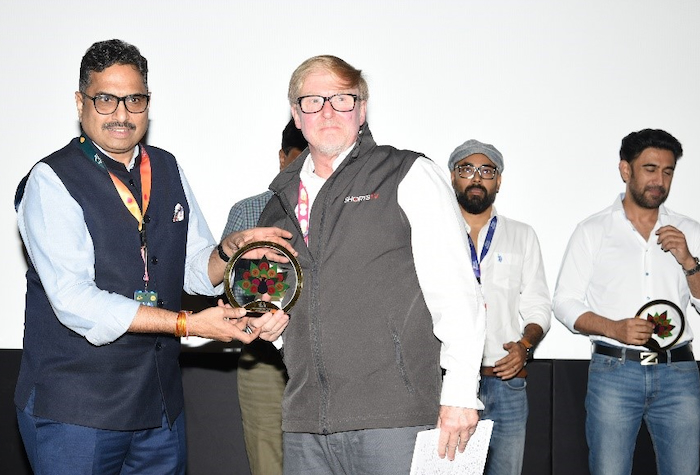
tireless yet unforgettable hours – this was the scene at Maquinez Palace today during the closing ceremony of Creative Minds of Tomorrow (CMOT), held in the Fifty fifth International Film Festival of India (IFFI).
CMOT has emerged as a leading platform for discovering and nurturing India’s most promising young filmmakers. This year marked a significant milestone, with the program expanding to include 100 young talents across 13 filmmaking disciplines, a notable increase from the 75 participants and 10 crafts featured in previous editions. The initiative garnered an overwhelming response, receiving nearly 1,070 entries from across India, showcasing their talents in 13 film-related trades.
A highlight of the event was the 48-Hour filmmaking challenge where participants, divided into five teams of 20 members each, created short films centred around the theme “Relationships in the Age of Technology”. The challenge took place from 21-23 November, across 12 locations within a four-kilometer radius of Panjim, which tested the team’s creativity and resilience.
,
This year, the winners of the 48-hour Filmmaking Challenge at CMOT were
1. Best Film: Gullu
Best Film (Runners-up): We Hear the Same Music
2. Best Director: Arshaly Jose (Gullu)
3. Best Script: Adhiraj Bose (Lovepix Subscription)
4. Best Actress: Vishakha Nair (Lovepix Subscription)
5. Best Actor: Pushpendra Kumar (Gullu)
Arshaly Jose, who won the best director award, expressed her gratitude, saying,: “This achievement belongs to my entire team. The script was the true hero of our film, and the moment I read it, I knew we had something special. Working with this exceptional team has been an unforgettable experience.”
The young talents were mentored by the previous year’s CMOT alumni who were invited as CMOT Champions – Chidananda Naik, Akhil Lotlikar, Subarna Dash, Akshita Vohra and Krishna Dusane.
Information and broadcasting ministry secretary Sanjay Jaju said: “To produce such exemplary films within 48 hours under immense pressure is an achievement in itself. Every participant here is a winner.” He further emphasized: “This year, we have dedicated IFFI to legends- of the past and of the future, represented by the youth of our country. Initiatives like CMOT, Film Bazaar, and the Red Carpet provide a gateway for aspiring filmmakers to realize their dreams.”
Actor Amit Sadh, also present at the ceremony, praised IFFI for bringing the film industry’s opportunities directly to young filmmakers and actors from across the nation. The event was graced by several dignitaries, including Neerja Sekhar, special secretary of the ministry of information and broadcasting; Prithul Kumar, joint secretary of broadcasting and MD, NFDC; Vrunda Desai, joint secretary of films, and Apurva Chandra, former secretary of the ministry of I&B. Acclaimed writer and grand jury Member Samrat Chakraborty also attended the event.
As the winners were announced amidst an enthusiastic crowd, Shorts International founder & CEO Carter Pilcher lauded the participants, remarking, “the quality and content of the films produced this year are brilliant and outstanding.”
Organised in collaboration with UK-based network Shorts International, the 48-hour filmmaking challenge offered a unique opportunity for young filmmakers to test their creativity, storytelling skills and teamwork under intense time constraints. Shorts TV also took on the task of the entire pre-production, production and post production of these films at CMOT.

Hollywood
Did the ballet and opera controversy cost Timothée Chalamet his Oscar?
The actor’s ‘dying art forms’ comments may have danced away his Oscar chances.
LOS ANGELES: Last night, the 98th Academy Awards delivered a performance that wasn’t in the script, as Michael B. Jordan clinched the Best Actor statue, leaving Timothée Chalamet’s widely predicted win to pirouette away into the night. While Chalamet was long considered the frontrunner for his starring turn in Marty Supreme, many are whispering that a singular, ill-timed performance, not on screen but on the campaign trail, may have rewritten the finale.
For months, the narrative surrounding the race had a singular star, Chalamet, the critics’ darling and the bookies’ bet. However, the closing numbers saw a dramatic plot twist. Chalamet found himself upstaged not just by his fellow nominees but by the ghost of public opinion, following remarks he made during a Variety and CNN actor-on-actor conversation in February.
What started as a breezy discussion turned distinctly frosty when Chalamet, the conversation’s designated trendsetter, took aim at some classical institutions. “I don’t want to be working in ballet or opera, where no one is interested anymore,” he said, before branding them “dying art forms.”
The backlash was swift and, unfortunately for Chalamet’s campaign, star-studded. For the film industry, an establishment that often fancies itself as the glamorous custodian of the high arts, the actor’s comments didn’t just strike a bum note. They sounded like a discordant symphony. Academy heavyweights, including Jamie Lee Curtis, Whoopi Goldberg and Steven Spielberg, publicly voiced their disapproval. Spielberg himself countered that the “cinematic experience” and classical performance are bound by a similar dedication to audience engagement, effectively suggesting that Chalamet’s view was perhaps a bit too modern for its own good.
The conversation quickly became a media maelstrom. In a masterstroke of high-culture clapback, renowned ballerina Misty Copeland didn’t just issue a statement. The Academy even choreographed a surprise performance by her for the ceremony itself, a powerful, wordless rebuttal that many saw as a direct riposte to Chalamet’s dismissive claims. Even regional arts institutions joined the choreography. The Seattle Opera offered a cheeky “TIMOTHEE” discount, granting a 14 percent markdown to prove that people do, in fact, care.
Did this cultural counterpoint truly cost Chalamet his win? While some industry insiders argue that Michael B. Jordan’s complex dual performance in Sinners, a performance that also swept the SAG Awards, had simply built up too much momentum, the timing of Chalamet’s comments was undeniably poor. Coming as final Oscar voting began, they arguably soured his narrative and made a vote for him feel, to some, like a vote against artistic unity.
Even the ceremony itself wasn’t finished with the narrative. Host Conan O’Brien, whose sharp tongue is a celebrated feature of these galas, didn’t miss a beat. “Security is extremely tight tonight,” O’Brien jibed during his opening monologue, glancing toward the front row. “I’m told there are concerns about attacks from both the opera and ballet communities. They’re just mad you left out jazz!”
The laughter that followed was pointed, a final public curtain call for a controversy that Chalamet likely wished had closed weeks ago. Whether it was a case of genuine peer disapproval, a sudden surge in support for Jordan’s powerhouse performance, or simply a case of poor footwork on the campaign stage, the ballet and opera debacle has now cemented its place in Oscar history. Chalamet’s experience serves as a clear memo to future contenders. Even when you are the headline act, a solo performance can still fall flat if you forget to play to the entire house.