Hindi
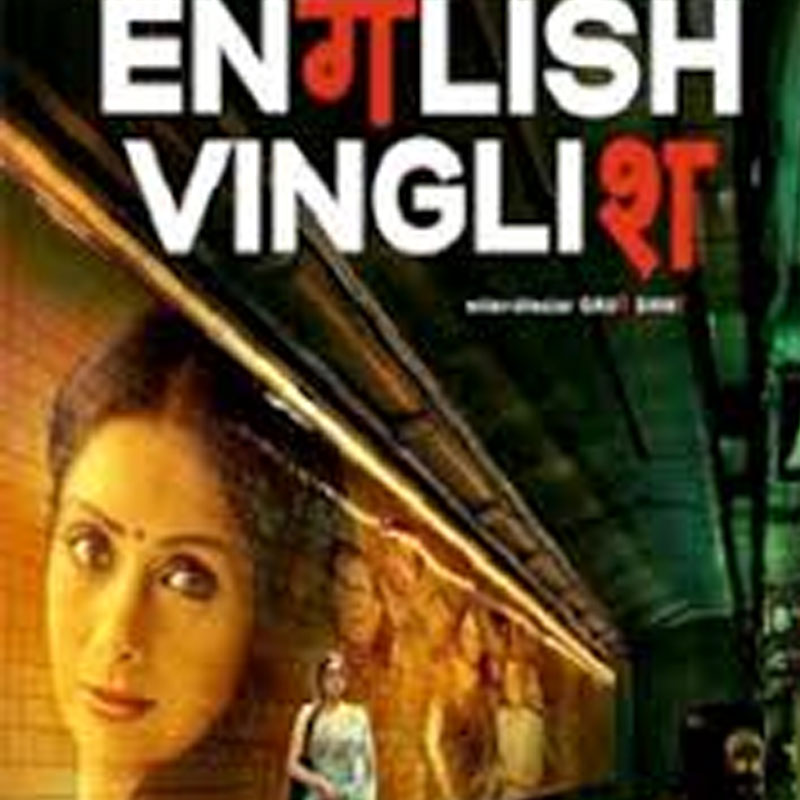
English Vinglish: A competent first attempt
MUMBAI: English Vinglish raises expectations on a couple of counts. First, the film marks the comeback of Sridevi, the sizzling superstar of 1980s and ‘90s. It is not only her return to Hindi cinema after 14 years, but it also marks her return to Tamil movies as the film has also been made in Tamil. Secondly, it is the directorial debut of Gauri Shinde, an ad film maker and the wife of R Balki, the director of acclaimed films, Cheeni Kum and Paa.
Sridevi, away from the glamorous self of her heydays, is a middle class Marathi housewife in Pune and a mother of two. Hers is a happy, compact family of husband, Adil Hussain, two kids, Navika Kotia and Shivansh Kotia, and a supportive mother-in-law, Sulbha Deshpande. Sridevi herself runs a small business of preparing and supplying homemade snacks to her regular clients. Bundi laddoos are her speciality. However, she still finds herself incomplete as her lack of knowledge of English makes her feel excluded from a lot of her family activities such as attending a PTA meeting for her daughter or discussions with kids. To add to her misery, she is often reminded of her handicap and chided as being ‘born only to make laddoos‘.
Then Sridevi is faced with a real challenge. She has to travel to the US for her niece‘s wedding; to help prepare. She is needed to travel alone, before her husband and kids can join her. With no experience or exposure of international travel and limited by language, Sridevi manages to clear the formalities and boards the flight. On board, she is lucky enough to have a helpful gentleman next to her to get her acquainted with international travel; he trains her on how to call a hostess in case of need as well as the use of in-flight entertainment and even convinces her to try a glass of wine. The gentleman is Amitabh Bachchan but not featured as the star Bachchan but as just a co-traveller.
So far so good but Sridevi‘s lack of English communication is to be tested soon. Rather than cool her feet at home alone, her niece suggests she accompany her and have a look at the great city, hanging around while she went and finished her thing. Feeling hungry, she steps into a deli where she does not know how to go about ordering food. The big black woman manning the counter has no patience for her, adding to her nervousness and making her stumble and causing a customer‘s tray to spill all over. Humiliated and distressed, Sridevi runs out to cry but there she finds a sympathiser, Mehdi Nebbou, a French chef. Nebbou has taken great fancy to this sari clad Indian beauty instantly when he saw her in the Deli.
All is not lost and Sridevi spies an advertisement: Learn English in Four Weeks. Just what the doctor ordered to get her life on level with a world that was leaving her out because she could not communicate in English. Nothing can stop her now and, on the sly, without informing anybody, she enrols. And so does Nebbou, as he says, look at Sridevi everyday! That is a silent romantic angle in the film, albeit one-sided! The class of learners consists of a variety of immigrants: one from Pakistan, one from South India and one from China and another from Spain. This part is mildly funny and on the lines of popular British TV series of 1970s, Mind Your Language. While she learns English, Sridevi also learns that as a domestic snack maker, she is an entrepreneur, which is how she is described in the English language. This gives her confidence a great boost.
Happy endings cannot be all that happy if some hurdles were not faced and anxieties not caused in the plot. A few days to go before Sridevi ends her four week course with a test and earn a certificate, her husband and kids surprise her by landing up earlier than she was told. Also, the date of her niece‘s wedding coincides with day of the test. These are the parts which lead to a pleasantly satisfactory ending to the story.
This is one of those films where, though the film revolves heavily around one character, the casting and performances of other characters have to be convincing and that has been achieved by the first time director, Shinde. She has done a competent job as the writer as well as the director of English Vinglish. Songs are situational and have been used very well with one Marathi wedding song included for good measure because the farther one goes away from native land, the more the urge to retain what one grew up with.
An absence of 14 years from films has not rusted Sridevi‘s acting abilities and she carries the film on her shoulders with no glamour, song and dance or romance coming to her aid. However, she has an able supporting cast in Hussain Mehdi Nebbou, Sujata Kumar, Priya Anand as well as Shivansh and Kotia besides a nice cameo by Bachchan.
English Vinglish, as was expected, has not opened to encouraging houses and may only end up with acclaim sans rewards. Making it in a vernacular would have made better business sense.
KLPD Kismet Love Paisa Dilli: Crass and un-watchable
The title of the film, KLPD Kismet Love Paisa Dilli, aptly serves as a forewarning about the merits of the film as well as what is in store for the viewer. The maker of KLPD, Sanjay Khanduri, who earlier made Ek Chalis Ki Last Local, claims that the film‘s title has been inspired by Manoj Kumar‘s 1974 film Roti Kapada Aur Makaan which is an insult to the great filmmaker Manoj Kumar to say the least. Even Mohan Choti‘s production, Dhoti Lota Chowpaty, can be termed a classic compared to KLPD.
The basic plot in KLPD remains the same as the director‘s earlier film, Ek Chalis Ki Last Local in that Vivek Oberoi, a Delhi lad, boards the last Metro and tries to project himself as a true blue Delhi boy by trying to flirt with the women in his compartment. What follows after that is a banal chain of events lacking imagination about anything but vulgarity. The film is replete with double meaning dialogue in which finding the clean meaning would be difficult; the idea is to be unabashedly filthy.
The writer knows no subtlety or, may be, they did not plan to be subtle as everything in the film revolves around sex of all kind till it becomes repulsive.
No self-respecting artistes would have done this film nor could the best available talent have saved it and, hence, no miracle expected from Vivek Oberoi.
There is nothing to say about the box office potential of KLPD since the film does not have any.

Hindi
GUEST COLUMN: Why film libraries & IPs are the new engines of growth
Unlocking value through catalogue strength and IP synergy
MUMBAI:In a media landscape defined by fragmentation, platform proliferation, and ever-evolving audience behavior, the economics of filmmaking are undergoing a fundamental shift. No longer confined to box office performance, a film’s true value is now measured across an extended lifecycle that spans digital platforms, syndication networks, and global markets. As content consumption becomes increasingly non-linear and algorithm-driven, film libraries and intellectual properties (IPs) are emerging as strategic assets, capable of delivering sustained, long-term returns. For Mohan Gopinath, head – bollywood business at Shemaroo Entertainment Ltd., this transformation signals a decisive move from hit-driven models to portfolio-led value creation. In this piece, Gopinath explores how legacy content, when intelligently repurposed and distributed, can unlock recurring revenue streams, why the interplay between catalogue and original IP is critical, and how media companies can build resilient, future-ready entertainment businesses.
For all these years, we thought that a film is successful if it performs well in theatres. There are opening weekend numbers, box office milestones, and distribution footprints that gave a good picture of how the movie has done commercially and also tell us about its cultural impact. However, there are multiple platforms today, always-on content ecosystem, which has caused a shift. Today, the theatrical performance is not the culmination of a film’s journey but merely the beginning of a much longer and more dynamic lifecycle.
Film libraries today are emerging as high-value, constantly evolving assets that deliver sustained returns well beyond initial release cycles. This becomes a point of great advantage for legacy content owners with diverse catalogues, to shape long-term business outcomes.
According to FICCI-EY, the media and entertainment industry of India achieved a valuation of Rs 2.78 trillion in 2025 which is expected to reach Rs 3.3 trillion by 2028 through a compound annual growth rate of approximately 7 per cent and digital media will bring in more than Rs 1 trillion to become the biggest sector which generates about 36 per cent of overall market revenues.
This shift is the expansion of distribution endpoints. We know how satellite television was once the primary secondary window but today, it coexists with YouTube, OTT platforms, Connected TV, and FAST channels. Each of these platforms caters to distinct audience demographics and consumption behaviors, helping content owners to obtain more value from the same asset across multiple formats.
For instance, films that had great reruns, now find continuous engagement across digital platforms. On YouTube, classic Hindi cinema continues to attract significant viewership, reaching audiences across generations and geographies with remarkable consistency. At Shemaroo Entertainment, this is reflected in our film library shaped over decades as part of a long association with Indian entertainment. From classics such as Amar Akbar Anthony to much-loved entertainers like Jab We Met, Welcome, Dhamaal, Phir Hera Pheri, Dhol, Golmaal, and Bhagam Bhag, many of these titles continue finding new audiences while retaining their place in popular memory. Their enduring appeal reflects how culturally resonant stories can continue creating value over time. Similarly, FAST channels have created curated, always-on environments where catalogue content can continue to thrive through star-led and genre-based programming.
This multi-platform approach has very well transformed films into long-tail IP assets which are capable of generating recurring revenue across advertising, subscription, and syndication models.
The evolution of audience behavior is equally important. Nowadays, it’s more important to find what’s more relative than what’s recent as viewers are more influenced by mood, memories, and algorithmic suggestions than by release schedules. Even if a movie was released decades ago, it can trend alongside a newly released movie, if surfaced in the right context. Thoughtful packaging, whether through festival-based playlists, actor-driven collections, or genre clusters, allows catalogue content to remain dynamic and continuously discoverable. Shemaroo Entertainment has built extensive film libraries over decades and its focus has mostly been on recontextualizing content for the consumption of newer environments. This process doesn’t just include digitization and restoration, but also re-packaging of films as per platforms.
Syndication itself has evolved into a key growth driver. In perspective, when looking at the domestic market, curated content packages continue to find strong demand across broadcast and digital platforms. Meanwhile, in the international market, especially in markets like Middle East, North America and Southeast Asia, the appetite for Indian content is opening up new monetization avenues. Here, the ability to package and position catalogue content effectively becomes as important as the content itself.
Importantly, the need to re-package catalogue content does not diminish the role of new content. In fact, originals and fresh IP are essential to sustaining the long-term value of a film library because they act as discovery engines that bring audiences into the ecosystem, while catalogue content drives depth, retention, and repeat engagement.
This interplay between the “new” and the “known” is what defines a robust content strategy today. While new films generate spikes in consumption, catalogue titles offer familiarity and comfort. These are factors that are increasingly valuable in an era of content abundance and decision fatigue. This is also shaping our strategy, drawing value from both a deep catalogue assets and a growing focus on original IPs to strengthen long-term audience engagement and build more predictable revenue streams.
There is growing recognition that long-term value in entertainment will be shaped not only by how intelligently existing content continues to live, travel and find relevance, but also by how consistently new stories are created to renew that ecosystem. In that sense, film libraries and original IP are not parallel bets, but reinforcing engines of growth. For media companies, the opportunity lies in making these two forces work together, because that is increasingly where more resilient and predictable businesses are being shaped.
Note: The views expressed in this article are solely the author’s and do not necessarily reflect our own.