Hindi
Aayna Ka Bayna to close ReelWorld Film Fest
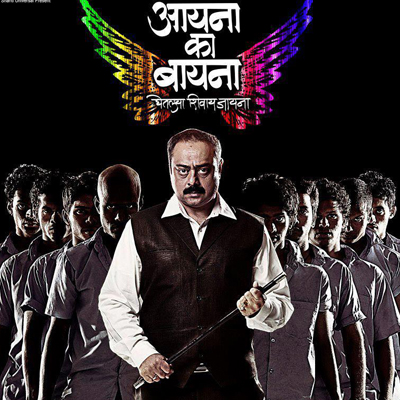
MUMBAI: Samit Kakkad‘s Marathi feature Aayna Ka Bayna will be the closing film of the 13th ReelWorld Film Festival that will be held from 10 to 14 April, 2013 in Toronto.
Aayna Ka Bayna narrates the story of nine juvenile delinquents in a detention centre under a tyrant warden. They dance for passion, for hope and for their dreams to come true. The film released in India in November 2012.
Suman Ghosh‘s Shyamal Uncle Turns Off the Lights and Vikram Dasgupta‘s Calcutta Taxi will also be presented under the Free Family Screening.
Shyamal Uncle Turns Off the Lights is about an eighty year old pensioner who wants the street lights switched off during the day to save waste and fights bureaucracy. The film has traveled to the Busan International Film Festival 2012 where it was picked up by the Global Film Initiative for North American distribution. The film premiered in India at the Mumbai Film Festival 2012.
Revolving around three lives that coincide and affect each other in a way that each one gains and loses something, Calcutta Taxi, is a Canada – India co-production.
The film was put in competition in the 35th International Short Film Festival of Clermont-Ferrand and won the best short award at the 12th River to River Indian Film Festival in Florence, Italy.
Started in 2001, the ReelWorld Film Festival celebrates dramas, documentaries, shorts and music videos. This year the festival will screen 85 films and videos from 17 countries.

Hindi
Remembering Gyan Sahay, the lens behind film, television and advertising
From a puppet rabbit selling poppadums to Hindi cinema, he framed it all.
MUMBAI: There are careers, and then there are canvases. Gyan Sahay, the veteran cinematographer, director, and producer who passed away on 10 March 2026 in Mumbai, had one of the latter. Over several decades in the Indian film and television industry, he turned lenses, lights, and the occasional puppet rabbit into something approaching art.
A graduate of the Film and Television Institute of India (FTII) in Pune, Sahay built his reputation as a director of photography across a career that stretched from the early 1970s all the way to the digital age. He was the kind of craftsman who understood that a well-composed shot is not merely a technical achievement but a quiet act of storytelling.
For most Indians of a certain age, however, Sahay will forever be the man behind the rabbit. His direction of the iconic long-running television commercial for Lijjat Papad, featuring its now-legendary puppet bunny, gave the country one of its most cheerfully persistent advertising images. It was the sort of work that sneaks into the national subconscious and takes up permanent residence.
His big-screen credits as cinematographer include Anokhi Pehchan (1972), Pagli (1974), Pas de Deux (1981), and Hum Farishte Nahin (1988). In 1999, he stepped behind a different kind of camera altogether, making his directorial debut with Sar Ankhon Par, a drama that featured Vikas Bhalla and Shruti Ulfat, with a cameo by Shah Rukh Khan for good measure.
On television, Sahay was particularly prized for his command of multi-camera production setups, a skill that made him a go-to technician for large-scale shows and reality programmes. In an industry that has never been especially patient with complexity, he was the calm hand on the rig.
In later life, Sahay turned teacher. He participated regularly in masterclasses and Digi-Talks, often hosted by organisations such as Bharatiya Chitra Sadhna, sharing hard-won wisdom on cinematography, the comedy of timing in a shot, and the sweeping changes brought by the shift from celluloid to digital. He was also said to have been involved in a project concerning a biographical film on Infosys co-founder N.R. Narayana Murthy.
Tributes from the film industry poured in following the news of his passing, with colleagues remembering him as a senior cameraman who served as a rare bridge between two entirely different eras of Indian cinema. That is, perhaps, the finest thing one can say of any craftsman: he kept up, and he brought others along with him.