News Broadcasting
Fashion Designer Gareth Pugh Revealed The Inspiration behind his first piece of fine jewellery

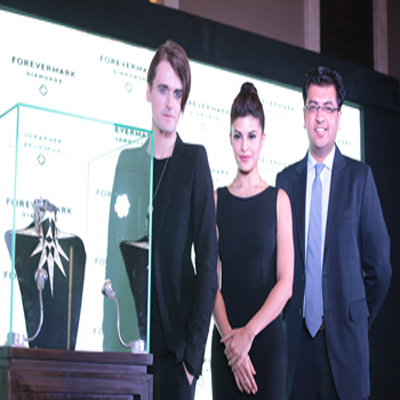
Forevermark, the diamond brand from the De Beers Group of Companies, announced its collaboration with British fashion designer, Gareth Pugh today. On the occasion, Mr. Sachin Jain, President, Forevermark India unveiled Gareth’s first fine jewellery piece at The Palladium Hotel, Mumbai along with actress Jacqueline Fernandez.
Featuring over a hundred natural and untreated precious Forevermark diamonds, this armour-like piece has been designed as a part of the Forevermark Promise Campaign. Gareth spoke about the inspiration and journey behind his design where he learnt about the unique promise inscribed on every Forevermark diamond. Set in stainless steel and Titanium, this piece was brought to life with cutting-edge digital mapping and 3D technology. The neckpiece has about 5600 diamonds, adding upto 91.98 carats.
THE INSPIRATION
The design process for Gareth began earlier this year during his trip to the Orapa diamond mine in Botswana, where he came to understand the incredible story behind each Forevermark diamond. From seeing and handling rough diamonds, Gareth witnessed their transformation into beautiful polished gems at an Authorised Forevermark Diamantaires cutting and polishing factory. One part of the operation that he found particularly compelling was the alliance between age-old craft and advanced technology. Gareth knew immediately that he wanted that relationship to be part of the story of this piece.
THE CREATION
Following this creative path, Gareth developed the idea of working with a unique set of contradictions. “The design was brought into existence in a most innovative way: utilising the power of technology – through digital body-mapping and 3D printing – combined with the knowledge and authority of experienced craftsmanship,” said Pugh. And the paradoxes continue with natural and untreated Forevermark diamonds, which are billions of years old, being set within a stainless steel base, built using completely new technology.
Pugh also explained, “The inspiration behind the neck-piece comes from my idea of what a promise is – an unbreakable bond. Coming back to Forevermark, it’s about the reciprocal relationship that they have with the communities they support. It’s not about taking, it’s about giving something back. The piece closes with a titanium pin which is set with a diamond on the top. I really liked the idea of using that as a signifier of an unbreakable bond.”
Sachin Jain, President, Forevermark India commented, “Forevermark prides itself on working with experts who are as passionate about their area of expertise as we are about diamonds. Gareth is undoubtedly one of the world’s great fashion talents and we are honoured that he has chosen to work with Forevermark diamonds for his first fine jewellery piece. Gareth has realised an extraordinary vision in the piece and we are thrilled, both with the creative inspiration and the iconic aesthetic of the neckpiece itself.”
This spectacular design was unveiled for the first time in Hong Kong on the 8th of August at an event attended by Gareth. The neck-piece will soon be revealed in China, Japan and the U.S.
THE CAMPAIGN
Forevermark holds firm the belief that all promises should be as unbreakable as theirs. Consequently, their unique 2013 Promise campaign reflects that. www.forevermark.com/promise features the news, promises and stories from Pugh’s personal journey with Forevermark as well as updates from a variety of international events hosted around the world, in honour of the campaign. Visitors will be able to design their very own piece of jewellery featuring a Forevermark diamond – the finished image of which can be sent to a loved one bearing its very own, personal promise.
The campaign also features online interactions at www.forevermark.com/promise allowing consumers to make a promise to a loved one connected to a specific location and place. The recipient will receive a personal note informing them of the very special promise that awaits them when in the relevant location.
Building on the success of the 2012 Promises and Pledges Exhibition and the corresponding website, designers and celebrities from all over the world are joining the Forevermark 2013 Promise campaign with each learning more about the unique way in which Forevermark diamonds are not only responsibly sourced, but also actively benefit the communities from which they come.