News Broadcasting
Prasar Bharati and Radio-Television Slovenia sign a deal

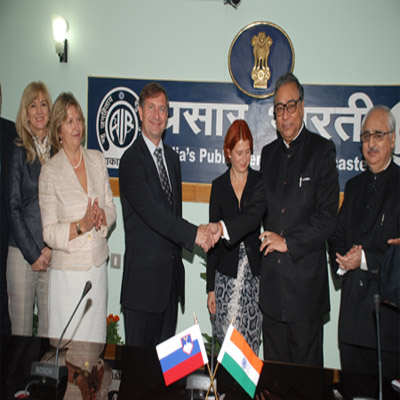
NEW DELHI: India’s largest broadcasting network, Prasar Bharti has found a potential business partner in Radio-Television Slovenia (RTV SLO). The two got together recently and have agreed to explore further opportunities in potential projects of co-production of programmes along with significant cultural, economic, political, social and festive events in the respective countries.
A Memorandum of Understanding (MOU) for cooperation in the field of broadcasting was signed between Prasar Bharati and RTV SLO. It aims at trading expertise of each of the broadcasters and entails exchange programmes in the fields of culture, education, science, entertainment, sports, and news on their respective networks, besides provision for personnel exchange and training of staff.

To sign the deal, a high level delegation that included Slovenia led by Deputy Prime Minister and Minister of Foreign Affairs Karl Viktor Erjavec, along with his team of ministers and officials – Mrs. Darja Bavdaz Kuret, Vlasta Vivod, International Department (RTV SLO) Head Suzana Vidas Karoli, and Boris Jelovsek visited Prasar Bharti.
The agreement was signed between Karoli and Prasar Bharati Member (Personnel) Brig (Retd.) V.A.M. Hussain.
In his speech, Erjavec emphasised the importance of the MoU and said: “In today’s world, TV is the medium with the most significant impact in the life of culture, education, science, entertainment, sports, and news. And I am sure this agreement will bring additional opportunities to strengthen so important people-to-people contacts and bring better understanding of our nations. Your contribution to these strengthened people-to-people contacts and better understanding of our nations will also lead to deepening of cooperation in economic, political, scientific, educational and cultural fields. And we thank you for that.”
The RTV SLO director GM Marko Filli could not attend the meeting, but he sent across a message that was read out by Karoli. He remarked: “Cooperation between media organisations is crucial for their quality work and development of programmes for the public they serve. New technologies are diminishing the distances that used to be a barrier for cooperation. The world is changing in such a way that not only small media organisations can learn and benefit from bigger ones, but also big media organisations are able to discover new ways of working and possibilities of cooperation with the small ones. At the same time the public is interested in the quality and contemporary content of the programmes and not so much of where the content is coming from.”
In his message, he also emphasised that the exchange of programmes in the fields of culture, education, science, entertainment, sports and news will help us to broaden content offer and make both parties stronger and more influential in their home lands. “I must point out this cooperation is of great importance especially for Slovenian public service and therefore we look forward for this first operational exchange. As the production of programme is depending more and more on technical knowledge, exchange of programme content can be and will be upgraded with exchange of expertise between personnel and providing the training with technical staff. We can learn from each other and certainly we will benefit from each other. The ultimate goal must always be satisfaction of our public,” he said in the message.
Prasar Bharati CEO Jawhar Sircar pointed out that India has always given importance to friendship with Slovenia. He stressed that cooperation in exchange of programmes, participation in each other’s cultural events are far more effective tools that enrich the knowledge and perception about nations and that Prasar Bharati would strive to reach the heart of Slovenian people through heightened co-operation as envisaged in the MoU.
This MoU is directed towards developing and strengthening friendly relations between the two countries through an increased co-operation in the field of broadcasting thus enabling the two countries to share their rich cultural heritage that includes a gamut of events and festivals.