MAM
73 per cent urban Indians believe our system is broken: Ipsos Global Advisor Populism in 2024 Survey


Mumbai: Circa 2024 is a landmark year for world politics and elections when over four billion people will cast their vote in 70 plus countries. India too goes to the polls in April-May 2024. Populism, anti-elitism and nativism, a 28-country global advisor study shows at least seven in 10 urban Indians polled (73 per cent) believe our system is broken. Further, there is a sentiment of lack of level playing field with at least 71 per cent urban Indians feeling the economy is rigged to favor the rich and powerful. 54 per cent Indians believe our society is broken. And 54 per cent Indians also believe the country is in decline.
In fact, the common man seems quite excluded in the complete scheme of things – 72 per cent say traditional parties and politicians do not care about them; while 73 per cent feel experts in the country do not understand their lives and 74 per cent believing political and economic elite don’t care about hardworking people. The grouse of the common man was with the lack of fairness, with 74 per cent of the view that there was a glaring divide in society between the ordinary citizen and the political and economic elite. Similar view was held by citizens of Hungary (80 per cent), South Africa (79 per cent) and France (77 per cent).
Solution? panacea? 74 per cent citizens believe we need a strong leader who is willing to break the rules, to fix the country and take the country back from the rich and powerful. Urban Indians also had strong views on political discourse with 74 per cent of those polled being of the view that most important political issues in India should be decided directly by the people, through referendums and not by the elected officials. This view was most pronounced in India across all the 28 markets covered in the survey, and some of the other top markets emerging included Thailand (73 per cent), Hungary (69 per cent) and South Korea (69 per cent).

Opinion about governments
Should the government increase taxes to pay for any additional spending? While 40 per cent agreed (highest globally), 32 per cent disagreed, 15 per cent were unsure and 13 per cent neither agreed nor disagreed. Most markets disagreed with increase in taxes to provide govt with additional funds for spending, esp in Hungary (74 per cent), South Africa (72 per cent) and Colombia (68 per cent).
The survey also factored in views of citizens on what govt should increase their spends on: 63 per cent Indians endorsed increase in spends by govt on infrastructure (roads, bridges, rail and air networks, water, electricity and broadband); 65 per cent citizens want govt to spend more on education (schools, universities, job training); 65 per cent citizens want govt to increase spends on public safety (law enforcement, fire and emergency medical services); 66 per cent citizens want govt to increase spends on defense and national security (e.g. military); 66 per cent of urban Indians want govt to increase spends on creating jobs and 60 per cent Indians want the govt to increase spends for reducing poverty and social inequality.
Summarising on the findings of the survey, CSR & ESG group service line leader, public affairs, corporate reputation Parijat Chakraborty said, “The common man believes the system is broken and society is broken. There is this accentuated feeling that power and privileges rest with the political and the elite and they get a short shrift. And they largely believe the society is divided, between the common citizens and the politicians and the elite. For an emerging, growth oriented market like India, citizens want govt to increase spends on infrastructure, education, public safety, defense and national security, job creation and reducing poverty and social inequality.”
Methodology
These are the results of a 28-country survey conducted by Ipsos on its Global Advisor online platform and, in India, on its IndiaBus platform, between Friday, November 22 and Friday, December 6, 2023. For this survey, Ipsos interviewed a total of 20,630 adults aged 18 years and older in India, 18-74 in Canada, Malaysia, South Africa, Turkey, and the United States, 20-74 in Thailand, 21-74 in Indonesia and Singapore, and 16-74 in all other countries.
The sample consists of approximately 1,000 individuals each in Australia, Brazil, Canada, France, Germany, Great Britain, Italy, Japan, Spain, and the U.S., and 500 individuals each in Argentina, Belgium, Chile, Colombia, Hungary, Indonesia, Malaysia, Mexico, the Netherlands, Peru, Poland, Singapore, South Africa, South Korea, Sweden, Thailand, and Turkey. The sample in India consists of approximately 2,200 individuals, of whom approximately 1,800 were interviewed face-to-face and 400 were interviewed online.
Samples in Argentina, Australia, Belgium, Canada, France, Germany, Great Britain, Hungary, Italy, Japan, the Netherlands, Poland, South Korea, Spain, Sweden, and the U.S. can be considered representative of their general adult populations under the age of 75. Samples in Brazil, Chile, Colombia, Indonesia, Malaysia, Mexico, Peru, Philippines, Singapore, South Africa, Thailand, and Turkey are more urban, more educated, and/or more affluent than the general population. The survey results for these countries should be viewed as reflecting the views of the more “connected” segment of their population.
Some of the analysis refers to a “28-country average”. This reflects the average result for all the countries and markets where the survey was conducted. It has not been adjusted to the population size of each country or market and is not intended to suggest a total result.
India’s sample represents a large subset of its urban population — social economic classes A, B and C in metros and tier 1-3 town classes across all four zones.
The data is weighted so that the composition of each country’s sample best reflects the demographic profile of the adult population according to the most recent census data. The “28-country average” reflects the average result for all the countries and markets in which the survey was conducted. It has not been adjusted to the population size of each country or market and is not intended to suggest a total result.
When percentages do not sum up to 100 or the ‘difference’ appears to be +/-1 percentage point more/less than the actual result, this may be due to rounding, multiple responses, or the exclusion of “don’t know” or not stated responses.
The precision of Ipsos online polls is calculated using a credibility interval with a poll where N=1,000 being accurate to +/- 3.5 percentage points and of where N=500 being accurate to +/- 5.0 percentage points. For more information on Ipsos’ use of credibility intervals, please visit the Ipsos website. The publication of these findings abides by local rules and regulations.







Brands
Jubilant FoodWorks faces Rs 47.5 crore GST demand, plans appeal
Tax authorities flag alleged misclassification of restaurant services
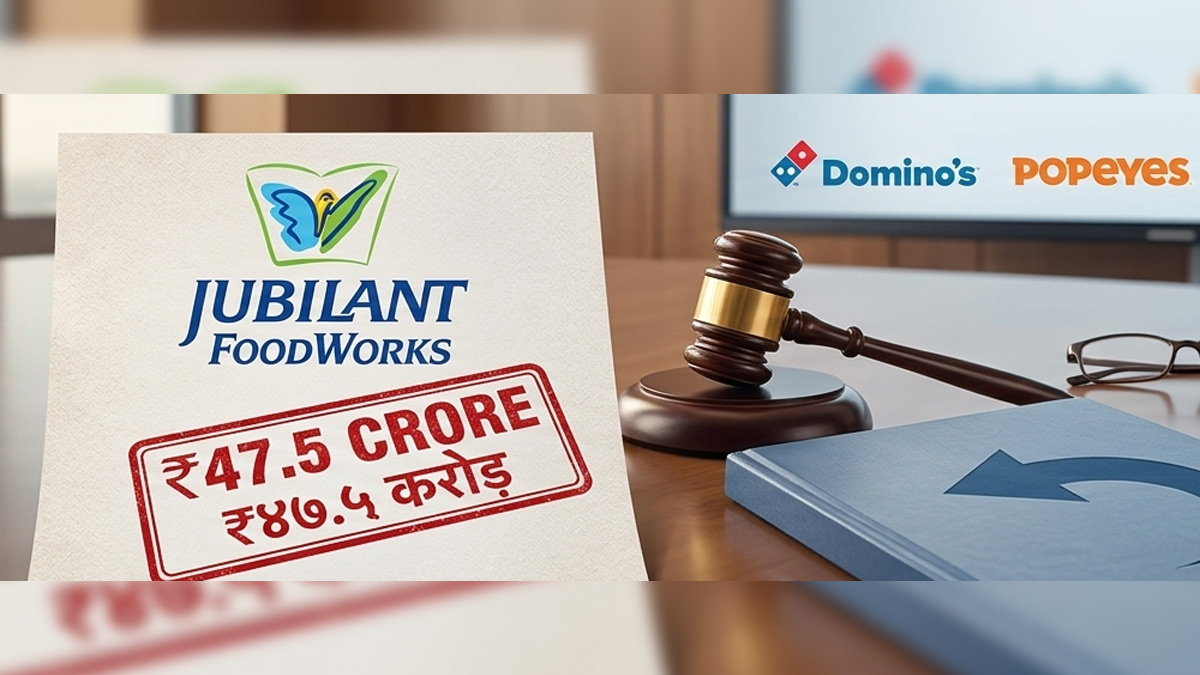
MUMBAI: Jubilant FoodWorks Limited has landed in a tax tussle after receiving a GST demand of Rs 47.5 crore from the office of the additional commissioner of CGST and central excise in Thane, Maharashtra.
The order, issued under the provisions of the Central Goods and Services Tax Act, 2017, relates to an alleged incorrect classification of certain services under the category of restaurant services. According to the tax authorities, this classification resulted in a short payment of goods and services tax for the period between the financial years 2019-20 and 2021-22.
The demand includes Rs 47.5 crore in GST along with an equal amount as penalty, in addition to applicable interest. The order was received by the company on March 13, 2026.
In a regulatory filing to the BSE Limited and the National Stock Exchange of India Limited, the company said it disagrees with the order and believes its arguments were not adequately considered.
The company is preparing to challenge the decision and plans to file an appeal. It added that once the redressal process is complete, the demand is likely to be dropped.
Despite the sizeable figure attached to the notice, the company said it does not expect any material impact on its financials, operations or other activities.
The disclosure was signed by Suman Hegde, EVP and chief financial officer, who confirmed that the company received the order at 19:06 IST on March 13 and has already initiated steps to contest it.
The development places the quick service restaurant major in the middle of a tax debate that could hinge on how certain restaurant-linked services are classified under GST rules. For now, the company appears ready to take the matter from the tax office to the appeals desk.







