Press Release
“Sahyadri Sanjeevani – feliciating rural medicos”

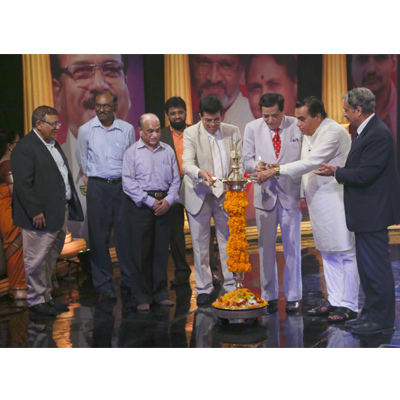
MUMBAI: Doordarshan, television network of Prasar Bharati, Broadcasting Corporation of India, launched World’s biggest health campaign ‘Swasth Bharat‘ (Healthy India) supported by the Union Government in 2012. The audiences welcomed the five-days-a-week telecast of Swasth Bharat program from 30 TV stations which continue to educate, explore and lead a healthy – bright INDIA till today.
“SAHYADRI SANJEEVANI SANMAN SOHALA” is the brainchild of Shri Mukesh Sharma, Additional DG of DD Sahyadri to felicitate and acknowledge the outstanding work done by the medicos in the rural areas and to the under privileged. DD Sahyadri honors these “COMMUNITY LEADERS” through the visual medium, applauds their dedication and untiring service to the have-nots. Such initiative will encourage/motivate the young medicos to go the rural areas and work for the masses in the villages.

The Ten Doctors felicited during the SAHYADRI SANJEEVANI SANMAN SOHALA:
- Dr.Prakash Amte & Dr. Mandakini Amte were honored with the Magsasay Award for “Commnity Leadership” towards their philanthropic work in the form of Lok Biradari Prakalp among the Madia Gonds in Gadchiroli district of Maharashtra. Dr. P. Amte has written Marathi books like “Prakashvata” & “Negal” and believes that his family is passionately engaged in social work, considering that they have been doing it for three generations now.
- Dr. Vikas Mahatme & Dr. Sunita Mahatme in 1987 established “Mahatme Eye Bank & Eye Welfare Charitable Trust and is government recognized eye bank with maximum corneal retrieval & usage in Nagpur. What began as his one room, one man operation has now evolved into one of the most extensive charitable ophthalmic hospitals in the country.
- Dr. Uday Bodhankar a renowned senior pediatrician has been elected as the President of COMHAD(Commonwealth Association for Health & Disability) which links professionals across the commonwealth and advocated prevention of brain damage due to birth asphyxia, childhood blindness, epilepsy. It also runs a joint programme with WHO on early childhood psycho-social development.
- Dr. Narendra Vaidya developed the first ever Emergency Medical Service in India at Lokmanya Hospital (Pune). He initiated Golden Hour project where the patient met with an accident will be attended in an hour for reducing mortality which saved around 40,000 lives until now. “Rashtriya Ratna” award winner for his contribution towards rescue of earthquake victims at Anjar, Gujrat 2001 and the first orthopedic surgeon to establish a comprehensive spine care centre in PCMC (Pune) area.
- Dr. Smita & Dr. Ravindr Kolhe (MD) devoted their lives for providing health services to tribal’s especially pregnant women and children’s living in remote. They were also in forefront to create awareness about women’s health, child education, developing food chains, power generation and minimum wages at Melghat region of Vdharbha & Buiragarh in Dharni Taluka, Maharashtra.
- Dr. Abhay Bang & Dr. Rani Bang have revolutionized healthcare for the poorest and have overseen a programme that has substantially reduced infant mortality rates. They founded SEARCH – a nonprofit organization in Gadchiroli district of Maharashtra which is involved in rural health service/research and have established a tribal friendly hospital with experienced health workers.
- Dr. Suresh V. Adkar one of the pioneers in creating “ASTITVA” an organization dedicated to the development of disabled. The first Govt. recognized “Sheltered Workshop” was his brainchild which aims at enhancing vocational training, theoretically & practically to the disabled of particular profession.The students, after training, can engage themselves in activities like making envelopes, card board boxes, Book binding, stitching, knitting etc. In group activities, they can make chalks, candles, incense sticks etc.
- Dr Rekha Davar, head of obstetrics – gynecology at JJ Hospital and working tremendously for controlling the incidences of babies born with HIV – positivity she is the head of PPTCT which aims to prevent the prenatal transmission of HIV from an HIV infected mother to her newborn.
- In the Kokan region of Maharashtra lies Mahad, this obscure place is home to Dr. Himmatrao S. Bawaskar, India’s internationally acclaimed physician and a well known authority for his research and treatment for Scorpion poisoning to the patients where healthcare was once non-existent.
- Dr.Ulhas Wagh has been providing free clinical services by medical camps to the poor and needy people particularly villagers, adivasis who neglect oral health care and can’t afford the dental treatment since last 34 years. He also worked tremendously towards the reduction of HIV/AIDS prevalence among Female sex workers through effective intervention at Indira Nagar, Bhiwandi sex-workers brothel based area since last 15 years.
SPECIAL MENTION & FELICIATION: In the year 2013 -14 “Shree Siddhivinayak Ganapati Temple Trust” contributed eight crore rupees financial aid for heath related services and towards the upliftment of the underprivileged in 32 districts of Maharashtra. Also a grant of Rs.25000/- to the needy patients suffering from Kidney, Heart and Brain related ailment.
“SAHYADRI SANJEEVANI SANMAN SOHALA” will telecast on DD Sahyadri Channel on Sunday, 6th April 2014 from 4:00 p.m. onwards and repeat on same day at 10:00p.m.