MAM
LS elections: Mumbai shows the finger

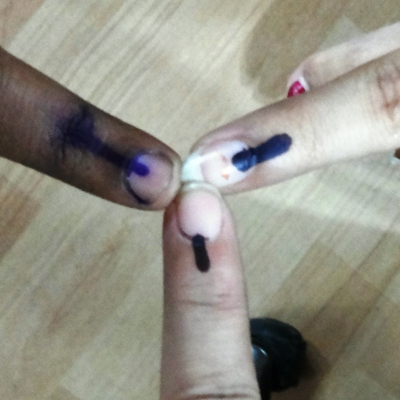
MUMBAI: It’s been 20 days since the largest democracy in the world started polling. Half of the country has already undergone the process while a few more wait eagerly to get inked.
These elections unlike the others in the past are different. Thanks to the role media played this time around. Political parties of course didn’t leave any medium to woo people to vote for them. From television to online, their presence was and still is everywhere. What is more interesting is that even television channels – general entertainment as well as youth – along with print told people to step out and vote.
In the sixth phase of polling, Mumbai, the financial capital of the country, was supposed to make a difference. Today almost 18 crore voters from whooping 117 constituencies, which comprised 11 states and one Union Territory went out for polling.
While Bihar witnessed 60 per cent voter turnout, Jharkhand-63.4 per cent, Madhya Pradesh-63 per cent, Assam-71 per cent, Puducherry-82 per cent, West Bengal- 81.42 per cent, Uttar Pradesh-58 per cent, Rajasthan-59 per cent, Chhatisgarh-65 per cent and Tamil Nadu saw a 73 per cent voter turnout. The six constituencies of Mumbai witnessed the lowest voter turnout amongst the lot- 53.1 per cent.
And this after all the efforts taken by both the television channels and the brands, who went out and out to woo the voters of the city.
While the celebrities stepped out of their comfort zones and happily got clicked with their inked fingers, it was the common man of the city, who did not show up in the polling booth, and not like it was expected. The only saving grace, that by the end of the day, the city had recorded a 53.1 per cent voting turnout.
Looks like in the city of dreams, many didn’t want to wake up from their sleep and go out in the scorching heat. And this, even after most companies including a few media houses were shut as it wanted people to vote.
Though, many in the city may rejoice over the better performance as compared to the last Lok Sabha polls, reality is that an even better voter turnout was expected from the city. And it is perhaps, the lowest amongst the states that have cast their votes so far.
Somehow the city and its citizens that don’t get tired of cribbing, doesn’t cast its vote. The reason (educated) some feel is that what difference will it make? For them, the policies made by the government are made for the poor and the rich and the middle class is bound to suffer no matter who comes to power.
While there are still a few who want to vote but couldn’t find their names in the list. They are tired of the officials and the process. A few also feel that at least in Mumbai, the political connect is missing. “The old style of campaigning has been taken over by twitter and electronic media, and so that personal touch is missing,” says an executive from the media house, who couldn’t vote since his name was not in the list.
In fact if a few have to be believed, one entire housing society, which comprises some 8,000 plus houses in the North West part of Mumbai, could not find their names in the voting list. “They have lost so many votes by this,” adds a source from the industry.
But at least some did go out and get inked.
When we contacted RK Swamy BBDO chairman & MD, Srinivasan K Swamy, he said, “Yes, I did vote. I got to understand that many names were taken off the voter list from various booths. These were people who have voted in the past. Though they had their voter’s ID card they weren’t allowed to cast their vote.”
Colors CEO Raj Nayak too showed off his inked finger but feels that today people have become insensitive and selfish. “It’s all about ‘I, me, myself’. They won’t make the effort to vote but then they will be laid back and criticise the government. I don’t think any other country in the world can have such a smooth process of voting such as in India. The staff is courteous and the police do their job well. It hardly takes time to go and cast your vote!”
Curry-Nation founder Priti Nair mentioned, “Frankly, I thought there was huge buzz about voting this time and genuinely thought a lot more professionals are all enthusiastic about voting. I am quite shocked at this turn out.”
DDB MudraMax OOH, Retail and Experiential president Mandeep Malhotra said, “Yes I did cast my vote and I am really sad on the turnout. While Bollywood and cricket celebrities did show up on the polling booth, where were the others? It is sad to see that this is how the city responds to a once in a five year event.”
Samyak Chakravarthy of Operation Black Dot feels that though slowly the turnout did improve but the youth turnout was still less in comparison to the total size of electorate per booth, “and this is worrisome.”
He along with his team through the initiative Operation Black Dot tried motivating people, especially the youngsters to go and fulfill their duty. Many youth icons too supported the initiative.
May be the next time the city goes out for voting, more push and initiatives will be needed to get the city voting: How about taking the electoral machine to each house? Is the Election Commission listening?