Connect with us

I&B Ministry

No government interference in acquisition of Network 18 by RIL: Prakash Javadekar

Published

on

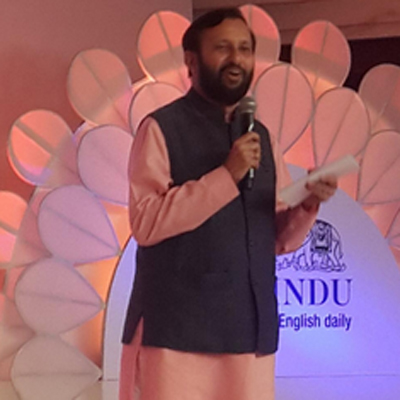
GOA: “There is no government interference in the acquisition of Network 18 by Mukesh Ambani owned Reliance Industries Limited,” announced I&B Minister Prakash Javadekar, brushing aside any rumour about BJP led government having a role to play in the recent acquisition of Network 18 by RIL. The newly appointed I&B Minister was addressing the gathering on the final day of GoaFest. Javadekar also accepted that cross media ownership was debatable and will be addressed soon.


“The I&B Ministry will always protect and respect the freedom of press,” emphasised Javadaker. The Minister further went on to say that I&B Ministry is looking at making both Doordarshan and All India Radio competitive. “It is my dream to make Doordarshan a success story,” he said.

Advertisement


“I would address the grievances of all cable operators if they take DD in the prime brand,” added the Minister on a lighter note. “The Ministry will take into consideration all the viewpoints of various stakeholders of the media and then take necessary actions in the near future,” he announced.  


Advertisement

The biggest challenge for the Minister will be the smooth rollout of the remaining two phases of digitisation. While in phase III of digitisation 11 crore set top boxes are expected to be installed, Javadekar is of the view that the set top boxes manufactured in China do not guarantee good value for money. “The Ministry is looking at creating opportunities to manufacture set top boxes locally. We will soon meet with both the Finance and Commerce Ministries to take this forward,” he said.  


Javadekar also touched upon the issue of FM radio in India. “I have already met all the FM radio heads and the way forward will be declared shortly.  The age old batteries of transmitters of AIR stations will soon get some ‘air’ as the Ministry is looking at replacing them with new ones,” he announced.  

Advertisement


The Minister, who believes in the age old thought that good advertising cannot make a bad product good and strongly feels that it holds true in today’s world too, also used the platform to address the advertising fraternity. “The difference that the nation will see now is not only difference in leadership but in its vision too,” he said.


Advertisement

Javadekar too has the experience of creating campaigns. The Minister who had crafted campaigns for his party away back in 1989 in Maharashtra said, “I truly understand the system that goes behind each campaign.”


Javadekar is impressed with what ASCI has been initiating and said the Ministry will give its complete support to the association. He also mentioned that issues related to ratings, if any, should be treated privately by advertisers and broadcasters unless there is conflict and they seek government intervention.

Advertisement


The Modi government has truly used the power of social media to scale up its communications. Javadekar said that under his leadership he will review the party’s social media activities very keenly. 


Advertisement

It will be interesting to see what Javadekar brings on table in the coming days for the media fraternity as a whole! 

Click to comment

Leave a Reply

Your email address will not be published. Required fields are marked *

I&B Ministry

India turns up the heat on piracy, orders Telegram to axe 3,142 channels and blocks 800 websites

New legal teeth, nodal officers and notices to intermediaries signal that the government is done playing nice with copyright thieves

Published

on

NEW DELHI: India’s war on film piracy just got significantly more aggressive. The government has ordered Telegram to remove 3,142 channels distributing pirated content, blocked access to around 800 websites through internet service providers, and put the full weight of freshly sharpened legislation behind the crackdown. The message from New Delhi is unambiguous: the free ride for copyright thieves is over.

Minister of state for information and broadcasting L. Murugan spelled out the legal architecture to the Lok Sabha on Wednesday. The Cinematograph (Amendment) Act, 2023, he said, now contains specific provisions designed to make piracy a genuinely painful proposition. Sections 6AA and 6AB prohibit unauthorised recording and transmission of films, with violations attracting a minimum of three months’ imprisonment and a fine of Rs 3 lakh. At the upper end, offenders face three years behind bars and fines of up to 5 per cent of a film’s audited gross production cost — a figure that, for a big-budget production, could run into crores.

The legislation also gives the government powers to act against intermediaries hosting infringing content, by notifying them under Section 79(3) of the Information Technology Act, 2000, and compelling takedowns and blocking actions. Under Section 79(3)(b), intermediaries are legally required to remove or disable access to unlawful content upon receiving government notice or court orders. The Information Technology (Intermediary Guidelines and Digital Media Ethics Code) Rules, 2021, add a further layer of obligation, requiring platforms to ensure their services are not used to host or distribute content that violates copyright or proprietary rights.

Advertisement

To put enforcement into practice, the Ministry of Information and Broadcasting has established a dedicated institutional mechanism, complete with nodal officers to receive complaints. Copyright holders, authorised representatives or individuals can report piracy through a prescribed format, after which the government issues notices to intermediaries to disable access to infringing links.

The most headline-grabbing action came on 11 March 2026, when Telegram was formally notified under Section 79(3)(b) of the IT Act and directed to remove and disable 3,142 channels found to be distributing unauthorised content belonging to OTT platforms, content owners and producers. The complaints that triggered the action came from OTT platforms including JioCinema and Amazon Prime Video, which alleged that copyrighted films, web series and other material were being shared on the platform on a massive scale. Telegram’s architecture, with its large file-sharing limits and capacity for user anonymity, has made it a favoured vehicle for exactly this kind of large-scale piracy.

The Telegram action sits within a broader pattern of escalating enforcement. Just days before the Lok Sabha statement, the ministry banned five OTT platforms for streaming obscene content: MoodXVIP, Koyal Playpro, Digi Movieplex, Feel and Jugnu. In July 2025, the Centre ordered the blocking of 25 OTT platforms accused of streaming obscene, vulgar or pornographic material, a list that included ALTT, ULLU, Big Shots App, Desiflix, Boomex, Navarasa Lite, Gulab App, Kangan App, Bull App, Jalva App, ShowHit, Wow Entertainment, Look Entertainment, Hitprime, Feneo, ShowX, Sol Talkies, Adda TV, HotX VIP, Hulchul App, MoodX, NeonX VIP, Fugi, Mojflix and Triflicks.

Advertisement

Rule 3(1)(b) of the IT (Intermediary Guidelines and Digital Media Ethics Code) Rules, 2021, provides the regulatory hook for those actions, prohibiting platforms from hosting content that is obscene, pornographic, invasive of privacy, gender-harassing, racially or ethnically objectionable, or that promotes hatred and violence.

For an industry that loses billions of rupees annually to piracy, the direction of travel is welcome. The question, as always, is not whether the laws exist, but whether the enforcement machinery can keep pace with the ingenuity of those determined to circumvent it. Three thousand channels down, and the pirates are already busy opening three thousand more.

Advertisement
Continue Reading

Advertisement News18
Advertisement All three Media
Advertisement Whtasapp
Advertisement Year Enders

Copyright © 2026 Indian Television Dot Com PVT LTD

This will close in 10 seconds