Hindi
‘Filmistaan’ to be released in more than 450 screens

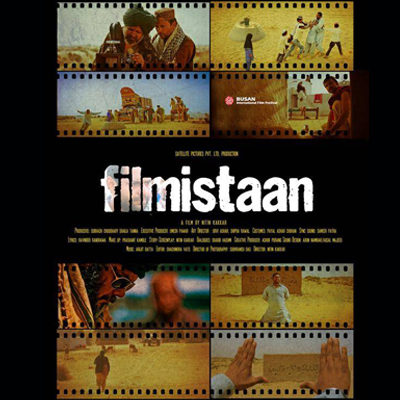
NEW DELHI: In a rare case, a film with no romantic angle or female character and based on the backdrop of terrorism is being released on 6 June in more than 450 screens across the country.
The film, ‘Filmistaan’ by debutante director Nitin Kakkar, is about interplay for a no-man’s land where the only connect between the two main characters of whom one is an Indian prisoner is their love for Bollywood.
Kakkar told indinatelevision.com in an interview that he wanted to highlight that cinema has no division of caste or religion.
‘Patriotism is the reality and jingoism is how one sells this sentiment’ he said in reply to a question on how filmmakers attempt to show patriotism.
Asked why he had kept the end open-ended, he said he wanted to convey the message that people are standing at the borders even today in the hope that these will open someday. He had also ensured thereby that the film was neither romanticized nor gloomy.
H also stressed that the focus was always on the love for cinema and not politics or terrorism. He attributed this to the fact that he had been seeing films from childhood which indulged in anti-Pakistani jingoism.
‘Filmistaan’ had won a National Award for 2012 and has received good response in several international festivals including Busan, across the United States and Europe and in Jaipur.
The response had been very positive even from those from Pakistan who saw the film at these festivals, Kakkar said.
Produced by Shyam Shroff and Balkrishna Shroff, the film stars Sharib Hashmi, Inaamulhaq, Kumud Mishra, Gopal Datt, Sanjay Mehta, Ravi Bhushan, Waseem Khan, Tushar Jha, Saroj Sharma, Manoj Bakshi, Sagnik Chakrabarty, Habib Azmi, Kavita Thapliyal, Punit Nijhawan, and Neela Gokhale. The lyrics are by Ravinder Randhawa and music is by Arijit Datta.
Kakkar said he based the film at the Bhatinda-Rajasthan border which is very close to Pakistan and people often cross the border easily.
The film was shot in just 20 days – 16 days in Bikaner, and two days each in Jaipur and Mumbai.
Interestingly, the film did not face any problems with the Central Board of Film Certification and was granted a ‘U’ certificate.
Asked about the involvement of UTV and Shringaar, he said they came in at the last minute.
He said the cost of marketing a film was often more if not equal to making it, and therefore independent filmmakers had to prove themselves before any distributor put his money into the film. He said what Bollywood needed at this time was high content and catchy stories.
The story is about affable Bollywood buff and wannabe actor Sunny who is kidnapped by an Islamist terrorist group when he is in Rajasthan with an American crew to work on a documentary, where an Islamic terrorist group kidnaps him. The house in which he is confined belongs to a Pakistani whose trade stems from pirated Hindi films. Soon the two realize that they share a human and cultural bond. .
Born in Mumbai, Kakkar made his first short film “Black Freedom” in 2004 which won some awards at various short film festivals. Since then he has been working on some television projects. This is his first feature, but he said he had three scripts ready and would get down to making them as soon as this film is released.