Hollywood
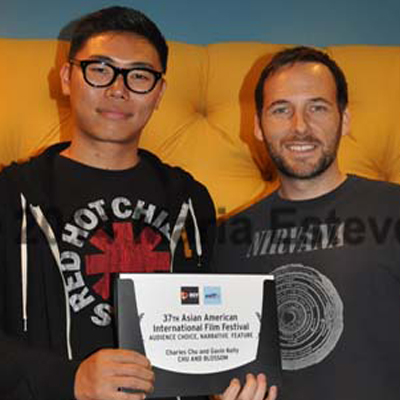
Chu and Blossom Top Winner at 37th Asian American International Film Fest
NEW DELHI: The film Chu And Blossom won two significant awards at the 37th Asian American International Film Festival in New York this week.
It received Audience Award as wellas the Emerging Director Awards for Charles Chu and Gavin Kelly.
The awards were presented by AAIFF programme manager Lesley Yiping Qin, honouring the best in Asian American filmmaking and emerging directors.
The screening of The Penny Farthing followed the ceremony.
The closing night presentation How To Fight In Six Inch Heels by Ham Tran and a question and answer session with producer Timothy Linh.
The Special Jury Prize went to The Rice Bomber directed by Cho Li while the documentary award went to Tenzin Tsetan Choklay for Bringing Tibet Home.
The Best Short was Sutures by Tiffanie Hsu and the One to Watch Award went to Animals, directed by Stefanos Tai (Shorts, For Youth By Youth)
The Screenplay Competition Finalists were Eugene Park for Michael’s Story. Jisen John Ho for The Tragedy of Ziad and Aysel, and Carol Lee Hall for Donaldina.
This year’s jurors were ‘Lunchbox’ fame Ritesh Batra (shorts), J.P. Chan (shorts), Clarissa de los Reyes (screenplay), Christopher Fiore (screenplay), Eric Lau (feature), Claus Mueller (feature), Brandon Ruckdashel (feature), Michael Sandoval (screenplay) and Tong Shen (shorts).
The Asian American International Film Festival founded by Asian Cinevision, Inc. (ACV) in 1987, is a national media arts organisation that annually presents independent cinema by Asian and Asian Americans, panel discussions, special events, screenplay competition readings, gala receptions and after parties. ACV staff members include John C. Woo, Lesley Yiping Qin, Sophia Giddens, Judy Lei and Jason Chu.

Hollywood
Remembering Chuck Norris: the man, the myth, the legend at 86
From martial arts legend to internet folklore, fans honour his final level up
KAUAI: The world lost a legend on 19 March 2026, when Chuck Norris died aged 86. For a man long treated as immortal in internet folklore, the news felt almost unreal. Yet in true Norris fashion, the farewell has been less about mourning and more about myth-making.
Just days before his passing, on his 86th birthday, Norris shared a video from Kauaʻi, Hawaii, showing him sparring under the sun. His caption was characteristically wry: “I don’t age. I level up.” It now reads like a final wink to fans who had spent years elevating him to near-superhuman status.
His death followed a sudden medical emergency while on holiday. He passed away peacefully, surrounded by family, who described him not just as a global symbol of strength, but as a devoted husband, father and grandfather.
Online, grief quickly gave way to tribute in the language Norris helped popularise. Social media filled with one last wave of “Chuck Norris Facts”, the tongue-in-cheek myths that turned him into a digital demigod. The jokes wrote themselves, as always. Death did not take Norris, it finally dared to meet him.
Behind the humour, however, lies a formidable real-world legacy.
Long before the memes, Norris was Carlos Ray Norris, a decorated martial artist. After serving in the US Air Force, he rose to become a six-time world professional middleweight karate champion. His on-screen duel with Bruce Lee in Way of the Dragon remains one of cinema’s most iconic fight sequences.
Through the 1980s, he became the face of action cinema with films such as Missing in Action and The Delta Force, embodying a stoic, no-nonsense hero. In the 1990s, he reached living rooms worldwide as Cordell Walker in Walker, Texas Ranger, blending Western grit with martial arts flair.
Off-screen, his work carried equal weight. His foundation, Kickstart Kids, continues to teach martial arts to at-risk youth, focusing on discipline and self-worth. He also founded Chun Kuk Do, a martial arts system that trained thousands.
What made Norris unique was not just his strength, but his willingness to laugh at it. When the internet transformed him into an exaggerated symbol of invincibility, he embraced the joke. In doing so, he bridged generations, from cinema-goers to meme-makers.
His passing marks more than the loss of an action star. It signals the fading of a rare cultural crossover, where genuine athletic prowess met Hollywood heroism and early internet humour.
For many, remembering Chuck Norris means recalling a time when heroes were simple, punches were decisive and the internet still felt like a playground of shared jokes.
And if the myths are to be believed, this is not quite the end. It is simply Chuck Norris moving on to his next level.