News Headline
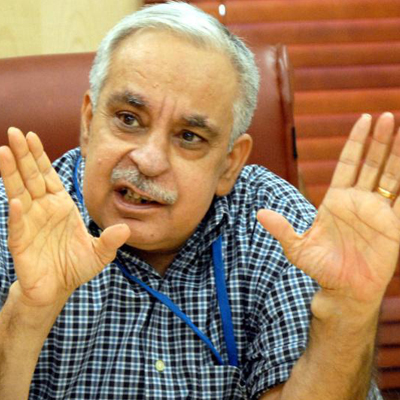
Govt sending wrong signals to foreign investors by delaying digitisation: Rahul Khullar
MUMBAI: Recently, a letter written by Telecom Regulatory Authority of India (TRAI) chairman Rahul Khullar pointed out that the government was committing a mistake by extending the deadline for digitisation. Khullar has many more points to present on the regulator and the industry.
In a conversation with Bloomberg, he said that his views on digitisation were very clear. “It is a very bad decision to defer it. It is bad for digital India, broadband delivery and not in public interest,” he said.
While the government says that its main aim is to push indigenous production of seven crore set top boxes (STBs) in two years, Khullar feels that this is a ‘pipe dream.’
Khullar said that last year several investors met him and conveyed that it was a miracle that they managed to get two crore boxes digitised. They also asked that by when will digitisation be completed because they are desperately interested in investments in cable. “By delaying digitisation, you are sending a signal to foreign investors that India isn’t ready for investment yet. This does great harm to public credibility,” he said.
Meanwhile, rumours are afloat that the government is mulling creation of a ‘super regulator’ that will oversee the communications sector. Khullar believes that it is necessary to keep content and carriage separate. “If your aim is to strengthen TRAI then you don’t need a super regulator, just empower the existing one. But if it is to regulate carriage and content, this is an experiment that hasn’t succeeded in the world,” he said.
According to him, issues concerning content immediately ‘stir up a hornet’s nest’ that usually involves freedom of speech. “My own sense would be to keep carriage and content separate and ensure that the content regulator has nothing to do with the government. Then you have some sort of fighting chance of regulatory survival,” he said.
Broadband is a growing medium of revenue that is catching the attention of all in media space. The TRAI is due to come out with a paper on ‘policy issues relating to broadband’ in the next 10 days. “Broadband and convergence is still five to 10 years away. If we are to deliver broadband we need to know how to do it in the cheapest way, who should be involved, what to be done in terms of application and software development,” he highlighted. It will focus on building infrastructure and delivering content.

Awards
Hamdard honours changemakers at Abdul Hameed awards
NEW DELHI: Hamdard Laboratories gathered a cross-section of India’s achievers in New Delhi on Friday, handing out the Hakeem Abdul Hameed Excellence Awards to figures who have left their mark across healthcare, education, sport, public service and the arts.
The ceremony, attended by minister of state for defence Sanjay Seth and senior officials from the ministry of Ayush, celebrated individuals whose work blends professional success with a sense of public purpose. It was as much a roll call of achievement as it was a reminder that influence is not measured only in profits or podiums, but in people reached and lives improved.
Among the headline awardees was Alakh Pandey, founder and chief executive of PhysicsWallah, recognised for turning affordable digital learning into a mass movement. On the sporting front, Arjuna Awardee and kabaddi player Sakshi Puniya was honoured for her contribution to the game and for pushing women’s participation onto bigger stages.
The cultural spotlight fell on veteran lyricist and poet Santosh Anand, whose songs have echoed across generations of Hindi cinema. At 97, Anand accepted the honour with characteristic humility, reflecting on a life shaped by perseverance and hope.
Healthcare honours spanned both modern and traditional systems. Manoj N. Nesari was recognised for strengthening Ayurveda’s place in national and global health frameworks. Padma shri Mohammed Abdul Waheed was honoured for his research-backed work in Unani medicine, while padma shri Mohsin Wali received recognition for his long-standing contribution to patient-centred care.
Education and social development also featured prominently. Padma shri Zahir Ishaq Kazi was honoured for decades of work in education, while former Meghalaya superintendent of Police T. C. Chacko was recognised for public service. Goonj founder Anshu Gupta received an award for his dignity-centred rural development initiatives, and the Hunar Shakti Foundation was honoured for empowering women and young girls through skill development.
The Lifetime Achievement Award went to former IAS officer Shailaja Chandra for her long career in public healthcare and governance, particularly in the traditional systems under Ayush.
Speaking at the event, Hamdard chairman Abdul Majeed said the awards were a tribute to those who combine excellence with empathy. “These awardees reflect Hakeem Sahib’s belief that healthcare, education and public service must ultimately serve humanity,” he said.
Minister Seth struck a forward-looking note, saying India’s young population gives the country a unique opportunity to become a global destination for learning, health and wellness by 2047.
The ceremony also featured the trailer launch of Unani Ki Kahaani, an upcoming documentary starring actor Jim Sarbh, set to premiere on Discovery on 11 February.
Instituted in memory of Unani scholar and educationist Hakeem Abdul Hameed, the awards have grown into a national platform that celebrates those building a more inclusive and resilient India. For one evening at least, the spotlight was not just on success, but on service with substance.