I&B Ministry
Govt reiterates no plans to cap number of TV channels in country
NEW DELHI: Even as the Government has no plans to put a cap on the number of satellite television broadcasting channels in the country, the Parliament was informed today that permission had been withdrawn to 27 news and current affairs channels in the past three years.
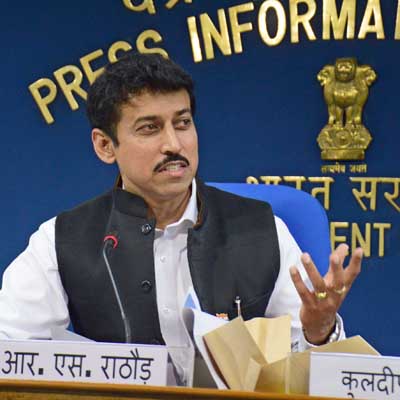
Minister of State for Information and Broadcasting Rajyavardhan Rathore today told Parliament that the Telecom Regulatory Authority of India (TRAI) in response to a reference by the Ministry had said on 23 July, 2010 that “no cap should be placed on the number of satellite broadcasting channels to be permitted to be downlinked from viewing in India or to be uplinked from India.”
The Minister also said that there was no proposal to amend the uplinking and downlinking guidelines to check the increase in the number of news channels in the country.
In reply to another question, Rathore said that the Ministry had withdrawn permission of 27 news and current affairs TV channels for reasons of non-operationalization of TV channels or surrender of permission, etc.
He said issues related to employment of media personnel, working in the TV channels (including news channels), are governed by the prevalent Labour Laws.
The number of permitted satellite television channels by the end of December last was 826, which include 405 news and current affairs channels and 421 general entertainment channels.
The statistics show that 697 channels (including 382 news channels) were permitted to uplink and downlink from within the country, and 36 (including seven news channels) were uplinked from India for beaming overseas and not in the country. The number of channels uplinked from overseas and downlinked into India was 93 (including 16 news channels).
The year 2014 has thus saw the clearance to more than 30 channels.

I&B Ministry
Press Sewa Portal digitises 1.5 lakh records, streamlines periodical registrations: MIB
Online system spans 780 districts; Rs 5.6 crore penalties, 88,315 titles cancelled
NEW DELHI: India’s print media registry has quietly moved from dusty files to digital dashboards. The government has digitised more than 1.5 lakh historical records of newspapers and periodicals and shifted registrations fully online through the Press Sewa Portal.
Introduced under the Press and Registration of Periodicals (PRP) Act, 2023, the portal now handles all applications for registering periodicals, replacing the earlier paper-heavy system created under the Press and Registration of Books Act, 1867, which has since been repealed.
The digital shift brings a wide range of services onto a single platform. Publishers can now register new periodicals, revise registrations, transfer ownership, file annual statements, pay penalties online and apply for circulation verification without navigating government offices.
As part of the rollout, specified authorities in 780 districts across India have been onboarded onto the platform. Since 1 March 2024, the portal has processed 11,081 applications and issued certificates across different categories.
The transition has also brought stronger compliance. According to government data, Rs 5.63 crore in penalties has been collected through the portal so far. States such as Maharashtra, Karnataka, Tamil Nadu, Uttar Pradesh and Madhya Pradesh account for some of the largest penalty collections.
At the same time, the authorities have carried out a major clean-up of inactive or non-compliant publications. A total of 88,315 periodicals have been cancelled nationwide, with Maharashtra, Uttar Pradesh and Delhi among the states reporting the highest number of cancellations.
The government says the system will continue to evolve based on feedback from users. The Press Registrar General of India (PRGI) regularly reviews suggestions to improve services and make compliance easier for publishers.
The full list of registered newspapers and periodicals is available on the PRGI website under the Registered Titles section.
The information was shared in a written reply in the Lok Sabha by minister of state for information and broadcasting and parliamentary affairs L Murugan, responding to a question from Damodar Agrawal.