News Headline
Govt. in favour of a fully autonomous Prasar Bharati: Rajyavardhan Rathore

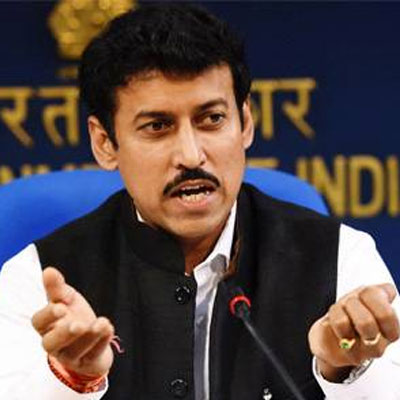
NEW DELHI: Minister of State for Information and Broadcasting Rajyavardhan Rathore today said that the government was in favour of Prasar Bharati becoming “fully autonomous.”
Rathore expressed satisfaction that the pubcaster was keeping public service ahead of commercial gains and reaching the nook and corner of the country, adding that it was a broadcaster, which could not be compared to any other broadcaster in the world or within India.

Prasar Bharati had also encouraged new talent from every part of the country including tribal and rural areas.
The Minister, speaking at a symposium on the ‘Role of different communication media in emergence of a new India,’ organized by All India Radio to mark Indian Broadcasting Day.
Broadcasting began in July 1923 with programmes by the Radio Club of Mumbai and other radio clubs. According to an agreement of 23 July, 1927, the private Indian Broadcasting Company Ltd (IBC) was authorised to operate two radio stations: the Mumbai station began on 23 July, 1927, and the Calcutta station followed on 26 August, 1927.
On 1 March, 1930, however, the company went into liquidation. The government took over the broadcasting facilities, beginning the Indian State Broadcasting Service (ISBS) on 1 April, 1930 (on an experimental basis for two years, and permanently in May 1932). On 8 June, 1936, the ISBS was renamed All India Radio.
The Minister said radio was a non-intrusive medium, which had become a part of every Indian. In fact, it increased the efficiency of the listener without intruding. Every Indian got information and entertainment from the medium as it was neutral and unbiased.
He welcomed the entry of FM and community radio, as these could fill the communication gaps.
Rathore also noted that persons like Jasdev Singh and Ameen Sayani had got recognition because of the medium.
Prasar Bharati chairman A Surya Prakash said that people could swear by news on All India Radio and Doordarshan as they were more credible than any other channel. However, he added that Prasar Bharati would not lose track of its role as a public service broadcaster. He said it was this consciousness that had led to its major contribution in making India polio free, and the pubcaster was now playing a similar role in Swachh Bharat.
Prasar Bharati CEO Jawhar Sircar said that radio continued to be a vibrant non-intrusive medium, which has brought emotional and linguistic bondage in the country, broadcasting in thirty languages.
“Millions of Indians today understand the nuances and importance of classical music because All India Radio has kept this alive in the face of the more popular film music,” Sircar said.
He also referred to the role of AIR in 1923 in the era of princely states and provinces when it provided leadership, but said the real challenges came after independence.
Member of Parliament and journalist Tarun Vijay said radio has been the informer from childhood and AIR taught him the nuances of language. “FM Gold and the AIR channels continue to stand out in the cacophony of private FM channels which had ruined values and language,” Vijay said.
Vijay also commended Prime Minister Narendra Modi for giving a new vitality with his ‘Mann Ki Baat.’ “The credibility of AIR remains higher than any other channel – be it television or radio,” he said.
Referring to the deterioration of the print media, he said that it was difficult to differentiate news from editorials. “The editor has no importance in today’s age,” he lamented, adding that most newspapers today had become “ad rags.”
Calling out to AIR to start a World Broadcasting Channel in order to reach out to the diaspora and the world, Vijay said he wanted Prasar Bharati to strengthen the infrastructure to reach out to countries in south east Asia.
Senior journalist Madhukar Upadhyay regretted that AIR appeared to have become complacent because it had the largest reach. He also asked why private FM channels should not be permitted news when television channels could do so.
Senior journalist Amit Baruah suggested the introduction of licence fee as he felt “that gives us all a stake in the broadcaster.” Mediaperson Pranjal Sharma said AIR has to keep in view the fact that social media is free with no bondages.
Eminent litterateur Anamikas said that AIR had helped the unity of the country through language and noted that Hindi which had accepted words from other languages had now become a truly Indian language.