Hindi
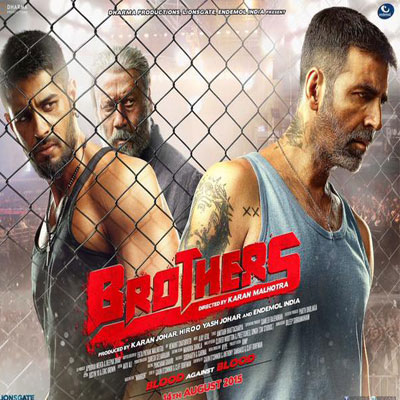
Box Office: ‘Brothers’ collects Rs 50 crore in opening weekend
MUMBAI: Brothers faced negative reports and a below par opening on Friday. The film had average collections on Friday to show a marked improvement despite bad word of mouth on Saturday thanks to 15 August, the mandatory Independence Day holiday. However, the film’s lack of merit caught up with it soon enough and despite being a Sunday, the film took a drubbing at the box office. The collections dropped instead of growing on Sunday to end its opening weekend with Rs 49.7crore.
Gour Hari Dastaan: The Freedom File is a biopic about a freedom fighter from a small town in Odisha who has contributed to India’s freedom struggle against the British rule. This film about the protagonist’s 32 year determined drive to earn recognition for his contribution from the authorities is rather personal, slow moving account and, hence, not the kind to impact the box office. Though appreciated on the international festival circuits, it has found scant patronage with the moviegoer.
Bangistan can be called a mediocre effort on all counts. With poor opening weekend, the movie continues with its poor run through its first week to end with collection figures of Rs 5.1 crore.
Jaanisar fails to relive the era that the maker’s earlier film, Umrao Jaan created. The film met with total rejection at the box office as it completes its first week run.
Drishyam fares reasonably well in week two in the absence of any strong opposition. There is a section of people who have positive things to say about the film, which helped it maintain in its second week. The film has collected Rs 17.45 crore to take its two week total to Rs 58.75 crore.
Masaan collects Rs 35 lakh in its third week to take its three week total to Rs 3.8 crore.
Bajrangi Bhaijaan establishes itself as among the biggest hits as it continued to hold sway even its fourth week to collect Rs 11.4 crore, taking its four week total to an unassailable Rs 312.85 crore.
Baahubali: The Beginning (Hindi- Dubbed) also continues to draw people. The film added an impressive Rs 5.3 crore in its fifth week taking its five week total to Rs 104.15 crore.

Hindi
Remembering Gyan Sahay, the lens behind film, television and advertising
From a puppet rabbit selling poppadums to Hindi cinema, he framed it all.
MUMBAI: There are careers, and then there are canvases. Gyan Sahay, the veteran cinematographer, director, and producer who passed away on 10 March 2026 in Mumbai, had one of the latter. Over several decades in the Indian film and television industry, he turned lenses, lights, and the occasional puppet rabbit into something approaching art.
A graduate of the Film and Television Institute of India (FTII) in Pune, Sahay built his reputation as a director of photography across a career that stretched from the early 1970s all the way to the digital age. He was the kind of craftsman who understood that a well-composed shot is not merely a technical achievement but a quiet act of storytelling.
For most Indians of a certain age, however, Sahay will forever be the man behind the rabbit. His direction of the iconic long-running television commercial for Lijjat Papad, featuring its now-legendary puppet bunny, gave the country one of its most cheerfully persistent advertising images. It was the sort of work that sneaks into the national subconscious and takes up permanent residence.
His big-screen credits as cinematographer include Anokhi Pehchan (1972), Pagli (1974), Pas de Deux (1981), and Hum Farishte Nahin (1988). In 1999, he stepped behind a different kind of camera altogether, making his directorial debut with Sar Ankhon Par, a drama that featured Vikas Bhalla and Shruti Ulfat, with a cameo by Shah Rukh Khan for good measure.
On television, Sahay was particularly prized for his command of multi-camera production setups, a skill that made him a go-to technician for large-scale shows and reality programmes. In an industry that has never been especially patient with complexity, he was the calm hand on the rig.
In later life, Sahay turned teacher. He participated regularly in masterclasses and Digi-Talks, often hosted by organisations such as Bharatiya Chitra Sadhna, sharing hard-won wisdom on cinematography, the comedy of timing in a shot, and the sweeping changes brought by the shift from celluloid to digital. He was also said to have been involved in a project concerning a biographical film on Infosys co-founder N.R. Narayana Murthy.
Tributes from the film industry poured in following the news of his passing, with colleagues remembering him as a senior cameraman who served as a rare bridge between two entirely different eras of Indian cinema. That is, perhaps, the finest thing one can say of any craftsman: he kept up, and he brought others along with him.