I&B Ministry
MIB asks stakeholders for details of DAS public awareness campaigns

NEW DELHI: All broadcasters, multi system operators (MSOs) and cable operators have been asked by the Ministry of Information and Broadcasting (MIB) to send details of the public awareness campaign being carried out by them about the third phase of digital addressable system (DAS) and the need for having a set top box (STB) in every television home.
The stakeholders have been asked by MIB Joint Secretary (Broadcasting) R Jaya to send this information within 15 days along with documentary proof.

Stressing that every TV home has to have an STB, she said it was essential that MSOs and cable operators carry only digital encrypted signals after 31 December this year.
At the outset, she said that since the cut-off date was very near, it was presumed that broadcasters, MSOs and LCOs had already done their bit.
Under Section 44 of the Cable Television Networks (Regulation) Act 1995 and the Rules framed there-under, the centre had notified phased implementation of DAS in the country by the cable operators.
Phases I and ll of cable digitisation had been completed and Phase lll of digitisation, which will cover all the remaining urban areas in the country was scheduled for completion by 31 December this year, while rural areas would be covered in phase lV to be completed by 31 December, 2016.
Jaya said that the public must be aware that they require a STB before the cutoff date and drew attention to the provision under Rule 12 of the Rules, which states, “Every Broadcaster, MSO and LCO shall create public awareness among, and provide information to, the subscribers in the notified areas from a period at least thirty days prior to the date such areas are notified either through advertisements in the print and electronic media or through such other means including leaflets, printing on the reverse of website, the receipts, personal visits, group meetings with subscribers or consumer groups. This should contain the salient features of DAS.”





I&B Ministry
CBFC speeds up film certification; average approval time cut to 22 days
Over 71,900 films cleared in five years as digital system shortens approval timelines
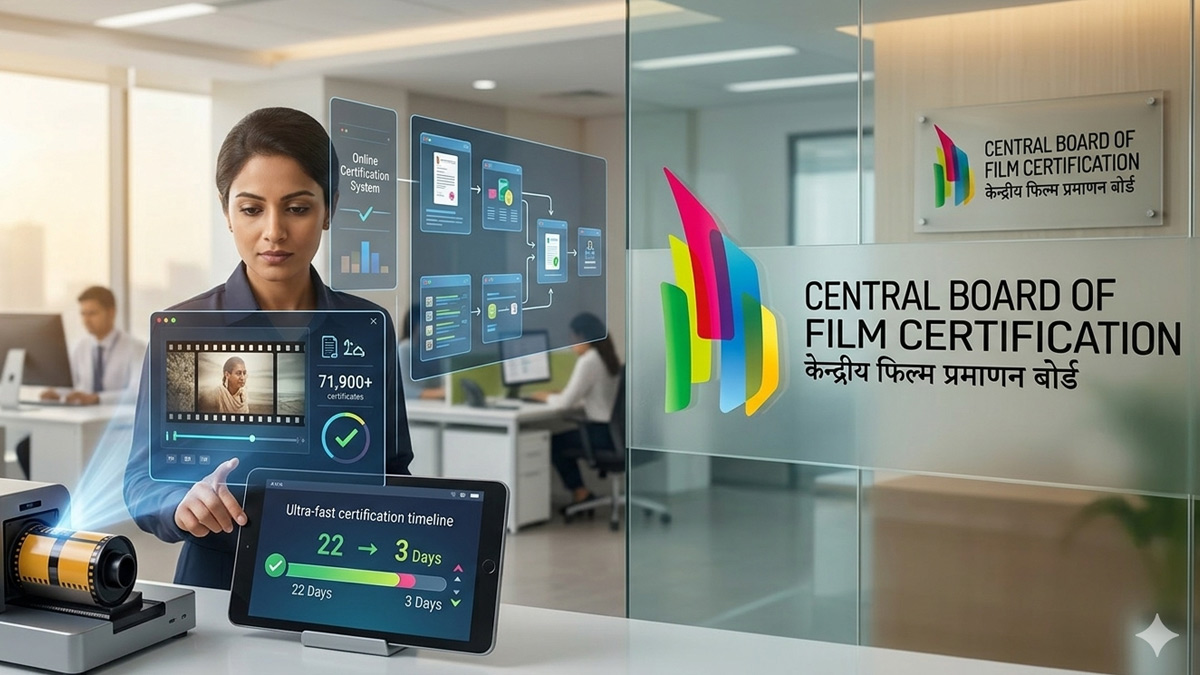
MUMBAI: The Central Board of Film Certification (CBFC) has significantly reduced the time taken to certify films, with the average approval timeline now down to 22 working days for feature films and just three days for short films.
Operating under the Ministry of Information and Broadcasting, the statutory body certifies films for public exhibition in line with the Cinematograph Act, 1952 and the Cinematograph (Certification) Rules, 2024. The rules prescribe a maximum certification period of 48 working days, though the adoption of the Online Certification System has sharply accelerated the process.
Over the past five years, from 2020-21 to 2024-25, the board certified a total of 71,963 films across formats. Of these, the majority fell under the U category with 41,817 titles, followed by UA with 28,268 films and A with 1,878 films. No films were certified under the S category during the period.
Film approvals have also steadily risen in recent years. The CBFC cleared 8,299 films in 2020-21, a figure that peaked at 18,070 in 2022-23 before settling at 15,444 films in 2024-25. During the same period, 11,064 films were certified with cuts or modifications.
Despite the high volume of certifications, outright refusals remain rare. Only three films were denied certification over the last five years, with one refusal recorded in 2022-23 and two in 2024-25.
The board may recommend cuts or modifications if a film violates statutory parameters relating to the sovereignty and integrity of India, security of the state, friendly relations with foreign states, public order, decency or morality, defamation, contempt of court or incitement to an offence.
Filmmakers can challenge CBFC decisions in court. Data shows that such disputes remain limited but have seen some fluctuation. Between 2021 and 2025, a total of 21 certification decisions were challenged before High Courts, with the number rising to 10 cases in 2025.
Responding to a question in the Rajya Sabha, minister of state for information and broadcasting L. Murugan shared the data. The question was raised by Mallikarjun Kharge.
With faster timelines and a largely digital workflow, the certification process appears to be moving at a far brisker pace, signalling a shift towards quicker clearances for India’s growing film output.