Applications
Next-generation EPR spectrometer at reduced costs, footprint and weight

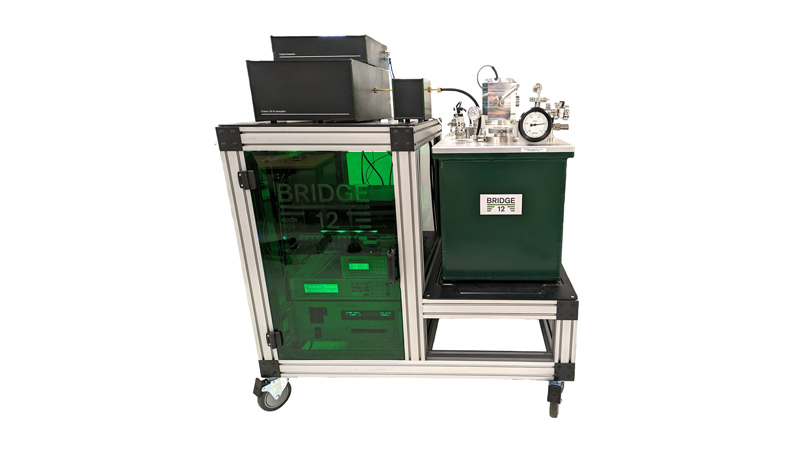
Mumbai: Electron Paramagnetic Resonance (EPR) or Electron Spin Resonance (ESR) spectroscopy is similar to Nuclear Magnetic Resonance (NMR) spectroscopy but examines the nature of unpaired electrons instead of nuclei such as protons. It is used in the fields of chemistry, biology, material science, and physics to study the electronic structure of metal complexes or organic radicals. Traditionally, EPR spectroscopy requires massive electromagnets that can weigh over a ton and therefore are often located in basements. Bridge12, located near Boston in the USA, has launched a next generation EPR spectrometer that is about half the cost of current instruments and a tenth of the size and weight so that it can be located on any floor of a building. At the heart of the system is a pair of Spectrum Instrumentation cards – an Arbitrary Waveform Generator (AWG) to generate the pulses and a Digitizer to capture the returning signal.
Bridge12 VP Magnetic Resonance Thorsten Maly said, “As a start-up, we had a clean slate to design our EPR spectrometer enabling us to use the latest technologies to create a next generation product that is much more compact than existing products. This will open up the use of this methodology to a much greater audience of researchers. Most of our customers are university researchers who gain access to the method through collaborations. Having a cheaper, state-of-the-art instrument will increase access to this powerful method. Our third goal was to make it much easier to use than current devices that need an experienced operator so that any scientist can use it for their research which will make EPR spectroscopy more widely used. Our control software has been designed to be intuitive to use with many features automated so that the set-up is straightforward and it immediately shows if the experiment is working correctly. You don’t have to be an expert in EPR spectroscopy to obtain results.”
How EPR works
An example of where EPR spectroscopy can be used is in structural biology to determine distances between radicals to determine the folded shape of (membrane) proteins. This provides insights on how these proteins can interact with other molecule or proteins. This is done by attaching two spin labels (markers) to the protein and measuring their distance using pulsed dipolar spectroscopy, a form of pulse EPR spectroscopy. The spin labels are specially designed, non-reactive, radical molecules that EPR spectroscopy can detect by exciting the radical with a sequence of microwave pulses and detecting the response. The dipolar coupling between the spins directly leads to the distance between the two markers. Spin label pairs can be put in different places on the protein to generate a set of distances that can be used to determine the three-dimensional model of how the protein is folded.
Low-noise and modular components
“EPR spectroscopy can measure distances in the range of 1 – 100 Angstroms but requires very accurately generated pulse sequences which is why we used Spectrum Instrumentation cards as they have extremely low levels of noise,” said Maly. “In addition, our spectrometer is designed to be modular so that the customer can specify exactly what performance they want and then we select the perfect AWG and Digitizer from Spectrum’s extensive range without being forced to use an over specified card. What we particularly like about the Spectrum cards is that they come integrated into Netboxes that then connects to our PC through ethernet. That way we can use a compact PC and not one that must be big enough to insert cards or have a bulky rack solution. It makes it also much easier to service our instrument and replace components in the field.”
Operation in the 35 GHz Q band range
EPR spectroscopy has evolved over the past few decades thanks to advances in radar technology and the mobile telecommunications that created equipment that could be used to build EPR hardware which uses microwave technology that needs increasingly higher frequencies for better resolution. Historically, EPR spectrometers have operated at 10 GHz (X-Band), but thanks to 5G technology, there is now new commercial equipment that can operate at much higher frequencies such as 35 GHz (Q band), a frequency that is much more desired for this type of application.
The AWG generates 10 – 100 ns long pulses in the 200 to 500 MHz range as required by the experiment that are then first up-converted to X band range using an RF I/Q mixer and then up-converted to the Q band range. The microwave pulses are then fed into 100 W solid-state amplifier before sent to the EPR resonator. The reflected signal is then down-converted to an IF frequency in the 200 to 500 MHz range and sent to the digitizer. In EPR spectroscopy, the signal is traditionally down-converted to DC, however this new approach drastically reduces noise and artifacts.
An example of the type of AWG generated pulses used in a modern EPR experiment is shown in figure 2. WURST (Wideband, Uniform Rate, Smooth Truncation) pulses are broadband microwave pulses with an excitation bandwidth and profile that exceeds that of a simple rectangular pulse by far. Pulses like this allow for broadband excitation in EPR spectroscopy and heavily rely on the performance of the AWG.
Intense magnetic fields with much lighter magnets
The other factor is being able to generate intense magnetic fields in the order of 1 to 1.5 Tesla which traditionally requires a huge, heavy electromagnet. Maly explained, “We are using a much smaller, super-conducting magnet to produce the required magnetic field strength. For this experiment, the sample always needs to be cooled to cryogenic temperatures using helium so we found a supplier of liquid cryogen-free (dry) magnets that are compact and can generate the high magnetic field of 1.2 Tesla but at a fraction of the size and weight at around 130 kg. Rather than using liquid helium, the instrument uses a cold-head and helium compressor, which is effectively a fridge achieving cryogenic temperatures in a closed cycle. This is crucial as liquid helium is becoming increasingly hard to obtain.”
Maly concluded, “Spectrum’s 5-year warranty gives us great piece of mind as these cards are key parts of our EPR spectrometer. The technical support was also first class in helping us set up the equipment so we know we can rely on Spectrum if any issues occur for our customers in the future.”






