Specialised and Niche
Niche channels to dominate TV in future

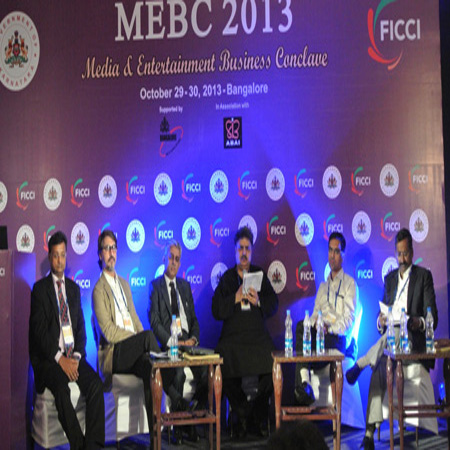
BENGALURU: At the opening ceremony of the FICCI MEBC (Media and Entertainment Business Conclave) – South, which was held on 29 and 30 October, Ministry of Information and Broadcasting Secretary, Bimal Julka highlighted the fact that digitisation is at a growing trajectory in the country and by the end of the next year we shall all be living in digital homes.
According to data provided by a FICCI Deloitte report on media and entertainment in south India, television constitutes 56 per cent of the market share with Rs 13,470 crore out of the total of Rs 23,900 crore. Digitisation is going to help the segment grow at a CAGR of 20 per cent in the next four years.
 |
|
(L-R) Sugato Banerjee, Raman Kalra, K Subramanian, Pradyuman Maheswari, Srinivasan K A and C R Rajagopal
|
While the digital world is changing phenomenally, we wonder how the broadcasting industry is adapting to the change. This, and various other points were discussed in a session on “the broadcasting ecosystem in the digital era” which included BECIL chairman K Subramanian, IBM global services head (media and entertainment) and ED Raman Kalra, Deloitte Coimbatore partner-audit C R Rajagopal, Amagi Media Labs co founder Srinivasan K A and Whats on India COO Sugato Banerjee formed the panelists, while MXM India CEO and editor in chief Pradyuman Maheshwari moderated the session.
The session kick started with Subramaniam highlighting the humongous task that was undertaken in DAS (Digital Addressable System) phase I to install about 75 lakh STBs and led to nearly 95 per cent digitisation in 38 cities. Five out of 38 are in South India, according to the report. He added that in all this DTH had taken a backseat except for Chennai where the DTH penetration is about 40 per cent and digitisation is lagging due to political turmoil.

Banerjee also supported it by saying that phase I and II saw DTH take a step back and digital penetrate strongly in Mumbai, Delhi and Kolkata.
Banerjee also highlighted certain issues that popped up during the process of digitisation. “In a city like Mumbai where people live in buildings, having a cable run through the building is easy. With DTH, the dish needs to be facing the satellite. In places where houses are far away from each other, cost of running the cable from home to home is higher and more efforts are needed. If some of these places don’t even get electricity for hours why would they want to pay for STBs?” he remarked.
There was a time when there was a scarcity of channels but now they are in abundance. According to Banerjee, there are about 700 working channels in the country but it is unrealistic to have so many channels in the digital arena. The rising number of channels has led to narrowing down of viewership. “Five years ago there was no food channel in the country and now there are five. The long tail will give more choice to viewers and fringe channels have benefitted due to digitisation especially in the urban cities,” said Banerjee.
At the same time, the growing number of channels will put pressure on its visibility. “Now, the issue would be to bring one’s channel to viewers notice,” said Srinivasan.
Viewership will be segmented leading to an increase in the number of niche channels. “Broadcast is a term that doesn’t seem to suit the current scenario. Now it is time to ‘narrow-cast’,” said Srinivasan.
According to Kalra, their IBM global survey on consumer insight has shown that people don’t want to be categorised in demographics. “Consumers want content tailor-made for them. The biggest challenge in the future will be to get direct content for people and then make them spend for it,” he said.
At the inaugural session of the event, Film Federation of India president Ravi Kottarakara raised the issue of service tax being a big hindrance on the industry. The same was also brought up by Rajagopal at the session. “Not having enough capital is a challenge for the industry to create things. Taxation needs to be looked into as well as interesting financial modules need to open up,” he said.
At the same time, there is also the issue of paying for individual channels in future as consumers are used to paying a small amount for a big pack of channels. But Kalra pointed out that a person who could pay Rs 300 for a movie now, as compared to Rs 25 a few years ago, will definitely have the capacity to pay more for TV.
However, Banerjee chose to disagree and said, “There is a difference between making them pay and the willingness to pay.”
Although carriage fees will disappear in the digitised world, Banerjee said it will reappear in another form of placement fees as to which channel will appear first. According to industry sources, carriage fees range from Rs 3-5 lakhs. The industry also lacks advertising funding as compared to print. “Print has about 2 lakh advertisers but TV has just 12,000,” said Subramaniam.
TV consumption on multiple screens is also set to grow. As on March 2013, 143 million users in India were mobile internet users (according to the FICCI Deloitte report). Its analysis report also showed that video consumption had increased from two hours to three hours from 2010 to 2012. “There will be monetisation of content as more connected devices emerge. Only then we will know which genre is being seen and its statistics,” said Subramaniam.



Specialised and Niche
Travelxp 4K launches on iNES Group in Romania
Premium travel channel arrives in native 4K HDR for viewers

BUCHAREST: Travel just got a little sharper in Romania. Travelxp 4K has officially launched on iNES Group, expanding its European footprint and bringing cinematic travel storytelling to more homes across the country.
Now available to iNES subscribers on channel 137, the fully Romanian-localised channel delivers immersive native 4K HLG HDR quality at the touch of a button. From bucket list landmarks to hidden corners of the globe, viewers can explore a sweeping range of destinations without leaving the sofa.
Travelxp 4K says it is currently the only television channel in Europe dedicated entirely to global travel and lifestyle programming in 4K. Its line-up blends striking cinematography with culturally rich narratives, designed to appeal to armchair adventurers of all ages and backgrounds.
Travelxp managing director Europe Sumant Bahl, described the launch as another key step in strengthening the brand’s presence in Romania and across the continent. He said the partnership with iNES Group would inspire Romanian audiences with high quality content showcasing the beauty, diversity and culture of destinations around the world.
iNES Group development director Sorin Ionescu, said the addition reflects the operator’s focus on enhancing its television offering with premium, relevant content. He noted that Travelxp 4K complements the company’s portfolio by giving subscribers access to world class travel and lifestyle programming in 4K HDR, delivering outstanding picture quality and an elevated viewing experience.
With this launch, Romanian viewers can expect fewer passport queues and more panoramic views, as global journeys arrive in vivid detail on their screens.






