News Broadcasting
IRF 2013: James Cridland: Indians love their radio II


This is the second part of the excerpts/summary of radio futurologist James Cridlands session on “How People Are Listening to Radio in Today’s Multiplatform World – and what your station needs to do about it” at the recently concluded International Radio Festival 2013 in Zurich (IRF 2013) by The Indian Television Dot Com Pvt. Ltd. South India Head Tarachand Wanvari. You can read the first part here: IRF 2013: James Cridland: Indians love their radio.
In Norway, a little piece of research was done where a man called Gunnar listened to internet radio on a full battery charge of his exciting Android device. He got six hours 53 minutes worth of radio streaming on 3G through his mobile phone until his battery ran down. He used it for nothing else, just streaming and then you look at how much he got in terms of FM – he got 48 hours out of the same battery. FM on mobile is a pretty good thing as compared to radio on mobile phone internet on the same device, opined Cridland.
My definition of radio is a live simulcast, Pandora is a not a radio station. My definition of approved mobile phones is that they are a little more than a transmitter-receiver which put the cord in touch with the personalised operator who dials up the number you want and then connects your remote radio extension with the rest of the telephone network.

Who is using mobile phones to tune in to radio?
“In the UK, there is a growth of adult population from a little more than 10 per cent in 2010 to 20 per cent now. If you look at young people then it is considerably higher from about 30 per cent in 2010 to about 40 per cent. Radio on the mobile is definitely a young person’s thing and that’s good news for the future of radio because younger people are by and large tuning into less radio than they ever have. Over 50 per cent of the adults in the UK own smart phones and that number is similar for most other European countries.”
“They are listening to FM mobile radio on their mobile phones by streaming. Back in 2010, 53 per cent of the listeners tuned into FM on their mobile phones, while 16 per cent ran a branded radio ad from a radio station. If only Apple would listen and included radio into its iPhones, there would be a lot more.”
“There are discussions in the US about many mobile phones not having FM radio. Many of the US mobile cell operators don’t want to put FM radio into phones because they sell bandwidth and they think its competing. That is a perception that is changing there, partially because of the work that Next Radio has been doing. Now you find less and less mobile phone companies
deliberately taking out the FM from phones. I don’t really understand why Apple has not put FM into the iPhone. One story that I have heard is that Apple do not consider the user experience of FM on a mobile phone to be good enough.”
Apple v/s Android
“53 per cent of the mobile applications downloads are happening on the Apple iPhone and 31 per cent on Android devices because most of the Android devices are of poor quality and cheap. So people are not installing too many apps on their Android phones.”
“In terms of usage in the US, they say that Apple and Android have very similar usage patterns, but Android delivers more users on the apps. Apple delivers more average time spent listening, almost twice the amount of time spent on listening.”
“I talked to a few research companies about this and one of them said that probably because Apple phones are premium, and are likely to be in peoples’ pockets while they are at work and they are more likely to be at work in an office with Wifi. Androids, which are sometimes cheaper and might be used by construction workers or people who are not necessarily in the office and do not have as much access to Wifi.”
Understanding the listening habits
“UK listeners tune into radio for roughly three hours per day across all platforms. I asked three different mobile phone app manufacturers how long people tune into the radio through their mobile phone? One came back and said 12 minutes 46 seconds. Another one came and said its between 12 and 16 minutes and the third one came back and said that it depends and could be anywhere between 14 to 45 minutes.”
“But when you look at other research for example O2, one of the large mobile companies in the UK, they say that 15 minutes a day is spent listening to music.”
“It is interesting to know what’s happening in the Indian market now, because it’s exploding with the amount of new commercial licenses, India has been relatively late in getting 3G as well, so what will that do in terms of consumption of media as a whole? India is very different in terms of culture of music and news and everything else.”
“As I have said earlier, radio has a future in India because 94 per cent of the listeners in Mumbai who tune into radio do on a mobile phone; only 16 per cent is on radio receiver. By the way all of this is FM, and it’s a really very amazing thing.”
“Absolute Radio published figures for July 2013- they have 232,000 active users that use
1,040,000 app sessions per month which means that people are using their mobile phone apps once a week, which probably means 15 minutes a week. Now, we listen to 23 hours of radio a week and 15 minutes of that is through a mobile device and it could be potentially quite expensive for people as well in terms of data and bandwidth. In the UK, 26 TB of radio a month is steamed over mobile.”
Where are people tuning in on mobile phone?
“In Germany they call the mobile phone ‘Handy’, I think that’s a brilliant name. In the UK, the European Union and Australia, 70-75 per cent of the listening requests are on Wifi of which 25 per cent is over 3G. That shows where people are actually tuning in.”
When to advertise Mobile Apps?
“If you want to know when to advertise your apps – advertise them at the end of the week because most people will install them on a Sunday when they have the time to do that.” “Here is some research -What do people do with their mobile phones? The first thing that they do is to change the background. Secondly is click on sponsors and ads, which is really surprising.”
Here are a few takeaways that I have:
(1) The majority of app users are not ‘mobile’ but on Wifi at home or at work.
(2) Usage is similar to a spare radio when you don’t have anything better – not a replacement to a radio receiver.
(3) Apps may increase audience recall of your brand (because of app on home screen) but unlikely to have a massive effect on audience figures right now. Having your radio station logo is going to do very good things to your audience figures.
(4) Advertising on them appears to work; but it simply hides the app. Time to add more to your app than just audio? I think you can earn quite significantly from that.
(5) Consumers want FM (and HD and DAB+) chips on their phones because that will save them battery life, save them bandwidth and a variety of other things.
“Even if we get all this stuff, you also have to remember content, because without the content, we won’t make our audiences smile,” concluded Cridland.







News Broadcasting
Network18 channels lead YouTube news viewership in March 2026
CNN-News18, News18 India and CNBC channels top categories with record views
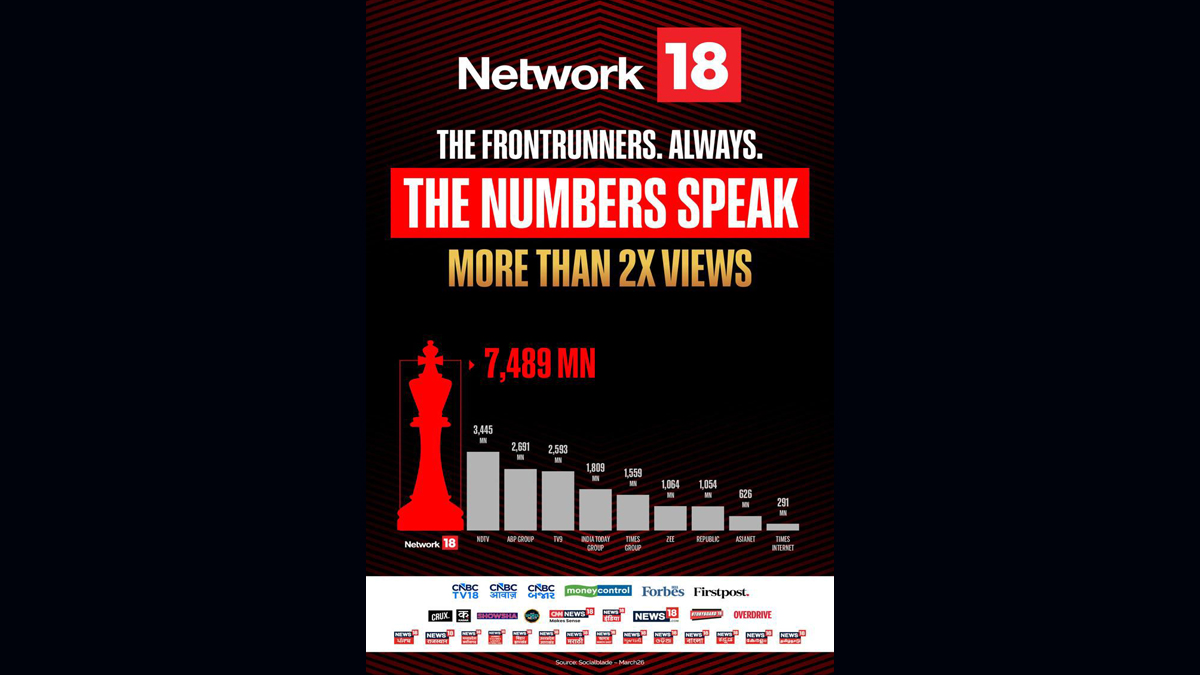
MUMBAI: When the world hit refresh on breaking news, Network18’s channels were already streaming ahead. As geopolitical tensions and war-driven headlines fuelled a surge in global news consumption, the network’s digital playbook delivered big clocking record Youtube viewership across English, Hindi and business news categories in March 2026.
At the forefront was CNN-News18, which emerged as the clear leader in the English news segment with 130 million live and video-on-demand views. The channel edged past competitors such as Times of India (126.5 million), Times Now (101.1 million), India Today (88.2 million) and NDTV (77.5 million), according to Databeings data for March.
In the Hindi news arena, News18 India delivered a commanding performance, racking up a staggering 3,297 million views on YouTube. The channel comfortably outpaced NDTV India, which recorded 3,119 million views, underlining its deep reach and consistent engagement with mass audiences, as per Playboard data.
The network’s dominance wasn’t confined to general news. In the Hindi business segment, CNBC Awaaz topped the charts with 92 million views, narrowly ahead of Zee Business (90 million) and well ahead of ET Now Swadesh (57 million). Meanwhile, its English counterpart CNBC-TV18 posted a strong 58 million views, reinforcing the network’s cross-category strength.
The spike in viewership reflects a broader shift in audience behaviour, with viewers increasingly turning to digital platforms particularly Youtube for real-time updates and in-depth coverage during high-intensity news cycles. For Network18, the numbers signal more than just scale; they underline the effectiveness of a multi-platform strategy that blends speed, credibility and continuous coverage.
In a month where the news never paused, it seems viewers chose to stay tuned where the stream never stopped.






