Comment
“How India is leading the way in BBC innovation”

It is always exciting to be in Delhi, to catch up with the latest political news and see a city that changes every time you visit. But for the BBC, India isn’t now only a fascinating story and a place with a large audience that is deep in the heart of the BBC. India is now a thriving hub of media and technology innovation.
Yesterday, I visited the instant messaging app firm Line, in Gurgaon. It has 30m users in India, with just five employees here. The BBC, I’m proud to say, is the first news organisation to distribute its content via Line. I had a fascinating conversation with Line about how it’s very young users react to the news, using the emoticons or emojis which chat apps are famous for. We discussed whether serious news and emoticons go together. But if users want to react to BBC News emotionally that’s fine by me. Images that say “amazing news”, “scary news”, “funny news”, “important news” can only show the power of BBC news’ impact on people.

For those of you who are users of chat apps and social media I hope that your reaction to my speech today about how well the BBC is innovating today in India will be, in the language of the chat app, smiley, smiley, smiley, smiley.
I’m going to speak about some of the BBC’s innovative projects in India and how they stand as a symbol of a revitalised and modernised BBC World Service throughout the world. And I will give you a glimpse of the further reinvention of the BBC that will be seen in India and globally in future years. I believe that the greatest days for the BBC around the world are yet to come, based on the incredible transformation that has happened in recent years.
First, let me detail the basis of the recent strength of the BBC. When I started my role as the director of BBC World Service Group in 2009, we had an estimated weekly audience of 238m globally. 177m of our audiences, the majority, were radio listeners and 82m were TV viewers and only 16.4m were online users. Six years on, our weekly radio audience has declined to 127m, but the TV audience has massively increased to 126m and online users have sharply risen to 46m, almost three-fold. Although our radio audience has declined sharply as Shortwave listening fades, our overall global audience now stands at 265m. Despite losing 50m radio listeners our total audience has gone up by over 10 per cent. We have achieved this through offering distinctive content via new platforms, in response to rapidly changing technologies and audience behaviours.
But while we develop onto new platforms the BBC’s core strengths remain – our accuracy, our impartiality, our independence. And those values mean we continue to be rated the world’s most trusted news brand – that’s something that I hope is never going to change.
In India trust in the BBC is still high and we remain a key player. Our BBC News website is the top international news site in India. The number of its page views is equal to the number of pages viewed by users of CNN, the New York Times and Huffington Post combined. Relied on by millions to understand the world and see how the world sees India, it serves a mainly young population. 73 per cent of users of BBC News website are under 35. We provide Indian audiences with a dedicated international homepage for BBC.Com, which curates the breadth of the BBC for Indian audiences – whether in News or in our world-beating factual genres like BBC Earth. Our BBC News app has an average of 11m page views per month in India.
BBC World News is one of the highest rated international news channels here. It reaches around 32m households in India, which constitute over 8 per cent of BBC World News’s total household distribution globally. And our Hindi services have grown on new platforms – TV, online and mobile.
Amongst its international competitors in India, the BBC is not only the most trusted, but research shows it is perceived to be relevant, high quality, unbiased, distinctive and providing a clear global view.
So I believe the BBC has a growing role but it is one that will differ significantly from the heyday of shortwave radio. To understand how that role is inevitably altering let me give you a quick tour of the global media context, as seen from BBC News.
In recent years the challenges in reaching global audiences have been intensifying. The platform on which BBC World Service historically was strongest – shortwave radio – has come under great pressure as FM radio, TV and mobile phones offer audiences compelling alternatives. In India, BBC Hindi is still available on shortwave and achieves an audience of 5.5 million which the BBC greatly treasures, but that audience has been declining fast as audiences switch to more audible radio and other platforms like TV.
Globally, state-funded and commercial players are investing heavily to increase their reach and influence. In the past decade, we have witnessed a host of new international players emerging, including Qatar’s Al Jazeera and China’s CCTV. While many news organisations, including the BBC, have to operate in a very tight financial environment, countries such as China are spending billions pumping news to audiences around the world.
At a local and regional level, news provision is rapidly increasing. India, for example, has nearly 800 TV channels, more than 240 private FM radio stations and over 94,000 registered periodicals.
The Indian audience has grown, recovering from the last few years of decline. This comes thanks to investments in digital and TV for the Hindi Service, including the launch of the Global India programme on TV, which pulls in 6m weekly viewers. These increases now more than offset the loss of shortwave listeners to the Hindi Service. Our services in India, shifting from old platforms to new ones, are a strong illustration of a shift going on all over the world. In this, as in other areas, India is leading the way.
This success has been mainly the result of our investment in digital and TV, and changing the way we work. However, we need to do a lot more to materialise our ambition, which is to double our international audience to half a billion by 2022.
The massive shift of news consumption towards mobile and social media demands we work in different ways in a modernised operation. Users consume our journalism everywhere, increasingly in real time on mobile devices and across social media. Working in platform based silos won’t work anymore.
Our London and Delhi newsrooms are a mix of talents from around the world and its output is enhanced by contribution from highly skilled journalists from our language services. We have individuals who come from the countries we are reporting, speaking the relevant languages fluently. They are bilingual reporters who work with our globally known English News teams, able to operate in English and their own language in various platforms.
We believe this is one of the most ambitious and innovative undertakings in international journalism. It is cost effective but, much more importantly, it means our agenda which already strives to be truly and even-handedly global, is driven further by our multinational, multilingual approach.
We have also been restructuring our overseas bureaux into multimedia, multilingual production units to work in an integrated way across platforms and languages. And the BBC Delhi bureau is also leading the way on this.
In Delhi we have created a new digital first newsroom. It consists of a single multimedia team, which is working across languages for bbchindi.com and bbc.com/news. And that means that the story of India is increasingly being told to the world through our brilliant Indian teams, including from BBC Hindi, alongside the traditional high class ex-pat correspondents. It is vital that the BBC’s global output reflects the world it is reporting on. And I am delighted by the way the BBC India teams are contributing to that.
As a result of our innovative ways of working and our distinctive editorial agenda we have been able to produce some unique output, covering topics that other media find uncomfortable to cover. I am particularly proud of our coverage of gender issues in India. I give you a few examples to illustrate this.
Since the Delhi bus rape in December 2012, we have consciously kept gender issues high on our agenda. The incident triggered an ambitious, highly popular season of programming called ‘100 Women’, in October last year and this year. The aim was to turn the spotlight on women’s lives around the world and feature more women’s voices and women’s stories on the BBC’s global news channels.
We have published moving pieces by our bilingual reporters in India, including a piece by Rupa Jha who highlighted the stigma and taboo around the issue of menstruation in the country. She reported on how women are considered impure and even cursed during menstruation and how at least one in five girls drop out of school during their periods due to lack of access to sanitary products.
In another piece, our Delhi-based bilingual reporter, Divya Arya, looked at how lack of toilets in rural India is endangering the safety of women who have to walk long distances to go to open-air toilets in the fields. She travelled to a village less than 50 miles from Delhi to speak to women who have to wait for the dark and move in groups to keep safe when going to toilet.
And our teams do original reporting and stage discussion on other important aspects of India.
Last week the BBC broadcast an extended debate from the India International Centre here in Delhi on India’s role in World War One. In conjunction with our partners the British Council we brought the often neglected enormous sacrifice of Indians in WW1 to a global audience. The pride of the descendants of those Indian soldiers was wonderful to hear.
And the BBC’s unrivalled network of correspondents around the world can keep an increasingly global India in touch with how the world sees it. For instance when PM Modi was in New York in September our reporter based there was able to tell the world of the powerful reaction to the PM, broadcasting in English, Hindi and Urdu, for BBC on TV, radio and online. (We keep our reporters pretty busy these days).
All of our strongest stories about India are produced in Hindi and English. Local reporters who tell the stories from their country to the whole world are now an essential part of the BBC’s international newsgathering approach. They provide a depth and subtlety of understanding that complements the indispensable insights of the BBC’s “ex-pat” foreign correspondents. This shift to bilingual journalism is one of the most important changes in the BBC’s face to the world in recent years. It is an historic and irreversible shift.
We are also innovating in our use of social media. BBC Hindi is operating as ‘Social First’, meaning social platforms are as important as publishing on its own homepage. BBC Hindi Facebook page has a fan base of 2.7 million and is growing faster than most of its competitors. BBC Hindi breaks news on Twitter and other social platforms first and produces infographics exclusively for social media.
New Products
Developing new digital products for mobile apps and web is a key priority for us. More than half of BBC World Service markets are “mobile first”, which means over 50 per cent of users’ first point of access to the internet is through their mobile phones. More than 70 per cent of BBC Hindi’s Unique Visitors online access our content through mobile devices.
Given the explosion in different types of mobile devices, all BBC World Service websites have been converted to responsive design, which adapts a site according to the device it’s being viewed on. BBC Hindi’s responsive mobile browser site was launched in March 2013 and its desktop went responsive in September this year. This has contributed to a rapid and steady growth of the Hindi website’s traffic. The number of Hindi’s monthly unique visitors across all platforms has jumped from 1.3m in April 2013 to 4.5m in October 2014 – remarkable tripling of audience in 18 months.
In editorial terms, we’ve adapted our storytelling approach. The Hindi service has been one of the first services to pilot a “mobile first” strategy this year, making the stories shorter and punctuated with more pictures and graphics. There was a 20 per cent uplift in mobile traffic after the first month of piloting these new editorial techniques.
For the coverage of the Indian general elections earlier this year, we used two new platforms, WhatsApp and WeChat, to reach Indian voters and the Indian diaspora globally. We used these chat apps, which are widely used in India, to create a new editorial service in English and Hindi.
This was the first time any international news organisation had used these platforms in this way. We had thousands of subscribers across both platforms and it meant we were able to deliver trusted news content, which was a big issue for many Indian voters with regards to domestic news providers, straight onto people’s mobile phones.
Last month we launched a new ‘lifeline’ Ebola service for people in West Africa on Whatsapp, based on that innovation in India. This was the first time the BBC has used a chat app specifically for health information content.
Recently BBC Hindi also made its content available on smartphone instant messaging platform Line, which is one the world’s top five chat apps. The launch of the BBC Hindi LINE app follows the recent launch on LINE of an English language BBC News account which has already acquired 300000 subscribers globally and over 100000 in India.
Last year, we launched a number of innovative programmes global programmes, based on social media. For instance, we set up a new social media unit, BBC Trending, to spot and investigate social media trends around the world. The team produces a weekly World Service radio programme, a blog and a unique video product which is built to be shared. Trending’s content is enhanced by BBC Monitoring and language services’ contribution which gives it a truly global flavour. Due to BBC Trending success, we have been expanding it to other languages including Arabic and Mundo and we hope also to launch in Hindi.
I would like to give you some examples of how BBC Trending works and goes behind the stories.
BBC Trending picked up the growing tension over the ‘’kiss of love’’ protest in Kerala at its very early stages and contextualised the social confrontation in India between young people and the conservative cadres of religious groups for a global audience.
Last week, BBC Trending made a video on the “We are South of India’’ song, which became a YouTube hit and was made by a comedy group from the south of the country to educate northern people about the diversity of their culture down south. This is an example of the conversation India is having with itself and shared with the wider world through BBC Trending.
When the newly elected Indian Prime Minister, Narendra Modi, launched a campaign to encourage Indians to clean up the country, there was a huge fanfare. But despite the huge coverage on the day, no other media outlets checked if it actually worked on social media. BBC Trending looked at the lack of spread of the trend forensically.
And those BBC Trending stories get reported back to India in both English and Hindi.
Partnership
We see editorial partnerships as a key way to reach a wider audience, enhance our content and help raise media standards around the world.
We have built a network of FM partner stations around the world. Here in India – we have a partnership with ETV which broadcasts the BBC Hindi TV programme, Global India, on its channels across the Hindi-speaking states. We have received encouraging indications of the substantial audiences already being achieved by Global India. I think this reflects a hunger among Indian audiences for content that relates India and the world, content that is largely missing from local providers who tend to be ruthlessly focussed on an India-only view of the world. The BBC can play a vital role in opening the eyes of audiences to the world.
However, although partners are important to the BBC on TV and in digital, there is one area where the BBC is not able to rebroadcast its news content in India – on FM radio. Since the election of the new government the former Minister for Information and Broadcasting, Prakash Javadekar, said this on deregulation of news on FM radio:
“About (broadcasting) news on FM radio, it is an issue close to my heart. Sometimes I am unable to understand the government logic. When 24×7 news channels have the freedom to show news the way they want to…, what have radio channels done that they can’t air news? “
“Why only restrict radio channels to AIR (All India Radio) bulletins (feed)? There can be three-four more options. We are looking at this issue very positively and we will take a decision soon.”
That was an encouraging statement and we hope the new minister will take this idea forward.
India is a highly modern and open society in so many ways. Its economically liberal IT sector, with an open internet at its core, is a huge advantage to the growth of India. But India’s out-dated approach to the control of news on FM radio betrays an unconfident approach. The BBC hopes that indications of reform from the Minister of Information are followed through with real action.
The components of a dramatically modernised BBC World Service are clear: a commitment to distinctive journalism that reports stories that others won’t, with utter fairness; delivering that journalism on any platform that audiences use; a global editorial ethos based on a multilingual and diverse global workforce; and the systematic use of social media to engage with audiences, to gather their news and anticipate their information needs.
But how will the BBC evolve further? It will need to continue to change as fast, even faster. I believe that if it does so, with the right support from the wider BBC, the best days of the World Service are yet to come. The remarkable advantage of committed public funding, a revitalised ethos of global journalism, the talents of the global BBC team and a commitment to technological innovation give the BBC inestimable advantages.
Here are some clues for what we will do in future in India and around the world:
The rapid proliferation of digital devices, the growth of digital video viewing and the declining cost of bandwidth create huge new opportunities for the BBC – an organisation with the strongest video news in the world. We are no longer constrained by the time limits of TV news bulletins. BBC teams are experimenting with a variety of technologies that will produce continuous video news streams for digital devices on the subjects and places that most interest the world.
Do you want news about the South Asia region? Do you want Asian business news? Do you want to know about new global developments in health technology? Do you want to know about Indian success stories in the UK and around the world? Each of those subjects will be able to be delivered as a video stream to your specification. We call this “channel in a box” – in other words a channel, or a visit stream, made in a black electronic box not a studio.
And our multilingual teams are prototyping new techniques to produce these video streams in multiple languages. I expect all the services I mentioned should be able to be delivered in Hindi, Tamil, Urdu and Bengali and possibly other South Asian languages. We will be organising our teams in multilingual subject-based global teams that make full use of our journalistic skills from across the world. This will shortly create the most innovative global content production of any news organisation in the world.
In recent months the BBC World Service has started to add languages rather than cutting them, as happened over previous decades. We launched an emergency service in Thai after the military coup in Bangkok. And just this week we started a temporary crisis offer, funded through BBC Media Action, in Liberian English to help tackle the Ebola crisis.
But I believe that with new technology and low cost translation methods the BBC could be producing content in 50 languages in five years’ time, with video streams/channels in about half those languages. That will help in achieving the BBC’s aim of a 500m global audience. More importantly, it would mean that in a world that has too much inaccurate, distorted and sensationalist news there will be a truthful news source available to a high proportion of the global population.
As you may know, I will shortly be leaving the BBC. But I believe that the robust health of the BBC around the world, along with the ideas I have mentioned and the innovation that is already in train, provide a firm platform for continued success. All that is needed is for the BBC, the politicians who ultimately decide about the World Service and the British public who now pay for it, to realise that it is within their grasp to create the greatest days of the BBC World Service.
If the BBC seizes that opportunity it will be following the example of many of the innovations by the BBC’s teams in India. In this, as in many other areas, India is helping to lead the way to help create the Future of the BBC World Service.
(These are purely personal views of BBC World Service Group director Peter Horrocks and indiantelevision.com does not subscribe to these views.)
(Peter Horrocks was speaking at the Observer Research Foundation)






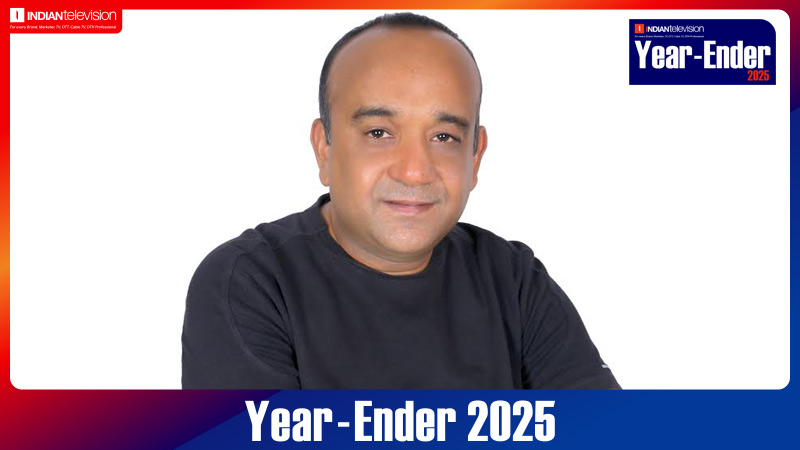
MUMBAI: 2025 will be remembered as the year India’s OTT industry stopped chasing scale for its own sake and began reckoning with how audiences actually consume content. Completion rates fell, patience wore thin and the limits of long-form excess became impossible to ignore. In this guest column, Pratap Jain, founder and CEO of ChanaJor, traces how micro-drama moved from the fringes to the centre of viewing behaviour, why short-form fiction emerged as a retention engine rather than a trend, and how platforms that respected time, habit and emotional payoff were the ones that truly grew up in 2025.
If there is one thing 2025 will be remembered for in the Indian OTT industry, it’s this: the industry finally stopped pretending.
Stopped pretending that bigger automatically meant better.
Stopped pretending that viewers had endless time.
Stopped pretending that scale without retention was success.
What began as a quiet reset in 2023 and a cautious correction in 2024 turned into a very visible shift in 2025. Business models matured. Content strategies tightened. And most importantly, platforms started aligning themselves with how Indians actually watch content, not how the industry wished they would.
At the centre of this shift was micro-drama—not as a trend, but as a behavioural inevitability.
When OTT finally understood the time problem
For years, long episodes were treated as a marker of seriousness. A 45–60 minute runtime was almost a badge of credibility. Shorter formats were pushed to the margins, labelled as “snack content” or “mobile-only.”
That belief quietly collapsed in 2025.
What platform data showed very clearly was not a drop in interest—but a drop in patience. Viewers weren’t rejecting stories. They were rejecting commitment.
Across platforms, the same patterns appeared:
* First-episode drop-offs on long-form shows kept increasing
* Completion rates continued to slide
* Viewers were sampling more titles but finishing fewer
At the same time, shows with episodes in the six to 10 minute range started showing the opposite behaviour: higher completion, higher repeat viewing, and stronger daily habit formation.
Micro-drama didn’t win because it was short. It won because it respected time.
Micro-Drama didn’t arrive loudly. It took over quietly.
There was no single moment when micro-drama “launched” in India. It crept in through dashboards and retention charts.
By mid-2025, it was clear that viewers were happy watching four, five, sometimes six short episodes in one sitting—even when they wouldn’t finish a single long episode. Romance, relationship drama, slice-of-life conflict, and grounded comedy worked especially well.
This wasn’t disposable content. It was compressed storytelling.
In shorter formats, there was no room for indulgence. Every episode had to move the story forward. Weak writing was punished faster. Strong writing was rewarded immediately.
Micro-drama raised the bar instead of lowering it.
Where ChanaJor naturally fit into this shift
ChanaJor didn’t pivot to micro-drama in 2025 because the market demanded it. In many ways, the platform was already built around the same viewing behaviour.
From the beginning, ChanaJor focused on short-to-mid-length fictional stories that felt close to everyday Indian life—hostels, rented flats, office romances, small-town relationships, young people figuring things out. Stories that didn’t need heavy context or cinematic scale to connect.
What worked in ChanaJor’s favour in 2025 was clarity:
* A clearly defined audience
* Tight episode lengths
* Storytelling that prioritised emotion and pace over spectacle
While several platforms rushed to copy global micro-drama formats, ChanaJor stayed rooted in familiar Indian settings and conflicts. That familiarity mattered. Viewers didn’t have to “enter” the world of the show—it already felt like theirs.
Why audiences started responding differently
One of the biggest misconceptions going into 2025 was that audiences wanted shorter content because their attention spans had reduced. That wasn’t entirely true.
What viewers actually wanted was meaningful payoff per minute.
On platforms like ChanaJor, episodes didn’t waste time setting the mood for ten minutes. Conflicts arrived early. Characters were recognisable within moments. Emotional hooks landed fast.
A typical consumption pattern looked like real life:
* One episode during a break
* Two more before sleeping
* A few the next day
This is how viewing habits are built—not through marketing spends, but through comfort and consistency.
Viewers came back not because every show was a blockbuster, but because they knew what kind of experience to expect.
2025 was also the year OTT faced business reality
The other big change in 2025 was on the business side. Subscriber growth slowed. Discounts stopped hiding churn. Customer acquisition costs rose.
Platforms were forced to ask harder questions:
* Are viewers finishing what they start?
* Are they returning without reminders?
* Is this content worth what we’re spending on it?
This is where micro-drama began outperforming expectations. A well-written short series could deliver sustained engagement without massive budgets. It didn’t peak for one weekend and disappear—it stayed alive through repeat viewing.
Platforms like ChanaJor benefited because they weren’t chasing inflated launch numbers. The focus was on consistency and retention, not noise.
Failures Became Visible Faster
2025 also exposed weaknesses brutally.
Several platforms assumed micro-drama was a shortcut—short episodes, quick shoots, instant traction. What they discovered was that bad writing fails faster in short formats than in long ones.
Viewers dropped off within minutes. Episodes were abandoned mid-way. Weak stories had nowhere to hide.
Micro-drama didn’t forgive laziness. It amplified it.
The platforms that survived were the ones that treated short storytelling with the same seriousness as long-form—sometimes more.
OTT Stopped Chasing Prestige and Started Chasing Habit
Perhaps the most important shift in 2025 wasn’t technical or creative—it was psychological.
OTT stopped trying to look like cinema. It stopped chasing validation through scale and awards alone. It began behaving like what it actually is in people’s lives: a daily companion.
Platforms like ChanaJor found their space here because that mindset was already baked in. The goal wasn’t to dominate a weekend launch. It was to quietly become part of someone’s everyday viewing routine.
That shift changed everything—from release strategies to how success was measured.
What 2025 Ultimately Taught the Industry
By the end of the year, three truths were impossible to ignore:
* Time is the most valuable thing a viewer gives you
* Retention matters more than reach
* Format must follow behaviour, not ego
Micro-drama didn’t take over because it was fashionable. It took over because it fit real life.
Looking Ahead
Micro-drama is not replacing long-form storytelling. It is redefining the baseline of engagement.
Longer shows will survive—but only when they earn their length. Short-form fiction will continue to evolve, becoming sharper, more emotionally confident, and better written.
Platforms like ChanaJor have shown that it’s possible to grow without shouting—by understanding the audience, respecting their time, and telling stories that feel real.
2025 wasn’t the year OTT became smaller. It was the year it became smarter.
Note: The views expressed in this article are solely the author’s and do not necessarily reflect our own.








