Movie Channels
Genre and commercial viability decide the budget, not the actor: Everest Entertainment Founder and CEO Sanjay Chhabria

Mumbai: This Maharashtra day, Everest Entertainment will give its Marathi audiences a visual treat. The company unveiled the motion poster for their upcoming big-budget Marathi film “Maharashtra Shahir” at a recent event in Mumbai.
This is the biopic of Shahir Sable, a prominent personality in the Marathi music industry. His extraordinary talent and contribution to Marathi folk music are set to be fascinatingly revealed in the film. The film’s highlight is its exceptional music, which has been composed by the well-known music personality duo Ajay – Atul. Their music has given the film a new dimension, heightening its emotional impact and connecting with the audiences on a deeper level.
Indiantelevision.com spoke to Everest Entertainment Founder and CEO Sanjay Chhabria who talked about his upcoming movie, the journey of Everest Entertainment, and the Marathi industry.

Edited excerpts
On the movie
We are excited to bring the story of Shahir Sable to the big screen. We hope that this movie will be a fitting tribute to his immense talent and contribution to Marathi folk music. The lead actor Ankush Chaudhari who’s playing Shahir has done an outstanding job. He’s playing a 20-year-old to a 70-year-old. It’s a 9-crore film with music by Ajay-Atul and has 15 songs. We will take the movie to the rural areas where there are great legacies. The Films directed by Shahir Sable’s grandson Kedar Shinde. ‘Jay Jay Maharashtra’ recreated by Ajay -Atul will be a symbolic feature of this film releasing on 28 April, which is a weekend extending upto 1st May i.e. Maharashtra Day.
On the journey
Everest has been in the business for 20 years. Our adventure, which began in 2003, has been quite interesting. Along the road, we have picked up a lot of new knowledge and we have expanded our business significantly. We began as a video publishing business, purchasing the home video rights of Marathi films.
We started content aggregation and now are the largest aggregators to Broadcasters & Digital Platforms.
Our production journey started in 2008 when I first met Mahesh Manjrekar, and it was at that point that my debut film, 2009’s ‘Me Shivajiraje Bhosale Boltoy’,” was greenlit.
With that, Everest Entertainment began its production journey in 2009. Between 2009 and 2022, we have produced 25 movies and the journey has been eventful & wonderful.
In 2013/2014 the company expanded to acquire music rights. We now have a music label as well. Today Everest Entertainment is a company which is into film production, content aggregation, monetising the music ourselves, and we’re working on creating original content for the digital space. We’ve recently ventured into production of Gujarati and Bhojpuri language films.
On Marathi industry
I was introduced to the Marathi industry first by renowned producer Sushma Shiromanee in 2003. My first acquisition for home video were her blockbuster films. I enjoy working with and being among the production community in the Marathi film space. The culture herein is very healthy & creative. The Marathi industry has a very strong and effective theatre community. Over 50 stage dramas that we own the rights to have been converted to video format.
Everyone I’ve interacted with in the Marathi film industry have been amazing, and I’m an integral part of this industry. People keep asking me, “Why don’t you do Hindi films?” My father was a leading distributor of Hindi films, and my background is in the Hindi industry. But the Hindi film industry is a spoilt industry.
I can’t relate to the kind of culture, where more money is spent on lead actors than on the making of the film.
In comparison the Marathi industry is more balanced. We were a niche industry when I first arrived, we are now mainstream. We still have a long way to go as compared to the other regional languages in particular the South Indian cinemas. But we’re making progress.
On the changes in the Marathi industry
Here, a significant change has taken place. The quality of filmmaking and writing has improved. We used to make films in 50 lakhs to 80 lakhs back then now we’re producing films with budgets ranging from 3 to 10 crores.
We have some of the best technicians, directors, writers .. Laxman Utekar, Nagraj Manjule, Aditya Sarpotdar, Sameer Vidwans, Nipun Dharmadhikari are a few examples of talent spreading their wings successfully beyond Marathi !
Shwaas, Court & now ‘Me Vasantrao’ is among the top ten contenders for the Oscars. It is a testimony to our talent.
On the thing that attracts you to the Marathi industry
Purity of thoughts, pristine ideas un-corrupted by commercial compulsions is what attracts me to this industry & it’s talent. It’s like a ride from the big bad city to a picturesque countryside ! We’ve produced some fabulous films (which may not be commercial hits) .. Tukaram, Aajcha Divas Majha, Happy Journey, Amhi Doghi, Ananya are films we’re extremely proud of. The challenge now is the cost of filmmaking has risen & unfortunately we unlike Hindi & the south Indian languages do not have a model in the Marathi language which gives us the luxury to make films directly for OTT or Broadcast.
Unfortunately today, we have to rather must consider commercial viability. When a script comes to me, the first thing I have to consider is it’s theatrical potential to aid commercials. Post pandemic, things have changed drastically.
On the budget of Marathi films now
A surge in Marathi began with the film ‘Saade Maade Teen’ produced by ZEE, it was the first film to release like a mainstream Hindi film, this was followed by ‘De Dhakka’ and then ‘Me Shivajiraje Bhosale Boltoy,’ which was the third big hit at the time. This set the tone.
The distribution and exhibition sectors lacked respect for the Marathi industry or cinema. It has been overcome; we were regarded as the inferior cousins of Hindi or other languages back in 2004 or 2005. That’s no longer the case. Multiplexes have realised & know the potential of Marathi films.
We still churn out about 75-80 films, sad thing is 30 to 40 of these are unquestionably below par.People today are intelligent enough, and this is true in all languages. There are numerous mediocre products produced.
We’ve overcome the multiplex challenge today. Pre-digitization, cinema distribution was done with physical 16mm /35mm Prints, which limited our ability to showcase a film wide. As a result, we used to release & exploit film’s territorially – in stages. Gone are those days and we can release a film in as many as 300 – 400 theatres with 1200 to 1800-2000 shows a single day.
On the challenges
One of the most difficult challenges today is the exhibition of trailers in cinemas. There is a ridiculous rule that multiplexes follow, which exhibits Marathi film trailers only with Marathi films and not in Hindi or Hollywood films. As an industry, we must work together to address these types of biases. Marathi trailers should be shown alongside mainstream films.
Another challenge is lack of stardom ! Actors sticking to one medium ie cinema.
We have actors in our industry who do Films, Theatre, Digital & dialy Soaps on TV. One can’t gain or achieve stardom if you’re visible in all formats ! Posturing is important for audiences to pay monies & buy a movie ticket !
On the competition
We’re not up against Hindi cinema, we are not in competition with anyone. We need to find our own space, create our own recipe. We have made our presence felt. Box Office of hits like Sairaat, Ved is an indicator of our untapped potential
We’re still thinking & making movies which are primarily in Mumbai & Pune. We need to think wider i.e All Maharashtra & Pan India !. We have forgotten to make films for single-screen audiences.
On the technology disruption
Everyone has profited from movie digitization, which is why there are now many big releases. Pre-pandemic, OTT was present as well, but OTT consumption wasn’t.
Our audiences in the past two years people have now consumed a lot of content on OTT. The standards are high, mediocrity will not be tolerated.
A movie trailer is the be all or end all, if it does not excite or compel me to go to the theatre, I have other option’s… OTT. I have the option of spending my weekend watching something on one of my multiple subscriptions. In addition to that, there is always cricket in India, or some other sport to be consumed.
On collaborations
We syndicate the majority of our films with Amazon and all three big broadcasters as well. We have a great relationship with all of them.
The OTT players now have five years of data at their disposal, allowing them to understand what works and what doesn’t.
Amazon began in 2016 and they’ve already completed five years. They’ve had their learnings. They have always been very supportive & bestowed faith in our company.
On the theatre/ shows occupancy
Its very important to choose the correct date to release a film & and that responsibility rests with us.One must be very careful when selecting a release date ! this is where many producers go wrong, you can’t be complaining about showcasing after choosing a crowded date !
The second important thing is the promotional material you generate for a film. There are agencies like Ormax who can help in that area while launching any product, one must support it with aggressive advertising and create that buzz. If the buzz is created, I don’t see why multiplex owners wouldn’t give you a chance. However, if your marketing fails, it will always be a battle with the plexes.
On the quality of films
We as an industry should choose quality over quantity; 30 – 40 films better in quality is better than a 100 films. There are a lot of inexperienced filmmakers / money bags who produce films for all the wrong reasons
Bollywood went wrong when they started making profitable projects rather than great stories. Lucrative forward deals from broadcasters and OTT players spoilt them, there was no hunger in the belly to create good content.
Time now is to make films for the box office. As a producer, one must accept that risk. Theatrical success translates into high value Satellite & Digital deals. It’s a by-product of a good theatrical run.
On the year 2022
It’s been a mixed bag. Some great successes and a couple of setbacks. PawanKhind, Boyz 3 scored big. Ananya’ a film very close to my heart got a tepid response. There have been a lot of learnings post pandemic.

Movie Channels
Ek Deewane Ki Deewaniyat Premieres 14 Feb on Zee
Ek Deewane Ki Deewaniyat world TV premiere 14 Feb at 8pm passion meets politics.
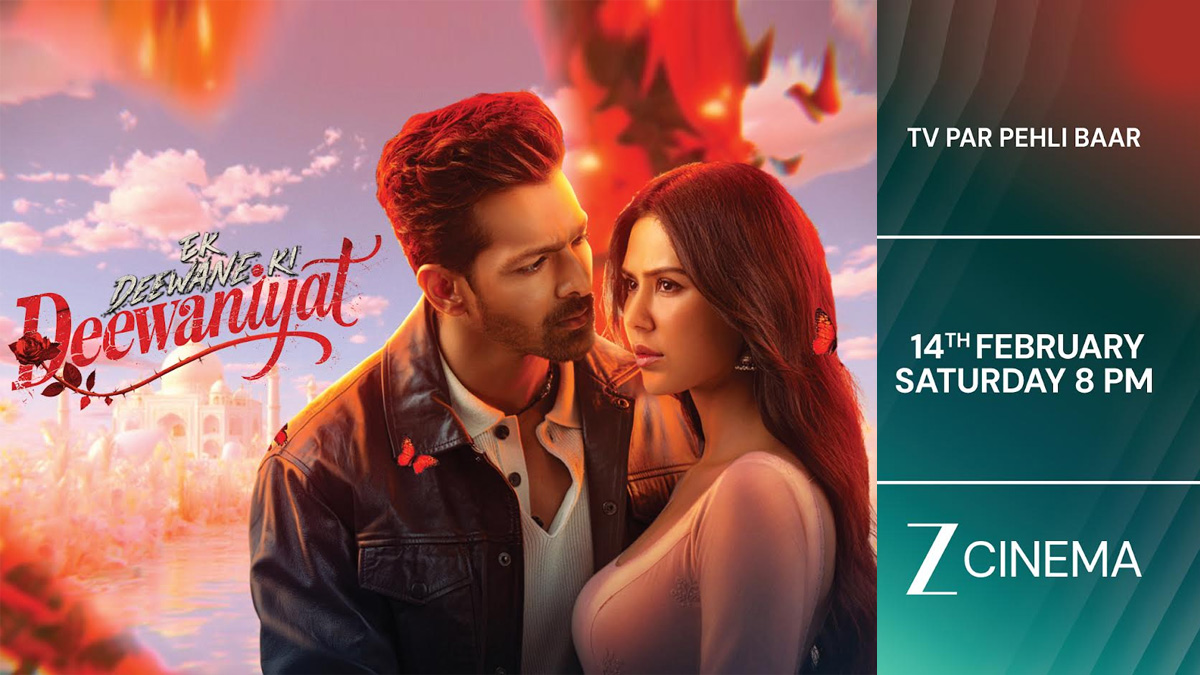
MUMBAI: Cupid’s arrow just got a plot twist and it’s heading straight for your TV screen. This Valentine’s Day, Zee Cinema is turning up the heat with the world television premiere of Ek Deewane Ki Deewaniyat, a raw, rule-breaking romantic drama that proves love doesn’t always come wrapped in roses.
Set to air on Saturday, 14 February at 8pm, the film stars Harshvardhan Rane and Sonam Bajwa, directed by Milap Zaveri. It dives headfirst into obsession, heartbreak, and the kind of unconditional love that leaves scorch marks. Rane plays Vikramaditya, a powerful politician whose all-consuming passion for actress Adaa spirals into chaos when his feelings go unreturned unleashing a storm of emotion, misunderstanding, and life-altering consequences.
The timing couldn’t be sharper. Audiences are clearly craving intense love stories over sugar-coated ones, and this film taps straight into that vein. Harshvardhan Rane already has a loyal fanbase from his cult hit Sanam Teri Kasam, which cemented his status as the go-to guy for heart-wrenching romance especially among younger viewers who keep the film on repeat.
Milap Zaveri captured the film’s beating heart, “This film is about love that doesn’t follow rules. With Valentine’s Day being a time when audiences gravitate towards romantic narratives, the television premiere of Ek Deewane Ki Deewaniyat on Zee Cinema felt like the perfect fit. The continued love for intense romances shows there is a strong emotional appetite for such stories.”
Rane himself called it a story rooted in messy, honest emotion, “Ek Deewane Ki Deewaniyat explores love in its most intense and vulnerable form where emotions are messy and deeply human. It’s a story that doesn’t shy away from passion or pain on Valentine’s Day making it even more special as it reflects the many shades of love people experience.”
Sonam Bajwa added her take, “Ek Deewane Ki Deewaniyat is not a conventional love story, it’s raw, intense and emotional. Valentine’s Day is usually associated with happy romance but this film explores love in its most vulnerable form.”
So if your Valentine’s plans include more than chocolates and clichés, tune in to Zee Cinema at 8pm on 14 February. Because sometimes the most unforgettable love stories aren’t the ones that end neatly, they’re the ones that leave you questioning just how far passion can push before everything changes.