News Broadcasting
“CPRP linked deals fail to accurately capture the quality of our audience” : Haresh Chawla Chief Executive CNBCI


It’s the festival of lights. And for many the festival of noise courtesy exploding fireworks. In the hope of reducing the number of those belonging to the latter tribe, we, at indiantelevision.com, decided to put a display of firecracker articles for visitors this Diwali. We have had many top journalists reporting, analysing, over the many years of indiantelevision.com’s existence. The articles we are presenting are representative of some of the best writing on the business of cable and satellite television and media for which we have gained renown. Read on to get a flavour and taste of indiantelevision.com over the years from some of its finest writers. And have a happy and safe Diwali!
(Written By Thomas Abraham in 2002. Thomas Abraham today leads a sports specialty company Sportz Power. He was associated with Indiantelevision.com for more than seven years as editorial director)

Posted on May 18 2002
It‘s been a happening year at CNBC India. Functioning in an unchallenged news space, the purely business channel has seen a happy growth curve in a climate where market sentiment has been pretty grim overall. Revenues have grown tremendously and the channel has achieved operating break-even. CNBCI chief executive Haresh Chawla, who also oversees e-18 – the the portal business of the TV18 group (which manages CNBCI) – has been the man at the helm in all this.
Chawla, who joined CNBC India in December 1999 as CEO from the Times of India group where he headed its music division (Times Music), speaks to indiantelevision.com‘s Thomas Abraham on where the channel‘s at and where it‘s headed. –
How do you evaluate your performance this year over the previous year? What have been the significant changes to the channel that were introduced in the last year?
In the direction of enhancing CNBC‘s presence as a complete business channel, we added a number of feature shows touching a wide spectrum of sectors. We have also paid close attention to the format of our core business news programmes to make them crisper and meatier.
We have launched a number of special shows and on-ground properties that act as effective communicators of our core brand. Shows and events like Boardroom, Managing India; Union Budget and Credit Policy Specials; Mutual Fund of The Year Awards, etc. have created fora for the most influential corporate decision-makers to exchange views and ideas and platforms for top-notch business analysis.
We have augmented our studios and technological infrastructure to support the growth in the depth and breadth of our programming. In the year that went by we have demonstrated our capability to manage highly complex live broadcasts.
Our revenues have grown tremendously over the last year and we have achieved operating break-even.
Are there any new programming initiatives that CNBC India is looking at?
A case in point is Storyboard, which has proved a big hit.
Yes, Storyboard has been quite a satisfying addition to the CNBC show roster. Along with Digital Revolution, Trend Mill, Managing India and Cutting Edge, it forms part of a strong feature band created to meet the evening viewing needs of corporate managers.
We will continue to expand the width of our programming and introduce shows that touch various business sectors. We have plans to introduce shows in the spheres of success profiling, executive health and technological advances, among others.
“For all practical purposes, English is integral to communication throughout corporate India. Be that as it may, if we see demand for regional language business programming we‘ll not lose time in meeting it.”
Any major brand associated events that you have lined up? Due to some bad experiences in the past, your current policy seems to be that you will not associate with any events unless you have total creative control. Could you elaborate?
Our on-ground events are fundamentally business feature shows done on a considerably larger scale. As with all our programming, they are created with the idea of giving viewers the information and tools to achieve success in their spheres of activity – careers, business, investments, etc. In the process, we have been able to showcase the highest standards in business and establish benchmarks for the corporate community. Hence, these events are logical extensions of our core brand and, like any responsible brand custodian, we would like these activities to reflect the core values of the CNBC brand.
Currently how many hours of programming does TV 18 provide for CNBC India per day?
About 11 hours a day. (When we started, the only India-related programming on CNBC was an hour of Bazaar in the morning).
What is the break-up between English and Hindi timewise? Will that hold for the year ahead as well?
We have around 90 minutes of Hindi programming every day. We have found that this is the ideal mix of English and Hindi for a business channel.
What are your thoughts on other regional language feeds?
The lingua franca of the business world is essentially numbers. Therefore, differences in language across regions don‘t affect CNBC‘s viewership as much as it would a general news channel. And for all practical purposes, English is integral to communication throughout corporate India. So, we don‘t have plans at the moment to expand into other languages. Be that as it may, if we see demand for regional language business programming we‘ll not lose time in meeting it.
The links that bind you to Sony Entertainment Television seem to be loosening rather than deepening. Earlier Sony was to take a stake in the CNBC. We now have a situation where advertising sales for the channel is also with CNBC. Talking of ad sales, what has your growth been like in the past year?
We enjoy an excellent business relationship with Sony. Yes, as the channel grew, it began to make more strategic sense to have a TV18 team dedicated exclusively to handle CNBC ad sales. This is purely from a commercial stand-point. It‘s early days yet to evaluate the outcome of this new focus, but if the first indications are anything to go by, we expect a sharp rise in our ad revenues from here on.
As far as the previous year goes, we‘ve seen an ad sales growth of around 30 per cent.
How are you positioned today as far as filling up inventories is concerned? How many minutes of ad time per hour do you place? What is your stand on CPRP-linked deals? Are you okay with it?
We‘d rather not disclose inventory usage numbers, but we are very satisfied on that front.
It is our belief (and this has been borne out many times in the past) that CPRP-linked deals fail to accurately capture the quality of our audience and the quality/involvement of our viewership. The reasons are many: the SEC categorisation is not defined to reflect the higher echelons wealth-wise, OOH is still an elusive audience for any system that tracks reach and the low sample sizes preclude any great depth of analysis.
The very nature of CNBC‘s content engenders high involvement ‘lean forward‘ viewing, which in this age of low-attention spans commands its own premium.
“We enjoy an excellent business relationship with Sony. Yes, as the channel grew, it began to make more strategic sense to have a TV18 team dedicated exclusively to handle CNBC ad sales.”
Coming back to Sony, even the distribution deal seems dicey now. Why is there this feeling in the industry that post March 2003 you may well be on another platform?
There is no change in our distribution deal with Sony and we have no plans as of now for post-March 2003.
Let‘s keep that aside for now, but what are you looking for in a distribution deal for CNBC India?
Put simply, apart from the normal commercial underpinnings of a distribution agreement, our key consideration would be the effective reach of our target audience – investor population, the corporate and business community – across regions.
Talking of distribution, what are your all-India numbers?
About 11 million homes.
Related to the dip in revenues to moneycontrol.com in the last fiscal, how does this impact on your broadband plans? Or is it a no-no for the present at least.
Today, moneycontrol.com is the leading personal finance portal and business news website in India, with above 10 million page views a month and more than 45,000 registered users. Unlike many portals floated during the Internet boom, investments in moneycontrol have been based on rational expectations and focussed objectives. It is a media integration success story and the huge following that it has today bears testimony to this.
Yes, Project Broadband, which was in fact envisaged as an infotainment television channel supported by allied web-enabled activity, has been off the radar for almost a year now. Quite frankly, our focus is on the combined thrust of the business channel and the finance portal, aimed at providing greater salient value to our users and establishing the high-quality service that the brands stand for in the business information arena.
Any roadmap that you‘ve set forth for the year ahead?
We have established ourselves among our viewers as an influential partner in business, investing and corporate life. Our goal will be to buttress this relationship with our viewers by continuously improving the total information package.
After a strong phase of growth, we are in an interim consolidation mode right now. We see this phase lasting another three months, after which we‘ll start introducing more shows relevant to our audience across time bands. We shall also focus on increasing our distribution reach further as, apart from the business community, there is a large population of investors that follows the channel keenly.





News Broadcasting
News18 India launches Command Centre war explainer with Arya
New show shifts from debates to decoding global conflicts and impacts
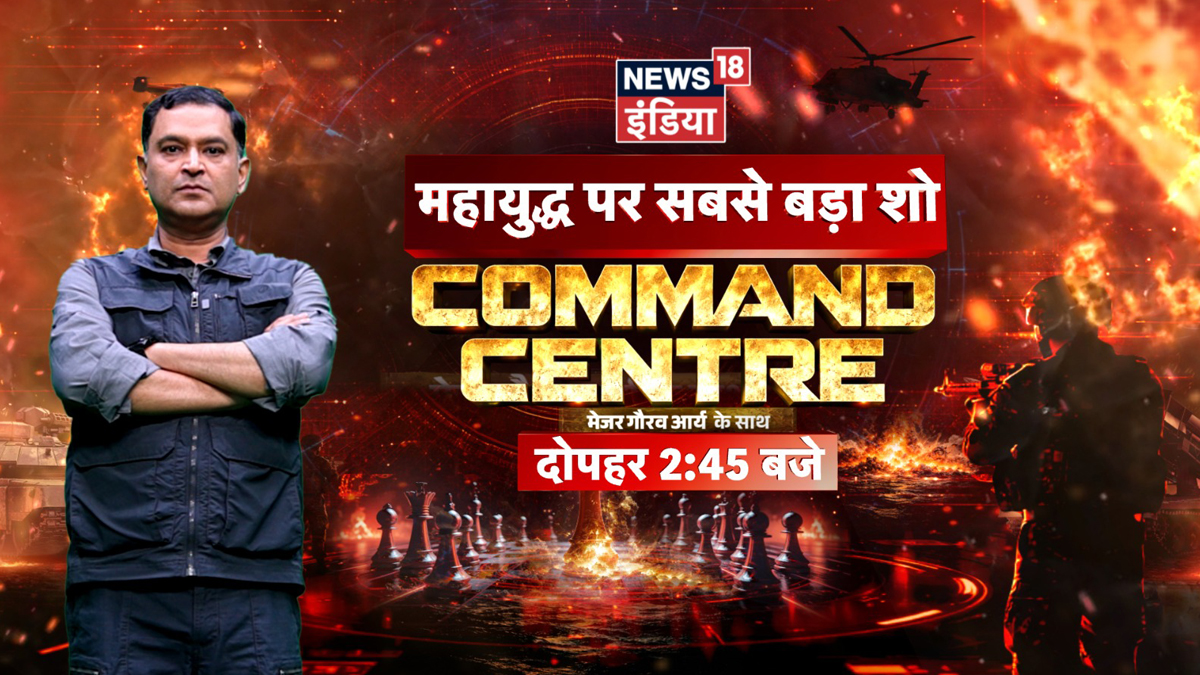
MUMBAI: News18 India has rolled out a new war-focused programme, Command Centre, featuring Gaurav Arya, as it looks to offer viewers a sharper, more grounded take on global conflicts amid rising tensions in West Asia.
Positioned as an “insider war room”, the show moves away from conventional panel debates and instead focuses on explaining military developments, decoding strategy and connecting global events to their everyday impact, from fuel prices to economic shifts.
The format leans heavily on visuals and data. The studio has been designed like a command hub, complete with large LED war maps, real-time graphics and an alert system to track developments as they unfold.
At the centre of it all is Arya, who brings his military background to simplify complex war strategies for viewers. His signature line, “Seedhi baat samjhiye”, anchors the show’s promise of clarity over noise.
News18 India managing editor Jyoti Kamal said, “Command Centre, featuring Major Gaurav Arya is designed to deliver accurate insights and a clear perspective on how evolving conflicts impact everyday life, from household budgets to national security. With expert voices analysing every development in real time, the show goes beyond headlines to decode what’s happening now, what it means, and what could come next.”
Echoing the intent, Gaurav Arya added, “In times of war, confusion is the biggest threat. With News18 India’s Command Centre, we are bringing viewers inside the war room, decoding strategies, tracking every escalation, and explaining, in the simplest terms, what it means for India and for every household. Seedhi baat samjhiye, this is where you understand not just what is happening, but what happens next.”
The weekday show will air in the afternoon slot and will also feature Gaurav Shukla, adding to its editorial depth.
With its mix of analysis, visuals and a clear focus on impact, the show reflects a broader shift in news consumption. Viewers are no longer just watching events unfold, they are looking to understand what those events mean for them.







