News Broadcasting
Close What do buyers want?

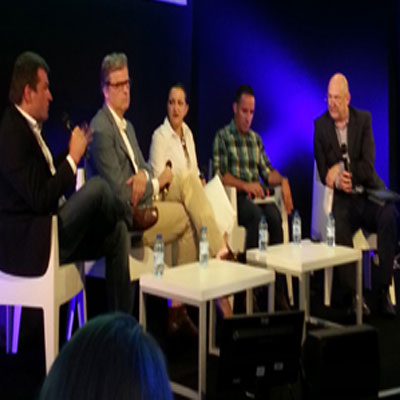
CANNES: That they’ve come to Mip Junior looking for kids’ content doesn’t really mean they are clear about what they want to buy. Which is where the conference titled ‘What do buyers want’ stepped in and did some much-needed hand-holding.
Moderated by C21 Media editor-in-chief and managing director David Jankinson, with panellists including Nickelodeon senior VP, global acquisitions and international programming Jules Borkent; The Walt Disney Company SVP, programming, scheduling, multi platform and acquisitions Paul DeBenedittis; RTL Disney Fernsehen head of acquisition and co-productions Frank Dietz; and Cartoon Network VP content acquisitions and co-productions Adina Pitt, ‘What do buyers want’ concentrated on the proliferation of devices and platforms for kids’ entertainment.
DeBenedittis said: “We don’t really think of ourselves as just a linear TV screen. Today, content is a means to distribute the message about the Disney brand, no matter where the audiences are.”
Added Pitt: “The number of screens from where kids can consume our content has increased. So, the focus now is to provide the best possible content on the screens that are being used widely.”

With viewers today moving faster than channels, this was probably the best time for producers to be in the business of kids’ content, Pitt pointed out.
DeBenedittis spoke about how audiences are just a click away. “Considering the amount of content one can watch online, viewers have moved from the remote to just a click. Channels are competing with YouTube. But what is different about us is that we can tell a story,” he said.
Pitt spoke about how channels were concentrating more on comedy content for kids. “Kids come to us to laugh. So even if it is mystery or action or drama, our content always comes with a bit of humour and it works well with our core target audience. Ben 10 being the biggest example,” said Pitt.
Ditto for Nickelodeon. “We are looking at pure comedy. Kids want to laugh and that is what brings them to us,” said Borkent.
Pitt said their budgets were so tight they could not afford to buy anything that was less than extraordinary. Nickelodeon, which had launched an app earlier this year, was now creating content specifically for it, including some digital commissions, which according to Borkent, could be developed into a TV show.
Even channels like Cartoon Network were flipping through the internet to see if there was anything interesting to be converted into content. “There are numerous ideas in the internet, some brilliant. People just need someone to help them tell the story better. So we are always looking for something that is undiscovered,” revealed Pitt.
DeBenedittis cautioned against the tendency to develop any single platform in isolation. “Developing content for only one platform is not the most efficient way to leverage resources. It is about using the platform to distribute content as opposed to being very focused on a platform and developing content specifically for it,” DeBenedittis said.







News Broadcasting
Network18 channels lead YouTube news viewership in March 2026
CNN-News18, News18 India and CNBC channels top categories with record views
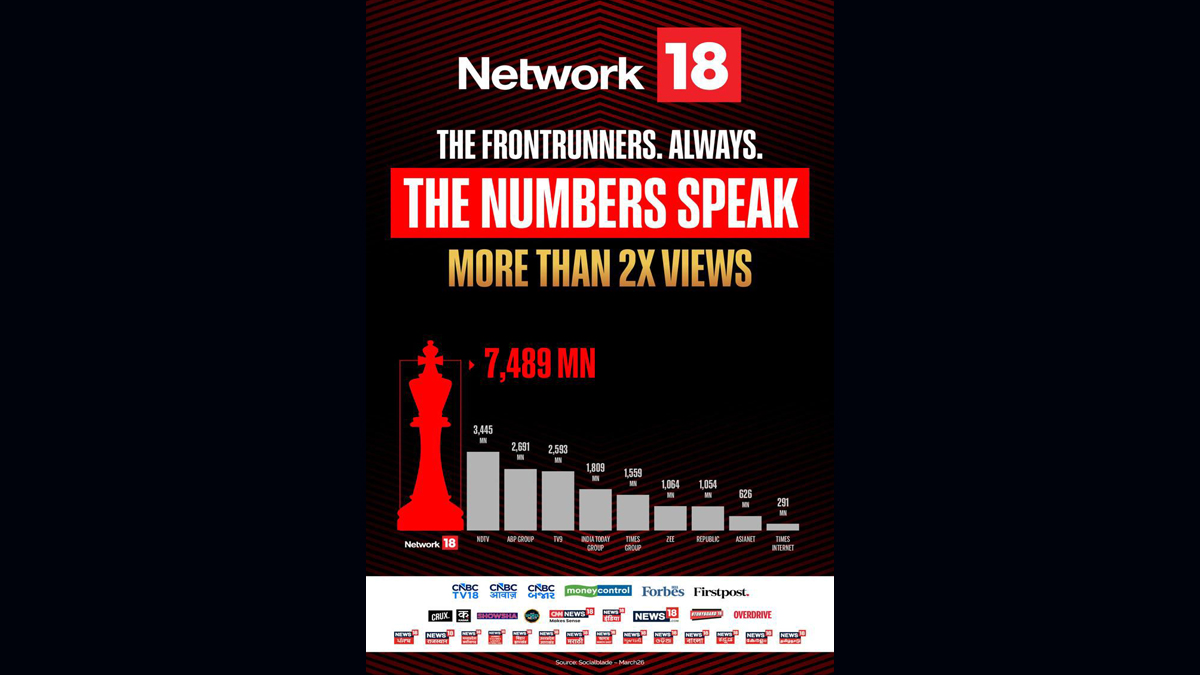
MUMBAI: When the world hit refresh on breaking news, Network18’s channels were already streaming ahead. As geopolitical tensions and war-driven headlines fuelled a surge in global news consumption, the network’s digital playbook delivered big clocking record Youtube viewership across English, Hindi and business news categories in March 2026.
At the forefront was CNN-News18, which emerged as the clear leader in the English news segment with 130 million live and video-on-demand views. The channel edged past competitors such as Times of India (126.5 million), Times Now (101.1 million), India Today (88.2 million) and NDTV (77.5 million), according to Databeings data for March.
In the Hindi news arena, News18 India delivered a commanding performance, racking up a staggering 3,297 million views on YouTube. The channel comfortably outpaced NDTV India, which recorded 3,119 million views, underlining its deep reach and consistent engagement with mass audiences, as per Playboard data.
The network’s dominance wasn’t confined to general news. In the Hindi business segment, CNBC Awaaz topped the charts with 92 million views, narrowly ahead of Zee Business (90 million) and well ahead of ET Now Swadesh (57 million). Meanwhile, its English counterpart CNBC-TV18 posted a strong 58 million views, reinforcing the network’s cross-category strength.
The spike in viewership reflects a broader shift in audience behaviour, with viewers increasingly turning to digital platforms particularly Youtube for real-time updates and in-depth coverage during high-intensity news cycles. For Network18, the numbers signal more than just scale; they underline the effectiveness of a multi-platform strategy that blends speed, credibility and continuous coverage.
In a month where the news never paused, it seems viewers chose to stay tuned where the stream never stopped.






