News Broadcasting
Balajis bright new sparks


MUMBAI: Even as television channels churn out soap operas in a bid to outdo each other, more and more youngsters are finding themselves dreaming of making it big in films and television.
Glamour struck as these young guns are, more often than not, they are not really equipped to deal with the big, bad world that lurks beneath the shiny surface.
This is where companies like Balaji Spark aim to step in to handhold and nurture the new talent. “Our philosophy is about nurturing. We want to do everything a parent does for a child,” exults Balaji Motion Pictures CEO Tanuj Garg about Balaji’s new talent management arm.
With its mission to identify and manage new talent, Spark will represent both on-screen and directorial talent discovered and launched by BMPL and Balaji Telefilms in films and television, respectively. The unit will be under BMPL, and will be helmed by Firoz Engineer, who will report into Garg.

Spark’s job will also be about guiding new talent, managing their image and PR among other things. Garg clarifies that among the hundreds of applications Balaji receives every day, its casting directors single out only such talent that they feel is worth grooming. “We are not looking at 100 people or so. It is just going to be a handful of them, who we will oversee so that there is some kind of class and pedigree involved,” he says.
With the likes of Yash Raj Films and Viacom18 Media too having established units offering similar services, what would differentiate Spark from the rest? “We clearly don’t look at ourselves as agencies or brokers because we don’t think that’s the way talent is managed or launched. Some of the biggest names in the industry have been launched by us, and we continue to do so. It is our responsibility to help them and not use them as commodities,” quips Garg.
Spark is all about about parenting and not deal making like others, says Tanuj Garg
Indeed, actors such as Smriti Malhotra-Irani, Sakshi Tanwar, Ram Kapoor, Prachi Desai, Rajeev Khandelwal, Shweta Tiwari, Sushant Singh Rajput, Ronit Roy, Hiten Tejwani, Urvashi Dholakia and more recently, Rajat Tokas and Paridhi Sharma of Jodha Akbar fame, rose from the Balaji stable to achieve iconic status. Garg points out that currently, Spark will focus on the selected lot of actors instead of searching for newer faces. “We don’t want to disturb the applecart and lure people to come to us. We might do that later but as of now, our immediate plans are to nurture the talent we want to launch in TV or films,” he says.
Spark will have a simple fee structure where it gets management fee, which is a certain price of the deal. All value-added services like paperwork, PR etc. will be part of the deal. Spark will get anything between 10-25 per cent of the deal, which is in keeping with industry standards. The contract timeframe will be a minimum of three years, though it may vary from deal to deal.
Elaborating on Spark’s low intensive business model, Garg says: “Consumers don’t have to know about us. What matters is people in the industry know us for they will consume our talent.”
Hats Off Production’s JD Majethia agrees. “Take the example of Sushant Singh Rajput; if he didn’t have the push of Balaji, do you think he would have been where he is today? Balaji has launched so many faces and since there are so many opportunities, it is bound to set new limits,” he says.
Beyond Dreamz’s Yash Patnaik too feels Spark will only benefit the industry as new talent will get an umbrella where they can get groomed and hone their skills.
Not just budding youngsters, Spark will also be managing Balaji head honcho Ekta Kapoor. “People want her for shows, as speaker or to host them. She is a brand to reckon with, and she has realised it is high time she came out if there is an interesting and exciting offer. So we will be handling her,” says Garg excitedly.
Spark plans to partner with other entities across the nation to work with its artists to recognise the right opportunities for them in terms of brand and cause endorsements, performances and appearances on various shows and events.
With a record-breaking career graph thus far, we are sure, Balaji will only forge ahead with this venture…





News Broadcasting
Network18 channels lead YouTube news viewership in March 2026
CNN-News18, News18 India and CNBC channels top categories with record views
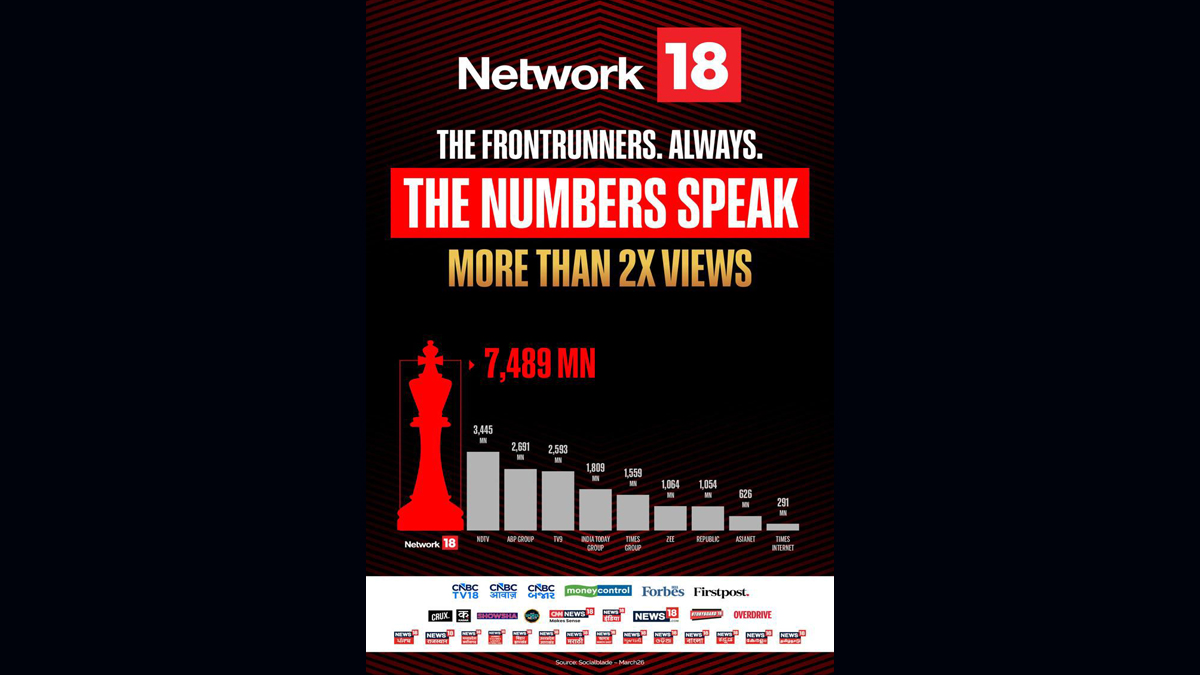
MUMBAI: When the world hit refresh on breaking news, Network18’s channels were already streaming ahead. As geopolitical tensions and war-driven headlines fuelled a surge in global news consumption, the network’s digital playbook delivered big clocking record Youtube viewership across English, Hindi and business news categories in March 2026.
At the forefront was CNN-News18, which emerged as the clear leader in the English news segment with 130 million live and video-on-demand views. The channel edged past competitors such as Times of India (126.5 million), Times Now (101.1 million), India Today (88.2 million) and NDTV (77.5 million), according to Databeings data for March.
In the Hindi news arena, News18 India delivered a commanding performance, racking up a staggering 3,297 million views on YouTube. The channel comfortably outpaced NDTV India, which recorded 3,119 million views, underlining its deep reach and consistent engagement with mass audiences, as per Playboard data.
The network’s dominance wasn’t confined to general news. In the Hindi business segment, CNBC Awaaz topped the charts with 92 million views, narrowly ahead of Zee Business (90 million) and well ahead of ET Now Swadesh (57 million). Meanwhile, its English counterpart CNBC-TV18 posted a strong 58 million views, reinforcing the network’s cross-category strength.
The spike in viewership reflects a broader shift in audience behaviour, with viewers increasingly turning to digital platforms particularly Youtube for real-time updates and in-depth coverage during high-intensity news cycles. For Network18, the numbers signal more than just scale; they underline the effectiveness of a multi-platform strategy that blends speed, credibility and continuous coverage.
In a month where the news never paused, it seems viewers chose to stay tuned where the stream never stopped.






