Sports
Asia’s sports media confab pitches its tent in Singapore
Sportel Asia returns with rights deals, piracy battles and a search for the holy grail of personalisation — all before the after-work drinks


SINGAPORE: The world’s sports-media deal-makers are descending on the Lion City this week, briefcases and business cards at the ready, for Sportel Asia 2026. Two packed days at the Orchard Grand Ballroom — 24 and 25 March — promise a collision of rights-holders, broadcasters, streaming platforms and tech vendors, all hustling for a slice of the most-watched, most-fought-over content on the planet. Think of it as a transfer window, but for television.
The conference, organised by Monaco Mediax, has made Singapore its home for the Asia-Pacific edition of Sportel — its glitzier sibling being the Monaco gathering each autumn. This year’s programme leans hard into the commercial tug-of-war between legacy broadcasters and the streaming insurgents eating their lunch, with a side-order of piracy panic and a dash of feminist economics.
The curtain-raiser on Tuesday morning is a masterclass on sports media rights in Asia — landscape, challenges and what comes next. With rights fees spiralling, streaming platforms multiplying and audiences fragmenting faster than a dropped smartphone, the question of who pays what for which rights has never been thornier. The session, one of several branded as masterclasses to lend proceedings an appropriately educational air, sets the intellectual tone for two days of vigorous back-scratching.

Hot on its heels comes a presentation from the Korea Professional Football League on how it is showcasing the K League through media and content strategy. Beyond the pitch, as the session title rather poetically has it. Korean football has punched well above its weight culturally — its clubs would like to do the same commercially, and the APAC broadcasting market is the obvious first port of call.
After the obligatory coffee break — networking, in conference-speak — attention turns to the rather clinical-sounding matter of content fabric. A presentation on its real value for sports rights holders will either illuminate or baffle, depending on one’s tolerance for infrastructure jargon. The gist: in a world where content must travel seamlessly from stadium to screen in multiple formats across multiple platforms, the plumbing matters.
Tuesday’s afternoon centrepiece may well be the masterclass on European football’s commercial push into APAC. The session, cheekily titled “Away goals,” will examine how the Premier League, La Liga, Bundesliga and their continental cousins are chasing Asian fans and, more to the point, Asian money. Broadcast deals, sponsorship, fan engagement, youth academies — there is no trick too small when the prize is 4.5 billion potential followers.
A technology masterclass on making sense of new trends follows, which in sports-media terms means artificial intelligence, augmented reality, automated production and whatever acronym the industry has invented in the past fortnight. That leads into what may be the most entertainingly titled session of the week: “What the buyers want! Content acquisition in APAC: a Q&A.” Day one closes with after-work drinks — because no amount of disruption, digital transformation or dynamic rights packaging cannot be improved by a cold beer.
Tuesday 24 March — programme at a glance
08:30 Exhibition opens & welcome coffee
09:45 MasterClass: Sports media rights in Asia
10:35 Presentation: K League media & content strategy
11:20 Presentation: The real value of content fabric for rights holders
11:45 MasterClass: Women leading sport in Singapore — legacy & economic power
14:00 MasterClass: Away goals — European football & APAC commercial growth
15:50 MasterClass: Technology — making sense of new trends
16:45 Session: What the buyers want — content acquisition in APAC
17:30 After-work drinks
Wednesday opens with a session that could prove the week’s most consequential: the booming sports media and technology landscape of Australia and New Zealand. The ANZ market has become a battleground between free-to-air incumbents, pay-TV holdouts and streaming newcomers, all fighting over rugby, cricket and Australian rules football with a fervour that makes the European super-league saga look like a friendly disagreement.
Then comes a presentation from FeedConstruct, a data and streaming infrastructure company, on its journey and where clients fit into it — corporate storytelling of the kind that keeps exhibitor halls financially viable. After lunch, the masterclass on streaming and the holy grail of personalisation tackles the central obsession of every platform executive: how to serve each viewer exactly what they want, the moment they want it, without haemorrhaging money in the attempt. The answer, spoiler alert, remains elusive.
Wednesday’s undoubted crowd-pleaser is the masterclass on streaming piracy in Asia, tartly subtitled “from illegal streams to cybercrime.” The region remains the world’s most enthusiastic market for pirated sports content, with illegal IPTV services, torrent streams and password-sharing operations costing rights-holders hundreds of millions of dollars each year. The session’s inclusion speaks to how seriously the industry now takes what was once dismissed as a niche law-enforcement matter. It is not. It is an existential threat to the economics of sports broadcasting.
The week closes with the Pitch Perfect Innovation Contest — a startup showcase where fledgling companies compete to impress an audience of potential investors and clients in the best Dragons’ Den tradition. The winner gets celebrated with drinks, which may be the most civilised prize in the business-events calendar. Everyone else gets a business card and a flight home.
Also tucked into Wednesday’s programme is an exploration of women’s sport and the economic power it increasingly commands — a subject that, a decade ago, would have warranted a footnote. Today, with women’s football, cricket and basketball smashing broadcast records across the Asia-Pacific, it commands a masterclass of its own. Progress, of a sort.
Wednesday 25 March — programme at a glance
08:30 Exhibition opens & welcome coffee
10:00 MasterClass: Australia & New Zealand — booming sports media & tech landscape
11:20 Presentation: Beyond FeedConstruct — journey & partnership
11:45 MasterClass: From illegal streams to cybercrime — tackling streaming piracy in Asia
14:00 MasterClass: Streaming and the holy grail of personalisation
14:50 Session: Pitch Perfect Innovation Contest
16:00 After-work drinks in honour of the Pitch Perfect winner
17:00 Exhibition closes
Between sessions, the real business happens on the exhibition floor — handshakes, hushed conversations about rights packages, and the kind of deal-making that never makes it into a press release. Sportel has always understood that the conference is the pretext; the corridor is the point.
The event is organised by Monaco Mediax. Registration and further details are available at sportelasia.com. Sportel Monaco 2026 follows in the autumn, for those whose appetite for sports-media deal-making is not yet sated. In this industry, it rarely is.







Sports
IPL 19 records 96.8 ad index as advertisers and categories decline: TAM Sports report
Fewer categories and advertisers as tech and FMCG brands reshape IPL ad mix
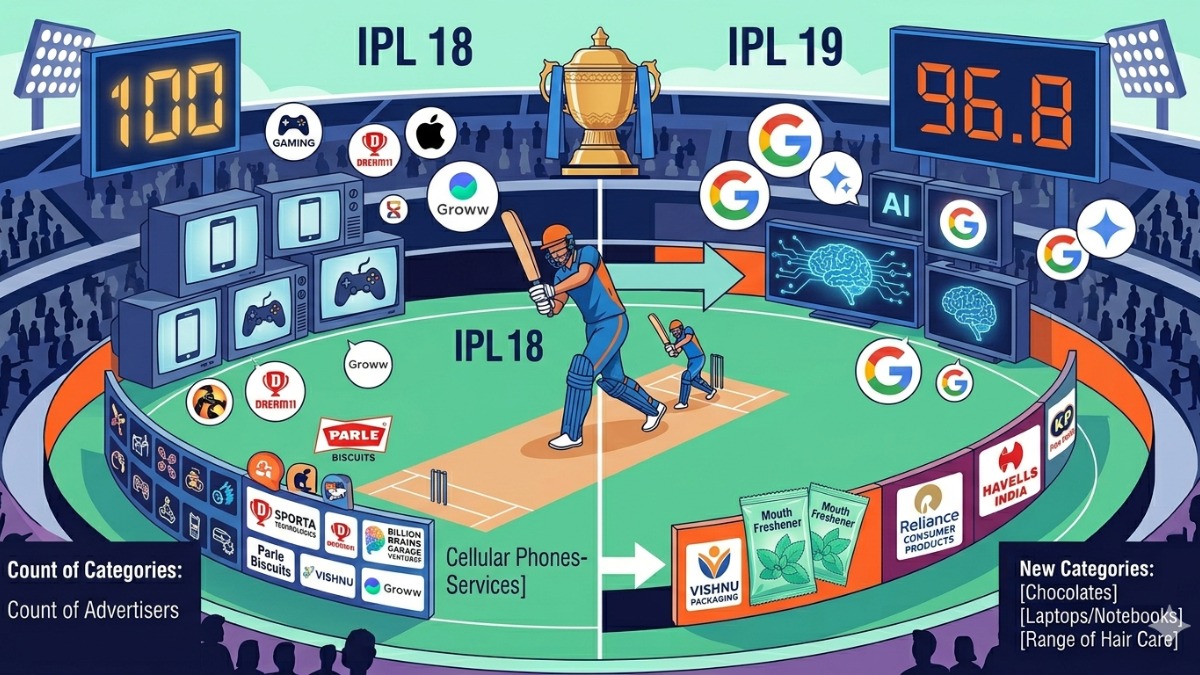
NEW DELHI: The on-field action remains strong, but advertising activity during the Indian Premier League has shown a slight shift this season. A report from TAM Sports, a division of TAM Media Research, indicates that the first 13 matches of IPL 19 have recorded a marginal decline in commercial volumes compared to the same phase last year.
Indexed ad volumes stood at 96.8, down from 100 in IPL 18. The number of advertising categories fell from over 50 to 40, while the advertiser base reduced from 65 to 45. At the same time, the number of channels broadcasting the tournament declined from 28 to 25.
Mouth Fresheners emerged as the leading category, contributing over 14 per cent of total ad volumes. Ecom-Other Services and Ecom-Wallets followed, maintaining a strong presence during the early part of the tournament.
The technology sector has gained prominence this season. Google ranked as the top advertiser, accounting for over 13 per cent of ad share. The company focused on promoting its Google Search Engine and Google Gemini AI platform. In contrast, categories such as Ecom-Gaming and Cellular Phones-Smart Phones did not feature among the leading segments this year.
TAM Sports analyst Arjun Sharma said the decline in volumes reflects a more focused approach by advertisers, with fewer but more prominent players dominating the space.
The report also identified new entrants, with ten additional categories including Chocolates, Laptops/Notebooks, and Hair Care products. Among companies, Vishnu Packaging and Reliance Consumer Products remained key advertisers, while Havells India and K P Pan Foods continued to feature prominently.
Among brands, Vimal Pan Masala and Kamla Pasand Silver Coated Elaichi recorded high visibility, while Cadburys Dairy Milk Chocolate was among the notable new entrants.
With the tournament still underway, advertising activity may increase in the coming weeks as more brands look to capitalise on IPL viewership.







