Specials
International Women’s Day 2026: India highlights women-led development
From rights to entrepreneurship, initiatives aim to strengthen women’s role in growth

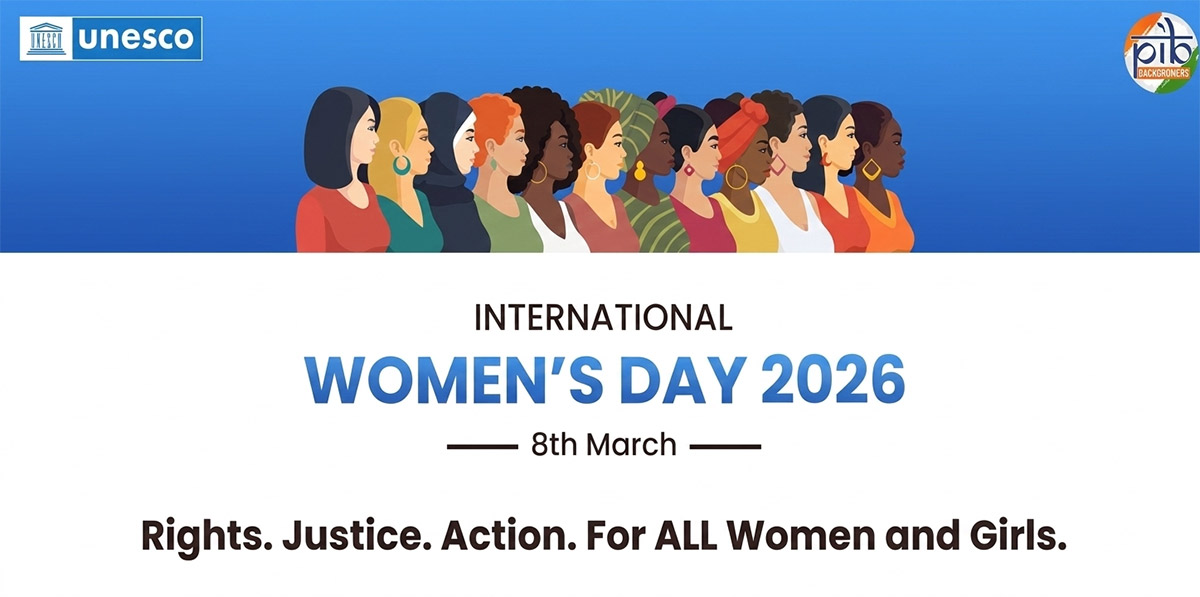
NEW DELHI: As the world marks International Women’s Day on 8 March, India is spotlighting the growing role of women in shaping the country’s development journey. This year’s global theme, “Rights. Justice. Action. For ALL Women and Girls,” calls for stronger protections, fair opportunities and faster progress toward gender equality.
The day traces its roots to labour movements in the early twentieth century. It is linked to a 1917 protest by Russian women demanding “bread and peace”, which took place on 23 February in the Julian calendar, corresponding to 8 March today. The United Nations formally recognised the day in 1977, and it is now observed worldwide to celebrate women’s achievements and push for further progress.
In 2026, global attention is also turning to the “Give to Gain” campaign, which encourages individuals, communities and institutions to support women through mentorship, resources and opportunities. The idea is simple: when women progress, societies grow stronger and more inclusive.

India’s approach to women’s empowerment has evolved over the decades. What once focused largely on development for women is now shifting toward women-led development, recognising women not just as beneficiaries of welfare programmes but as drivers of economic and social change.
The foundation for this transformation lies in India’s constitutional commitment to equality. The Constitution guarantees equal rights and opportunities, including universal adult franchise from the very beginning of the Republic. Articles 15 and 16 prohibit discrimination and ensure equal opportunities in employment, while Directive Principles promote equal livelihood and humane working conditions.
Over the years, a wide network of government initiatives has expanded opportunities for women across education, health, financial inclusion and safety.
Education has been a key pillar. Programmes such as Samagra Shiksha and Kasturba Gandhi Balika Vidyalayas support girls’ schooling, while initiatives like supernumerary seats in IITs and NITs encourage higher education. Female enrolment in higher education rose from 1.57 crore in 2014–15 to 2.18 crore in 2022–23, with women accounting for more than half of UGC NET-JRF scholars in STEM fields in 2024–25.
Financial security is also being strengthened through schemes such as the Sukanya Samriddhi Yojana, launched in 2015 under the Beti Bachao Beti Padhao campaign. By December 2025, more than 4.53 crore accounts had been opened, with deposits exceeding Rs 3.33 lakh crore.
Health and welfare programmes are another major focus. Under the Pradhan Mantri Matru Vandana Yojana, more than Rs 20,000 crore has been transferred to support pregnant women. Combined efforts under maternal care and nutrition programmes have contributed to a decline in India’s maternal mortality ratio from 130 in 2014–16 to 88 in 2021–23.
Access to basic services has also transformed everyday life for many women. More than 10 crore LPG connections have been provided through the Pradhan Mantri Ujjwala Yojana, while the Jal Jeevan Mission has increased rural tap water coverage to over 81 per cent of households. Meanwhile, the Swachh Bharat Mission has led to the construction of more than 12 crore toilets, improving sanitation and dignity.
Economic participation is also expanding. Self Help Groups under the Deendayal Antyodaya Yojana have mobilised more than 10 crore rural households, providing access to credit worth over Rs 12 lakh crore since 2013–14. Initiatives such as the Lakhpati Didi programme aim to help rural women build sustainable livelihoods.
Technology is opening new doors as well. Under the NaMo Drone Didi initiative, self help groups are being supported to operate agricultural drones, bringing rural women into emerging technology sectors.
Financial inclusion programmes are helping many women move from saving to entrepreneurship. Around 68 per cent of loans under the Pradhan Mantri Mudra Yojana have gone to women, while schemes like Stand-Up India and the Government e-Marketplace platform are expanding opportunities for women-led businesses.
Representation in governance has also seen steady growth. Nearly half of the elected representatives in Panchayati Raj institutions are women, creating one of the world’s largest networks of female grassroots leaders. The 106th Constitutional Amendment Act, also known as the Nari Shakti Vandan Adhiniyam, further strengthens this shift by providing one third reservation for women in the Lok Sabha and state legislative assemblies.
International Women’s Day celebrations in New Delhi this year include a Shakti Walk along Kartavya Path, bringing together women from diverse fields. A formal event at the Manekshaw Centre will honour women achievers from science, governance, entrepreneurship, arts and community leadership.
Beyond official events, the broader message of the day is clear. Women across India are increasingly shaping businesses, communities and institutions. From self help groups in villages to startups in cities, their journeys reflect a quiet but powerful transformation.
As the country moves toward its long term vision of Viksit Bharat by 2047, the growing presence of women in education, enterprise and governance suggests that the story of India’s progress will increasingly be written by its women.





Specials
Flipkart reveals what India bought for International Women’s Day
Flipkart data show a 5 per cent year-on-year surge in demand, with Gen Z driving a wellness boom and quick commerce growing fivefold

BENGALURU: India did not just send flowers this International Women’s Day. It sent smartphones, sarees and protein supplements. Data from Flipkart’s #FlipTrends report show overall platform demand surging 5 per cent year on year in the fortnight between February 23rd and March 8th, and the numbers reveal a nation that has turned a single calendar date into a multi-week retail moment.
Popular product choices clocked a 37 per cent year-on-year jump in orders and a 12 per cent rise in search queries. Women’s ethnic sets, sarees and mobiles were the top gifting picks, cutting across customer segments. The male-to-female shopper ratio stood at 2:1, with men buying gifts for mothers, sisters, partners, colleagues and friends, but that ratio is narrowing fast, as women shopped for themselves with notable purpose.
Gen Z shops with intent
Gen Z was the most engaged cohort, driving a 14 per cent year-on-year surge across fashion and lifestyle. The generation shopped not for indulgence but for need: searches linked to hair fall, skin pigmentation, stress, sleep and PCOS-friendly fitness rose sharply. Self-care and wellness categories, including protein supplements, vitamins, period care and grooming devices, led the charge, alongside beauty sub-categories such as face wash, face creams and sunscreens, which recorded the highest increase in demand.
Quick commerce comes into its own
Flipkart Minutes, the company’s quick-commerce arm, recorded over fivefold year-on-year growth between February 23rd and March 8th, a sign that last-minute gifting is no longer the domain of the corner florist. Curated International Women’s Day storefronts drew higher engagement than regular browsing, with shoppers discovering greeting cards, plant saplings, rings, handbags, bracelets and belts through themed collections.
Hyderabad topped the country for Women’s Day orders. Yet the more striking story was geographic spread: metros such as Ahmedabad, Chennai and Chandigarh were joined by a clutch of Tier 2 and 3 cities, including Jamshedpur, Dehradun, Coimbatore, Ranchi, Nashik, Agra, Durgapur and Bhubaneswar, signalling that aspirational, occasion-led shopping is no longer a metropolitan privilege.
If the data tell a broader story, it is this: the Indian woman is no longer waiting to be gifted wellness. She is buying it herself, in bulk, on her own terms. And she is doing it from Ranchi as readily as she is from Mumbai.






