Resources
CAS Rollout Could Provide Huge Push for DTH Operators as Well

In business as in life, timing is everything. And despite all the expected noises from the government (state elections are due in Kolkata after all) and the broadcasters (re-dusting the same arguments against CAS that they offered in 2003), one lot who might not be so peeved by the developments are the DTH operators.
IF, the CAS Dwitya rollout saga doesn’t get derailed again by the usual suspects, we have quite an interesting proposition that is on offer for the consumer. Tata Sky is quietly preparing its launch schedule and would more than likely advance its timelines if there is a definite direction from the powers that be that CAS is really going to take off.

In the meantime Dish TV, at present the only existing private sector DTH service provider, would be expected to sort out programming contracts with SET Discovery before that and any and all contentious issues with the Star Network at least by the time Tata Sky launches.
One could ask why is the CAS rollout timeline critical here? After all DTH retains the advantage of having a national footprint while CAS will be limited to the three metros in the first phase.
There is of course Chennai, which is already under the CAS regime but that should be kept out of this debate. Why? Because despite SET India CEO Kunal Dasgupta’s comment on “the CAS experience in Chennai not having been a happy one” the fact remains that the biggest reason that set top uptake did not happen was because the channel that is most critical in the Tamil viewer’s scheme of things – Sun TV (and others of its ilk) – is available in the FTA package so there was and still is no compelling enough reason to invest in one.
Coming back to the main discussion, crucial to our premise is the staggered rollout of the addressable system of transmission of pay channels that had been notified in 2003.
As per the notification, each of the three metro cities (Delhi, Mumbai, and Kolkata) would be divided into four zones. Within a one-month time frame, in Zone A in each metro, pay channels can be watched only with the use of STBs. From the second month onwards, CAS will take effect in Zone B in each metro. And so it follows in Zone C from the third month onwards and Zone D from the fourth month onwards.
For the government, there are two choices — implement the court order or appeal. For the purposes of this argument we are going with the implement premise.
The court instituted deadline for CAS rollout is 10 April. Therefore, the government after due consideration would be expected issue its fresh updated notification on 10 April that within a month all pay channels in Zone A would have to be delivered through a set top i.e deadline for Zone A to be “set top compliant” 10 May. Taking that timeline forward, Zone B’s deadline would be 10 may, Zone C 10 June and Zone D 10 July.
IF Tata Sky can launch by 10 April then it, along with Dish TV will be able to go to the consumer with their individual offerings as possible alternatives to cable delivered addressability. What is critical here is that the consumer is COMPELLED to take a set top box if he wants to get his daily fix of Star Plus or HBO (whatever the case may be). Since the set top is a given the only issue is which service he / she selects.
It will all then come down to which of the three alternatives is the best as per consumer understanding. Who offers the best deal, who is perceived as being capable of delivering the best in terms of technological quality and viewer experience at the most competitive cost?
We believe that of critical importance here will also be the perceptions and prejudices that are attached to the service providers. These issues could well guide choices if all other parameters remain basically the same.
What we could see is more “sophisticated” Zone A consumers opting for the DTH option while the skew could well be towards the more familiar “cablewallahs” in Zone D for example. Whichever way the skew swings, STBs will move. That ultimately is what all the players in the digital delivery game want.
A moot point though is this. IF the CAS rollout does go forward as per the Delhi High Court ordered schedule and IF there is a huge uptake of set top boxes (digital cable or DTH), one big loser could potentially be Anil Ambani’s Reliance, which is neither ready with its IPTV nor its DTH offering. Once there are a large number of boxes out in the market, to get consumers to make the switch to something else would take twice the effort.







Resources
Sameer Nair wants Indian storytelling to stop playing it safe
The Applause Entertainment boss says the industry must tell stories it “isn’t supposed to tell” to break out of its domestic bubble
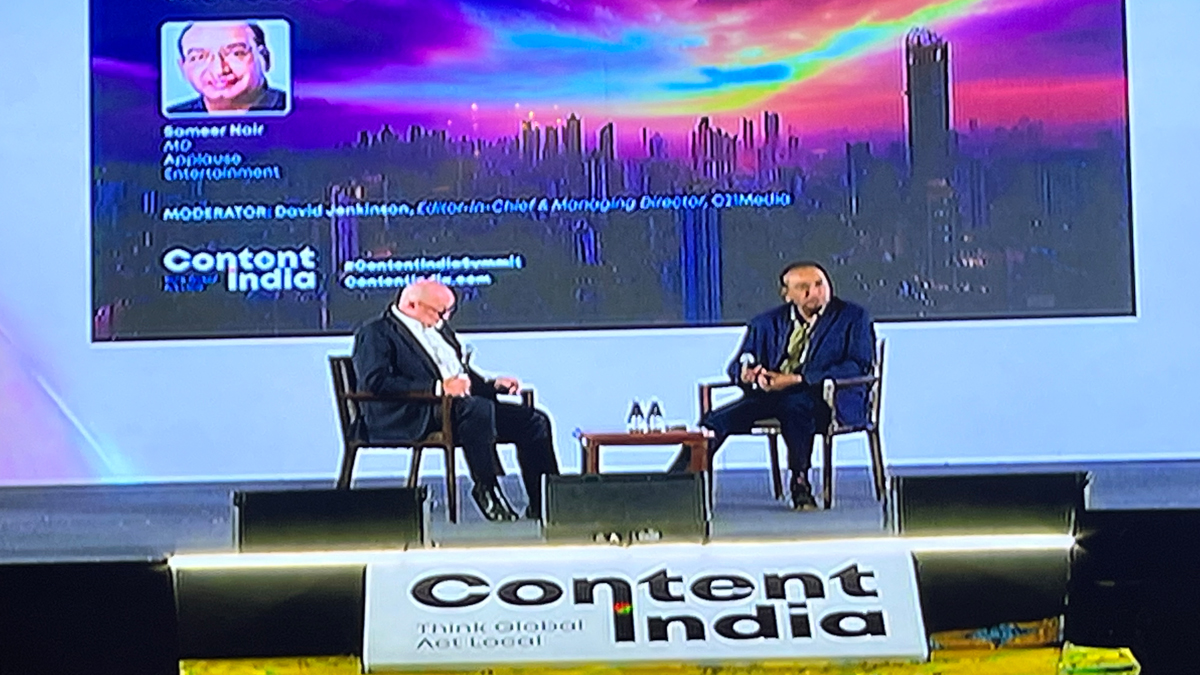
MUMBAI: Indian content has a domestic comfort problem. That, in essence, was the diagnosis Sameer Nair, managing director of Applause Entertainment, offered at Content India 2026, a fireside conversation at Taj Lands End in Mumbai that touched on micro-dramas, AI animation, data-driven formulae and the stubbornly local character of Indian streaming.
Nair was characteristically candid. India’s content industry, he argued, has historically been too busy feeding a vast domestic market to bother going global. “The crossover that happens is really to the Indian diaspora rather than to the non-Indian area,” he said. Streaming changes that equation, he added, but only if Indian creators are willing to compete on production quality with the shows sitting two slots away on a global platform.
At Applause, the pivot is already under way. The company, best known for premium scripted drama, is now moving into films. “Movies give you theatrical, a sense of electric revenue, you can expand the business a lot more,” Nair said. Animation is also on the agenda, though the approach has shifted sharply. “We spent some time trying to develop traditional animation. But now we are doing it using AI. That’s been a key pivot.”
Micro-drama is next on the list. Nair admitted to being something of a convert, confessing he had lost 20 to 30 minutes to a show about a CEO fighting off a boardroom coup before he knew what had happened. The format, which has exploded out of China and is now sweeping the US and UK, appeals to him precisely because it demolishes the myth of the shrinking attention span. Audiences, he argued, will watch a game of cricket for three hours or sit through a glacial episode of Landman without complaint, as long as the content holds them.
On data, Nair was sceptical of the industry’s growing addiction to algorithms. Data spots patterns, he acknowledged, but audiences spot patterns too. “Whatever data sees as a trend, audiences are also catching up with it.” The result, he warned, is a drift towards formula, and formula, however reliable, eventually bores people. His counterexample was Adolescence, the stripped-back Netflix drama that topped the platform’s India charts. “It went small but it went really deep. You don’t have to have a massive canvas to paint a picture.”
The commercial reality behind all of this was not lost on him. With most streamers outside Netflix still loss-making, the industry is caught between the prestige model that built streaming and the harder-working, lower-cost programming that platforms increasingly want. “Content creation can’t be a charitable exercise,” he said. “There must be profit because then that sort of goes back home.”
On the bigger question of geopolitics and what audiences want from their screens in unsettled times, Nair offered a characteristically sly answer. The job, he said, is to tell stories that “you’re not supposed to tell, but tell them anyway.”
For an industry that has spent decades telling people what they want to hear, that may be the most radical proposal of all.