Resources
All for control, says Star’s Mukerjea of Trai recommendations

NEW DELHI: Broadcast and cable regulator, the Telecom Regulatory Authority of India (Trai), may have come out with its recommendations, but Star India, for one, feels that there seems to be an attempt by the government to regain control, rather than go in for further de-control.
“Regulation has to be counter-balanced with policies so as to suggest a way forward, unlike control, which is trying to dictate terms,” says Star India CEO Peter Mukerjea.
Speaking to indiantelevision.com at length on various industry-related issues, including the Trai recommendations, Mukerjea says that the freedom to launch new channels is getting slightly restricted (in India), unlike in the recent past.
“The government feels that it is an opportunity to regain control, rather than divest control,” he says.
Dwelling on the price freeze on cable TV subscription, the Star India head honcho says that it’s not only “anti-competitive, but also anti-constitutional.”

Putiing forth the broadcasting industry’s point of view, Mukerjea says that considering that the prices have been frozen for over eight months now, it does not mean that other developments have come to a stand-still as the business has to go on.
Taking a swipe at the regulator’s stance, which is more in line with the government thinking, Mukerjea asked whether the newspaper industry would have agreed if a regulator had told them that a Times of India or a Hindustan Times or an Indian Express would not be able to “review their prices” till the regulator came out with a mechanism to decide how such things should be done.
“Does the price freeze mean that the cost of production has come to a standstill? Do we tell our producers (of programmes) that they would be paid later as the industry has been told by the regulator to freeze prices without any definite commitment? Do we stop production altogether,” Mukerjea asks, adding, “It’s almost like controlling the way a business venture is conducted and trying to suggest that the standards of programming should be standardised like (pubcaster) Doordarshan.”
Even while Mukerjea appreciates Trai’s efforts to bring about some semblance of orderliness in the industry, which has been unable to sort out intra-industry problems and issues, he feels that the industry, including Star India, is “still recovering from the after shocks” of the price freeze.
When pointed out that every sovereign government in the world reserves the right to set forth some guidelines for doing business in a country — Star’s parent company News Corp does business in a more controlled environment in China and is still investing there — Mukerjea countered that such steps should have some “definitive direction and a time frame.”
Offering an explanation, the veteran Star/News Corp executive says that Star India, like many others, would be comfortable if the regulator or the government, for example, tells that 18 months down the line there would be a price freeze for a year when various issues would be addressed.
“This would give the industry time to re-draw strategies and business plans and anticipate the unknown too,” Mukerjea says, which is unlike the present scenario where the path forward is full of unknowns even as “everything has been brought to a grinding halt.”
According to Mukerjea, Trai’s efforts to equate the yearly hike in subscription price to the annual inflation are also like “dictating terms” as to how a business ought to be conducted.
“Cable TV service does not fall under essential services, nor is it a product or a service like petroleum where the government or a regulator should feel the need to control prices. Has the automobile industry been told that the price tag of cars could not go beyond a certain limit? If no, then why is the cable and broadcast industry being singled out?” Mukerjea quips.
The Star India CEO also described as “absurd” Trai’s recommendations that a new channel’s price should be equivalent to a prevalent channel of the same genre as existing on a certain cut-off date.
Pointing out that there may be some similarity in products of the same genre, Mukerjea, however, made it clear that every single product or a channel would have its own uniqueness.
“It’s like saying that all the tyres that are available in the market are the same and, hence, should be priced at the same price. So what would be a difference between Bridgestone and MRF Tyres? Of course they have their own little USPs despite falling under a category,” Mukerjea further hammered home his point, adding that by that standards, every Yash Chopra (a Bollywood film-maker specialising in romantic movies) film should be the same, which is not the case.
Star, which is planning to launch a slew of channels as part of its bouquet, may find it hard to price new products if the Trai recommendation on pricing of new channels is accepted by the government.
Asked if Star is worried over the must-provide (making available all TV channels to all platforms on a non-discriminatory basis) clause being flaunted by Trai to give equal choice to consumers, Mukerjea said, “We are
not an exception. A large section of the broadcasting industry is worried. If such a scenario comes about, there would be no difference between a basic service and a premium one (like DTH, for example).”
Further quizzed whether such a system prevailed elsewhere in the world, as Trai has been saying while defending its suggestions, Mukerjea says the onus of doing such a thing is not on the broadcaster, but a platform manager.
According to Mukerjea, in the UK, for instance, a platform owner is mandated to give a channel it owns to other cable networks and platforms at 75 per cent of the retail cost of the product, which ensures the other player too can play around a bit with pricing before passing it down to the consumer.
How does it work? Space Sports (a hypothetical channel from a yet to-be-launched service by the Tata-Star joint venture) could be made available to Dish TV too at 75 per cent of the retail price of Space Sports. But, Mukerjea clarifies, Space TV, the entity that would manage the DTH operation, cannot force another bouquet channel or a broadcaster to follow suit as it does not own the channel.
“Trai seems to have got its wires crossed (on the must-provide clause),” Mukerjea said with his tongue firmly in cheek, even while admitting that a certain section of the broadcasting industry (read Zee Telefilms) would lap up such a clause if enforced.
The flip side of all this is that though under constraint on various fronts, including a continued price freeze, Star India is unlikely to increase commercial airtime per hour from the present level to partially neutralise losses.
“Taking in more ads is an option, but we would not do it,” Mukerjea said, making it clear that Star’s USP is top quality production and a better viewing experience for the viewers, which would not be compromised by increasing commercial airtime from the present industry standard of 10 minutes per hour.
Where does that leave consumer choice and benefits? The less you regulate, more the consumers are likely to gain, Mukerjea feels.
“Take the Maruti Esteem, for example. Till a few years back it used to cost more than Rs 600,000. But today, because of competition from new entrants and a wider choice available to consumers, the same car has slashed its price tag to about Rs 450,000. The same would happen in the cable and broadcast industry too,” he adds.
Is the regulator listening?





Education
Govt to set up creator labs in 15,000 schools to boost AVGC sector
Budget boost and WAVES initiatives aim to scale India’s creator economy
NEW DELHI: The government is doubling down on India’s so-called orange economy, rolling out an ambitious plan to expand content creation infrastructure and skill development across the country.
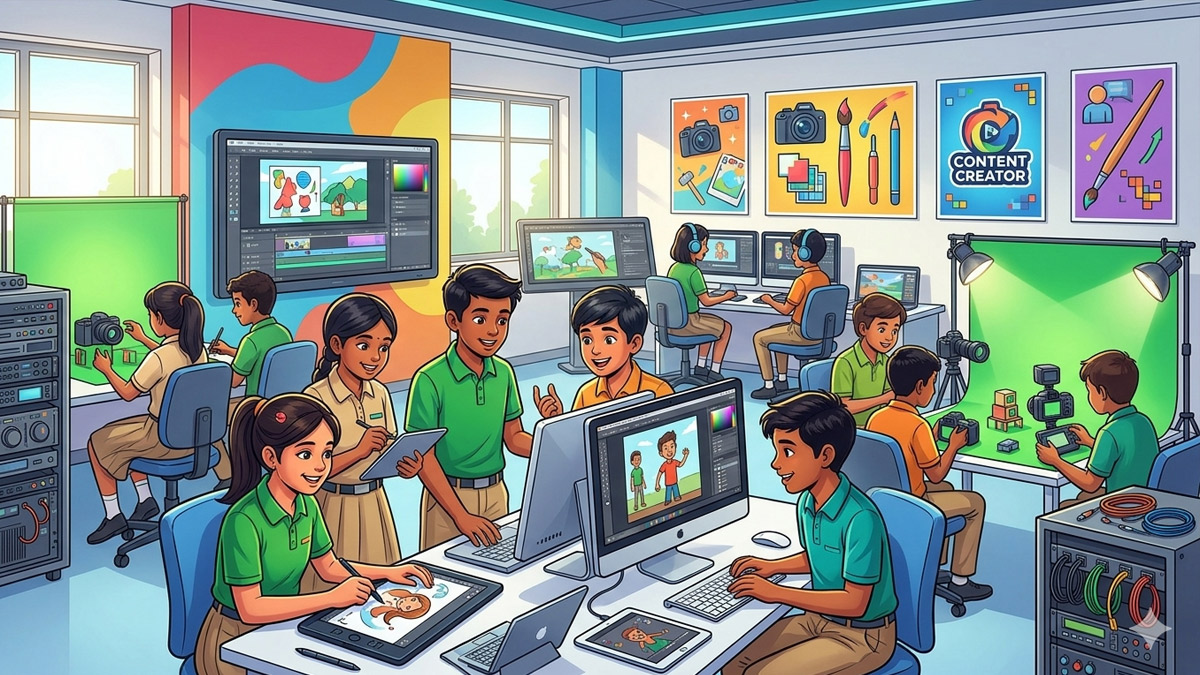
At the heart of the push is a proposal to set up AVGC Content Creator Labs in 15,000 secondary schools and 500 colleges, backed by an allocation of Rs 250 crore in the Union Budget 2026-27. The move is aimed at nurturing talent early and building a pipeline for the fast-growing animation, visual effects, gaming and comics sector.
The Indian Institute of Creative Technologies has been designated as the nodal agency to steer this rollout. Operating from the campus of National Film Development Corporation in Mumbai, the institute has already launched 18 courses, with over 130 students enrolled and a trainer network beginning to take shape.
The broader ecosystem push is rooted in recommendations by the AVGC Promotion Task Force, which estimates that the sector could require around two million skilled professionals by 2030. The government is now working to align training, infrastructure and policy to meet that demand.
Flagship platforms such as WAVES 2025 are playing a central role in this strategy. The summit brought together creators, investors and global industry leaders, while initiatives like the WaveX Startup Accelerator Programme are helping startups scale through mentorship, funding access and international exposure.
The Create in India Challenge has also emerged as a key talent pipeline. Its first edition saw 33 challenges and participation from over one lakh creators, including many from smaller cities, signalling a democratisation of content creation across India.
Sharing details in Parliament, Ministry of Information and Broadcasting minister of state L Murugan outlined the government’s multi-pronged approach in response to queries raised by Kriti Devi Debbarman and Eatala Rajender.
With policy, funding and platforms now aligning, India’s creator economy is getting a structured push. The message is clear. From classrooms to global screens, the next wave of storytellers is being built at scale.






