Regulators
TRAI outlines 6G, AI and inclusion roadmap for broadcast sector
Ashok Kumar Jha calls for tech leap, rural reach and FAST rules.

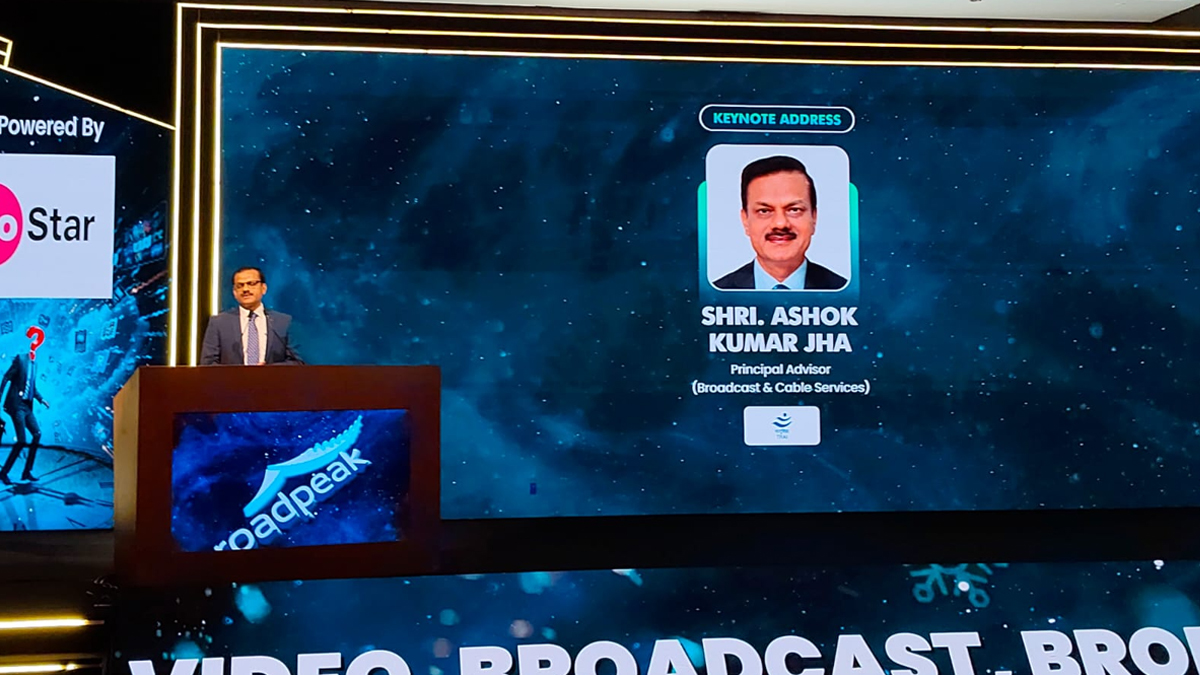
MUMBAI: The future of television, it seems, may not come with a remote at all. At the 22nd Video Broadcast and Broadband Tech Summit hosted by IndianTelevision Dot Com, Ashok Kumar Jha, Principal Advisor, Broadcast and Cable Services at the Telecom Regulatory Authority of India (TRAI), painted an expansive vision of what the next five years could hold for India’s media and entertainment ecosystem from gesture-controlled TV and AI agents to rural inclusion and regulatory reform.
Opening his keynote, Jha acknowledged IndianTelevision Dot Com founder Anil Wanvari and reflected on the platform’s journey from a news magazine 18 years ago to a digital presence that began 26 years ago. The focus then shifted to the summit’s theme: managing the great acceleration in technology and what that acceleration means for a diverse country like India.
For Jha, technological acceleration is not a uniform wave lifting all boats. It is layered and unequal. Out of roughly 33 crore households in India, around 23 crore have television access. On the telecom side, nearly 130 crore Indians own phones, but only about 100 crore have broadband connections. That leaves 30 crore people on feature phones without data access.

“How do we reach them?” was the question he returned to repeatedly.
He divided the challenge into two Indias those who have access and those who do not. For the connected viewer, the issue is no longer availability but experience. India’s combined pay TV base, including cable and DTH, stands at around 9.5 crore homes, with DTH alone accounting for roughly 6.4 crore. Yet consumer expectations have evolved far beyond channel surfing.
Today’s viewer, Jha argued, expects seamless switching between linear TV and OTT platforms, intuitive discovery and frictionless control. The traditional remote, he suggested, may soon give way to gesture and voice. With 6G technologies expected to take shape around 2030, integrated sensing and communication systems could allow networks themselves to act as sensors. A simple hand movement could change channels; a spoken command could summon archived content within milliseconds.
Artificial intelligence will sit at the heart of this shift. Jha envisaged AI agents that can access vast broadcaster repositories and data centres instantly, fetching specific episodes from specific years on command. Monetisation models will adapt, but the speed and responsiveness will redefine user experience.
Behind the screen, infrastructure will have to scale dramatically. India’s data centre capacity, currently estimated between 1.5 and 1.9 gigawatts, could rise to around 10 gigawatts by 2030. Technologies such as hollow core fibre which uses air instead of glass to transmit light, thereby reducing latency are being developed to support ultra-fast networks. Lower heat generation and higher efficiency will be critical as capacity expands.
Yet Jha was equally clear that innovation must not bypass the unconnected. In areas lacking electricity or broadband, low-cost set-top boxes and solar-powered solutions could bridge gaps. He referenced studies, including one by IIM Andhra Pradesh, suggesting that television penetration could grow alongside rural GDP growth and demographic shifts. As dependency ratios rise with larger proportions of young and elderly populations in-home media consumption is expected to increase.
Government incentives, including production-linked schemes, are already aimed at boosting domestic manufacturing and TV penetration. But Jha also pointed to emerging broadcast technologies such as ATSC 3.0 operating in the 470 to 582 MHz band, which could enable television delivery directly to mobile devices through software-defined radios and compatible chips. Such hybrid models would not only expand access but also strengthen communication resilience during disasters, when multiple layers GSM, radio and television become vital.
On the distribution front, Jha highlighted the flexibility of satellite, terrestrial and low Earth orbit systems, arguing that broader technology choices could reduce bandwidth constraints and expand high-definition offerings. Regulatory reforms are also under consideration. TRAI has recommended granting infrastructure status to broadcasters and cable operators to ease financing and operational bottlenecks. It has proposed faster clearances within 15 days to one month for local cable operators, enabling smoother service rollout.
Significantly, Jha urged local cable operators to consider becoming internet service providers. With fibre-to-the-home targets falling short of earlier ambitions to cover 50 per cent of households by 2022, cable networks present an existing last-mile opportunity. Bundled broadband and TV offerings, he suggested, could reverse stagnation in linear television revenues.
The financial landscape underscores the urgency. Digital media revenue is projected at around Rs 900 billion in 2025, growing at a CAGR of about 11 per ceent and having surpassed television revenue in 2024. Television revenue stands at approximately Rs 676 billion, reflecting a marginal dip of about minus 0.6 per cent. Online print media is steady at around Rs 262 billion, while online gaming, also near Rs 262 billion, faces disruption following the 2025 ban on real-money games.
In response, Jha called for collective action among network service operators and local cable operators to enhance consumer satisfaction rather than compete destructively. He proposed the creation of a formal Consumer Satisfaction Index for the sector, where operators would be rated on parameters such as picture quality, website usability, seamless OTT integration and service responsiveness. Transparency, he argued, would build trust and drive improvement.
He also turned to FAST free ad-supported streaming television noting its rapid growth and confirming that the Ministry of Information and Broadcasting has sought TRAI’s recommendations. A pre-consultation paper is expected shortly, and Jha urged industry stakeholders to participate actively in shaping guidelines that balance innovation with consumer protection.
Throughout the address, one theme resonated: collaboration. Technology, policy, entrepreneurship and industry coordination must move in tandem. The ultimate test, Jha suggested, is simple yet profound, when a child in a remote village opens their eyes, or when an elderly viewer seeks companionship in a screen, does the system deliver a smile?
The great acceleration is already underway. Whether it becomes a widening gap or a shared leap forward will depend on how decisively the industry acts now.






I&B Ministry
AIDCF moves TDSAT over Waves plan to stream linear TV channels
Industry body flags regulatory gap as OTT push sparks broadcast turf war
NEW DELHI: The battle between traditional television distributors and digital platforms has found its way to the courts, with the All India Digital Cable Federation (AIDCF) moving the Telecom Disputes Settlement and Appellate Tribunal (TDSAT) against Prasar Bharati’s latest OTT play.
At the heart of the dispute is Waves, Prasar Bharati’s OTT platform, which has invited applications to onboard linear satellite TV channels. Aidcf, which represents multi-system operators (msos), argues that this move sidesteps existing broadcasting rules and risks tilting the playing field in favour of digital platforms.
The federation’s petition hinges on a key provision in the Uplinking and Downlinking Guidelines, 2022. Clause 11(3)(f) allows broadcasters to downlink channels only if they provide signal decoders to recognised distribution platforms such as MSOS, DTH operators, hits operators and iptv platforms. OTT platforms, aidcf points out, do not feature on that list.
In simple terms, AIDCF’s argument is this: if OTT platforms are not officially recognised distributors, they should not be receiving broadcast signals in the first place. By inviting channels onto Waves, the federation claims, Prasar Bharati is opening a backdoor that lets broadcasters bypass long-standing rules.
The concern goes beyond legal interpretation. Aidcf says OTT platforms currently operate without a clear regulatory framework, allowing them to expand into traditional broadcasting territory without the compliance burden that cable and satellite operators must carry. That, it argues, creates an uneven contest.
There is also a warning for broadcasters. If they provide signal decoders to an OTT platform like Waves, they could risk breaching the very conditions under which their downlinking permissions were granted.
For its part, Prasar Bharati’s Waves initiative is positioned as a step towards wider access and digital reach, bringing linear television into the streaming era. But critics say the move blurs the line between regulated broadcasting and largely unregulated streaming.
The matter is expected to come up before tdsat next week. The outcome could do more than settle a single dispute. It may help define how India regulates the fast-merging worlds of television and OTT, where the lines are getting fuzzier by the day and the stakes, sharper than ever.