News Broadcasting
Verizon Identifies Key Enterprise-Technology Trends for 2014

MUMBAI: Enterprise users will gain unprecedented control over their technology environment in 2014, according to Verizon Enterprise Solutions’ list of top enterprise technology trends for 2014. The new year will see a sharp focus on how enterprises and governments use technology to enhance the customer’s experience and enable innovation.
“We are experiencing the democratization of enterprise technology,” said David Small, Verizon Enterprise Solutions’ chief platform officer. “Mirroring what has happened in the consumer technology space, enterprise technology users look for services to be delivered on demand, to a time and place of their choosing, and in the way that they want. In 2014, enterprise success will be measured by how well organizations are able to use technology to meet user expectations and harness individual innovation.”
Here are the key trends Verizon believes will drive change for enterprises and government in 2014:
1. The Customer of One Comes of Age

The ability to tailor a customer’s experience to best meet personalized, individual needs will increasingly be a brand differentiator. In 2014, enterprises will refocus on customer touch points, recognizing that integrated omnichannel connections – across online, mobile, broadcast and in-store –can make customers feel valued at every step of the purchase and experience lifecycle. These integrated systems will be the key to opening up new routes to markets by enabling businesses to engage directly with the individual on demand, and build trusted connections to simplify transactions. Insight provided by big data analytics will create new, individualized marketing opportunities that will transform and focus the customer engagement model.
2. M2M ‘as a Service’ Simplifies Path to the Connected World
Ubiquitous4G LTE wireless service and the availability of machine-to-machine (M2M) solutions “as a service” – on demand, over the Internet and ready to use –coupled with strong security will overcome the issues that have previously prevented many organizations from fully embracing M2M. By leveraging third-party expertise, organizations will be able to quickly transform the conversations of intelligent endpoints into unprecedented insights – and unprecedented business opportunities. As M2M adoption accelerates, manufacturers, dealers and business partners will be able to realize the full potential of new revenue streams and increased operational efficiencies, while better meeting the needs of their customers.
3. The Shortage of Security Expertise Forces Changes to Cyber security Management
Continued targeted attacks and high-profile security breaches impel corporate boards of directors to demand substantial increases in security investments in 2014 – and rethinking of traditional approaches to cyber security management. As enterprises increasingly adopt mobility, big data, cloud and broadcast solutions, the complexity of effective cyber security programs far exceeds both the availability of human capital around the world and the capability of any one enterprise to execute alone. Enterprises will develop and execute hybrid cyber security-management models that combine an agile staff of in-house security-minded business experts with trusted managed security services across a broad range of capabilities such as identity management, security analytics and cyber intelligence, and governance, risk and compliance.
4. IT Decentralizes
Organizations embracing the new information technology world of cloud, mobility and M2M will see IT increasingly decentralized. IT will be core to every business function. As a result, IT will work more closely with individual business units and focus on developing tools for seamless process enablement that empowers employees and customers. The C-suite (e.g. CFO, CMO, COO), lines of business and staff functions will increasingly take the lead role in engaging and deploying in the cloud, because of the immediate deployment speed, flexibility, control and cost value they see in cloud, as well as advantages in big data analysis. IT will be integrated into financial performance planning, and the lines between the IT department and finance will continue to blur as technology becomes the valued enabler, rather than the end game.
5. Providers Add Gravity to the Cloud
In a world where mobile is the norm, and rich media content is a given, the cloud will come into its own as the only location where growing data volumes can be stored, accessed and analyzed on demand. In 2014, adding software and services to the cloud will be a key focus for cloud providers seeking to attract customers –adding gravity and encouraging user stickiness.
Integrated cloud offerings will increasingly enable mashups of fixed and mobile networks; systems, ideas and solutions; people and things; and intelligence and information. Providing systems and tools to transform these data into insights in the cloud and on demand will transform the customer experience.
Small concluded: “Verizon Enterprise Solutions brings together an unparalleled set of assets with the objective of driving open a connected world of opportunity for our clients. Whatever their industry or sector, in 2014 our clients will look to invest and innovate so they can more rapidly and securely deliver their products and services where, when, and how their users want them. Our focus is on offering powerful answers to business challenges by harnessing the power of our advanced technology platforms to deliver industry-specific solutions that unlock productivity and value for our clients, their customers and society.”






News Broadcasting
Network18 channels lead YouTube news viewership in March 2026
CNN-News18, News18 India and CNBC channels top categories with record views
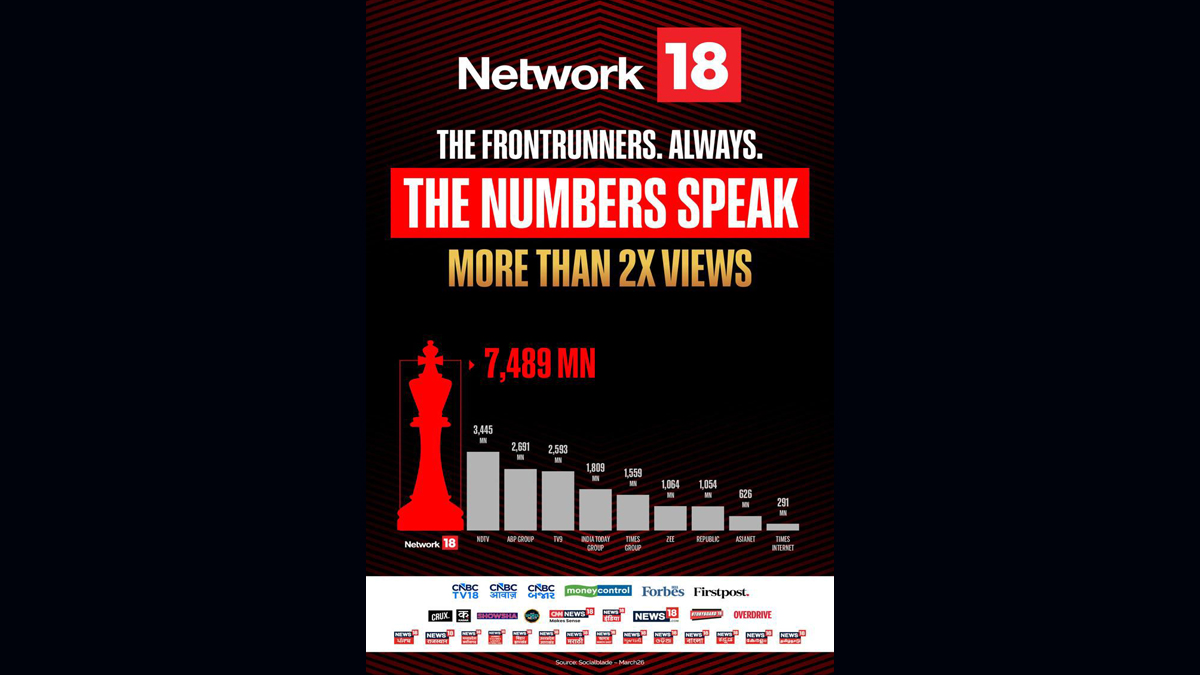
MUMBAI: When the world hit refresh on breaking news, Network18’s channels were already streaming ahead. As geopolitical tensions and war-driven headlines fuelled a surge in global news consumption, the network’s digital playbook delivered big clocking record Youtube viewership across English, Hindi and business news categories in March 2026.
At the forefront was CNN-News18, which emerged as the clear leader in the English news segment with 130 million live and video-on-demand views. The channel edged past competitors such as Times of India (126.5 million), Times Now (101.1 million), India Today (88.2 million) and NDTV (77.5 million), according to Databeings data for March.
In the Hindi news arena, News18 India delivered a commanding performance, racking up a staggering 3,297 million views on YouTube. The channel comfortably outpaced NDTV India, which recorded 3,119 million views, underlining its deep reach and consistent engagement with mass audiences, as per Playboard data.
The network’s dominance wasn’t confined to general news. In the Hindi business segment, CNBC Awaaz topped the charts with 92 million views, narrowly ahead of Zee Business (90 million) and well ahead of ET Now Swadesh (57 million). Meanwhile, its English counterpart CNBC-TV18 posted a strong 58 million views, reinforcing the network’s cross-category strength.
The spike in viewership reflects a broader shift in audience behaviour, with viewers increasingly turning to digital platforms particularly Youtube for real-time updates and in-depth coverage during high-intensity news cycles. For Network18, the numbers signal more than just scale; they underline the effectiveness of a multi-platform strategy that blends speed, credibility and continuous coverage.
In a month where the news never paused, it seems viewers chose to stay tuned where the stream never stopped.






