News Broadcasting
Verizon Expands and Enhances Next-Generation Identity Platform to Enable Safer, More Trustworthy Internet


Verizon Enterprise Solutions is expanding availability of its next-generation, cloud-based identity platform – Verizon Universal Identity Services – to Europe, effective immediately. The platform, previously available only in the U.S., also boasts new user-friendly features, including an updated mobile app, Quick Response code-enabled access, and a simplified end-user interface, making identities easy to manage and use.
Verizon Universal Identity Servicesuses multifactor authentication to verify users are who they say they are by combining an individual’s username-password with a computing device that generates a one-time password or a biometric scan, such as fingerprint recognition. Once authenticated, users can securely access online content such as websites, corporate resources and even electronic medical records from their computer, smartphone or tablet. Verizon’s cloud-based identity services are an alternative to traditional solutions and provide an easier, faster, more flexibleand secure way for organizations to implement two-factor authentication.
According to the “Verizon 2013 Data Breach Investigations Report,”weak or stolen passwords and credentials account for 76 percent of data breaches, underscoring the need for stronger online identities.

“The bad guys are becoming increasingly more sophisticated as they continue to probe business and government networks to gain access and steal information,” said David Small, chief platform officer for Verizon Enterprise Solutions. “Verizon Universal Identity Services is transforming the business of validating online identities to provide a safer, more trustworthy Internet. Our platform will help achieve the vision of a single, trusted universal identity that individuals can use for all online activities, whether at home, at work or on the go.”
The Verizon identity platform is available on the iOS Android, Windows and BlackBerry operating systems and can be used to validate the identities of employees, partners and customers. The platform also features legally binding digital signature capabilities, such as those required for electronic prescriptions, online tax filing and license renewals.
In addition, anew,simplified end-user interfaceoffers administratorsan enhanced dashboard with expanded security and operations reportingthat help organizations address and demonstrate security compliance.
“Verizon has invested in expanding the availability and enhancing the features of its next-generation, cloud-based identity platform,” said Amy DeCarlo, principal analyst for security and data center services, Current Analysis. “By focusing on the end-user experience to create an identity platform that is easy to deploy, manage and use, Verizon Universal Identity Services stands out from other identity solutions available on the market today.”
Launched in the U.S. in 2010, Verizon Universal Identity Servicesis delivered from Verizon data centers to meet enterprise security, availability and reliability requirements.
Said Small:“Verizon is investing today to meet the online identity requirements of tomorrow. By continuing our close collaboration with government and industry stakeholders around the globe, we are working to create a global identity ecosystem that will improve the privacy, security and convenience of sensitive online transactions.”







News Broadcasting
Network18 channels lead YouTube news viewership in March 2026
CNN-News18, News18 India and CNBC channels top categories with record views
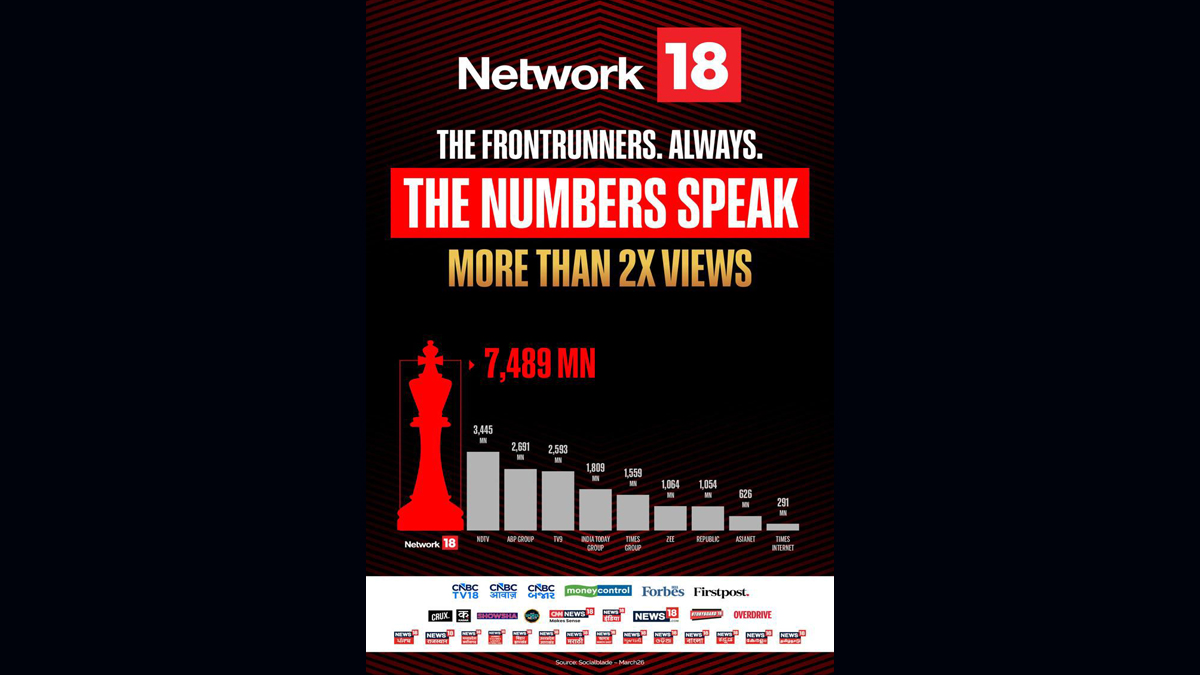
MUMBAI: When the world hit refresh on breaking news, Network18’s channels were already streaming ahead. As geopolitical tensions and war-driven headlines fuelled a surge in global news consumption, the network’s digital playbook delivered big clocking record Youtube viewership across English, Hindi and business news categories in March 2026.
At the forefront was CNN-News18, which emerged as the clear leader in the English news segment with 130 million live and video-on-demand views. The channel edged past competitors such as Times of India (126.5 million), Times Now (101.1 million), India Today (88.2 million) and NDTV (77.5 million), according to Databeings data for March.
In the Hindi news arena, News18 India delivered a commanding performance, racking up a staggering 3,297 million views on YouTube. The channel comfortably outpaced NDTV India, which recorded 3,119 million views, underlining its deep reach and consistent engagement with mass audiences, as per Playboard data.
The network’s dominance wasn’t confined to general news. In the Hindi business segment, CNBC Awaaz topped the charts with 92 million views, narrowly ahead of Zee Business (90 million) and well ahead of ET Now Swadesh (57 million). Meanwhile, its English counterpart CNBC-TV18 posted a strong 58 million views, reinforcing the network’s cross-category strength.
The spike in viewership reflects a broader shift in audience behaviour, with viewers increasingly turning to digital platforms particularly Youtube for real-time updates and in-depth coverage during high-intensity news cycles. For Network18, the numbers signal more than just scale; they underline the effectiveness of a multi-platform strategy that blends speed, credibility and continuous coverage.
In a month where the news never paused, it seems viewers chose to stay tuned where the stream never stopped.






