News Broadcasting
The Election Tracker & Agar Abhi Chunav Ho Toh


MUMBAI: As a prelude to the upcoming General Elections, CNN-IBN & IBN7 in partnership with THE WEEK are again back with the last round of The Election Tracker.’
CNN-IBN & IBN7 began this massive effort with its first round of The Election Tracker in July 2013, which was a one-of-its-kind study that tested the mood of the nation on key governance issues and attempted to track the fortunes of key political leaders; eventually endeavoring to answer the BIGGEST QUESTION – Who will rule India for the next five years?
The upcoming round of The Election Tracker on CNN-IBN and Agar Abhi Chunav Hon Toh on IBN7 scheduled from 31st March to 4th April, 2014 will see participation of approximately 18,050 respondents to be surveyed across 22 states with focus on social and political issues of national importance. Based on a rigorous methodology, this study, conducted by the ‘Centre for the Study of Developing Societies’ (CSDS) will project likely voting patterns and outcome.

The states to be covered will be: Andhra Pradesh, Assam, Bihar, Goa, Gujarat, Haryana, Himachal Pradesh, Jammu & Kashmir, Karnataka, Kerala, Madhya Pradesh, Maharashtra, Odisha, Punjab, Rajasthan, Tamil Nadu, Uttar Pradesh, West Bengal, Delhi, Jharkhand, Chhattisgarh and Uttarakhand.
Rajdeep Sardesai, Editor-in-Chief, IBN Network, said, “As we approach one of the most complex and debatably the most fascinating and exciting elections so far, we believe that our viewers need to be well armed with extensive and accurate information related to our present political and social scenario. This is crucial in order to enable them to make informed decisions while voting which will help take our country forward in the right direction. Through ‘The Election Tracker’ and ‘Agar Abhi Chunav Ho Toh’ on CNN-IBN and IBN7 respectively, our network aims to do precisely this.”
Philip Mathew, Managing Editor, THE WEEK, said, “THE WEEK is known for its incisive political reporting and exhaustive analytical articles. The election prediction polls we have been associated with over the years have always been credible and accurate. As we prepare to elect a new government, THE WEEK is happy to be part of an effort to gauge the mood of the electorate, and predict which way the wind blows.”
Don’t miss The Election Tracker on CNN-IBN and Agar Abhi Chunav Hon Toh on IBN7 from 31st March to 4th April, 2014 @ 8:00 PM.
You can also read the detailed results and analysis of the survey in the issue of THE WEEK hitting stands on 4th April 2014.







News Broadcasting
UDF poised to return to power in Kerala, says Manorama-CVoter survey
Massive opinion poll projects shift in Kerala politics ahead of 2026 Assembly elections.
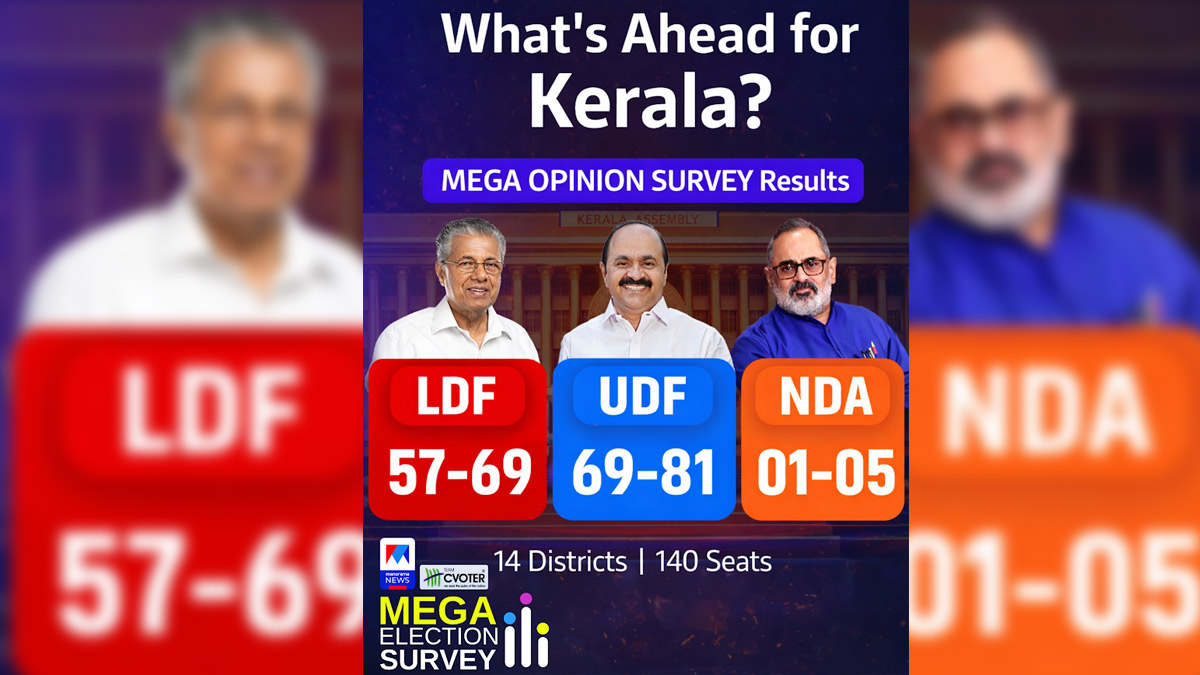
MUMBAI: The winds of change appear to be blowing through Kerala’s political landscape and this time, they seem to favour the United Democratic Front. A comprehensive mega opinion survey conducted by Manorama News in partnership with CVoter projects a potential comeback for the UDF in the upcoming Kerala Legislative Assembly Elections 2026. The survey, covering all 140 constituencies with a massive sample size of nearly 90,000 respondents, predicts the UDF could win between 69 and 81 seats.
The ruling Left Democratic Front (LDF) is expected to secure 57 to 69 seats, a significant drop from the 99 seats it won in the 2021 elections. This would mean the LDF losing 30 to 42 of its sitting seats. Meanwhile, the National Democratic Alliance (NDA), which drew a blank in 2021, is projected to open its account with 1 to 5 seats.
Region-wise, the UDF is expected to make strong gains in Malabar, winning 25 to 34 out of 48 seats, and in Central Kerala, where it could bag 29 to 33 out of 53 seats. In South Kerala, the LDF is likely to retain an edge with 21 to 25 seats, while the UDF may improve to 12 to 16 seats. The NDA could pick up 1 to 3 seats in the southern region.
The survey was conducted between 14 and 26 March 2026, with additional tracker and snap polls carried out from December 2025 to March 2026. A total of 89,693 respondents participated, ensuring representation across all demographics and social segments.
Manorama News has a strong track record of accuracy, with its previous projections closely matching the actual results of the 2019 and 2024 Lok Sabha elections as well as the 2021 Kerala Assembly polls.
In Kerala’s famously fierce political battles, this survey suggests the pendulum may be swinging back. Whether the final verdict matches these numbers or throws up another surprise, one thing is clear, the 2026 Assembly elections are shaping up to be one of the most keenly watched contests in the state’s history.






