News Broadcasting
Ted turner: The Maverick man


MUMBAI: CNN founder, Ted Turner, is the subject of a 60-minute profile encompassing his remarkable life and achievements. Reported by CNN anchor Wolf Blitzer, TED TURNER: THE MAVERICK MAN explores his difficult early years, his extraordinary career, his legendary America’s Cup win, Turner’s historic humanitarian and cable television legacies – and everything in between. The documentary will air on Sunday, November 24 at 4.30pm IST.
Blitzer traveled to Atlanta, Georgia, and outside of Bozeman, Montana – to Turner’s Flying D Ranch – where Turner works to preserve bison and land and water reserves for future generations – for the exclusive profile as Turner approaches his 75th birthday in 2013. During revealing interviews with Blitzer, Turner opens up about his successes and failures, both personal and in business. Intimate interviews with Turner’s five children and key figures in his life, including ex-wife Jane Fonda, President Jimmy Carter, broadcaster Larry King, MLB players Phil Niekro and Dale Murphy, and former U.S. Senator Sam Nunn, add additional layers to the complex portrait.
“Ted Turner has done for the broadcast media industry what Steve Jobs and Bill Gates have done for technology and personal communications,” Blitzer said. “From this in-depth look behind Ted’s hard won achievements and biographical challenges, viewers will come to understand the man we know today.”

The film features first-hand accounts from Turner on founding his first “Super Station” and rapidly transforming that venture into a global media company. Of CNN’s ground-breaking, enterprising broadcast coverage of the 1991 Iraq War, Turner reflected it as still the “greatest scoop in the history of journalism.”
In the film, Fonda describes her first meeting – and being wooed by – her former husband and describes their enduring friendship and love for one another. Carter describes how Turner hatched the idea to pursue Fonda – during a fly-fishing trip at Turner’s Flying D ranch.
In addition, Nunn and Turner’s children describe Turner’s environmental passions and the motivation for his historic United Nations Foundation gift and other philanthropies. Murphy and Niekro share memories of Turner’s purchase of the Atlanta Braves Major League Baseball team – and the team’s triumphant march from last to first place in the League. Exclusive family videos and photos are also included in the hour.







News Broadcasting
Network18 channels lead YouTube news viewership in March 2026
CNN-News18, News18 India and CNBC channels top categories with record views
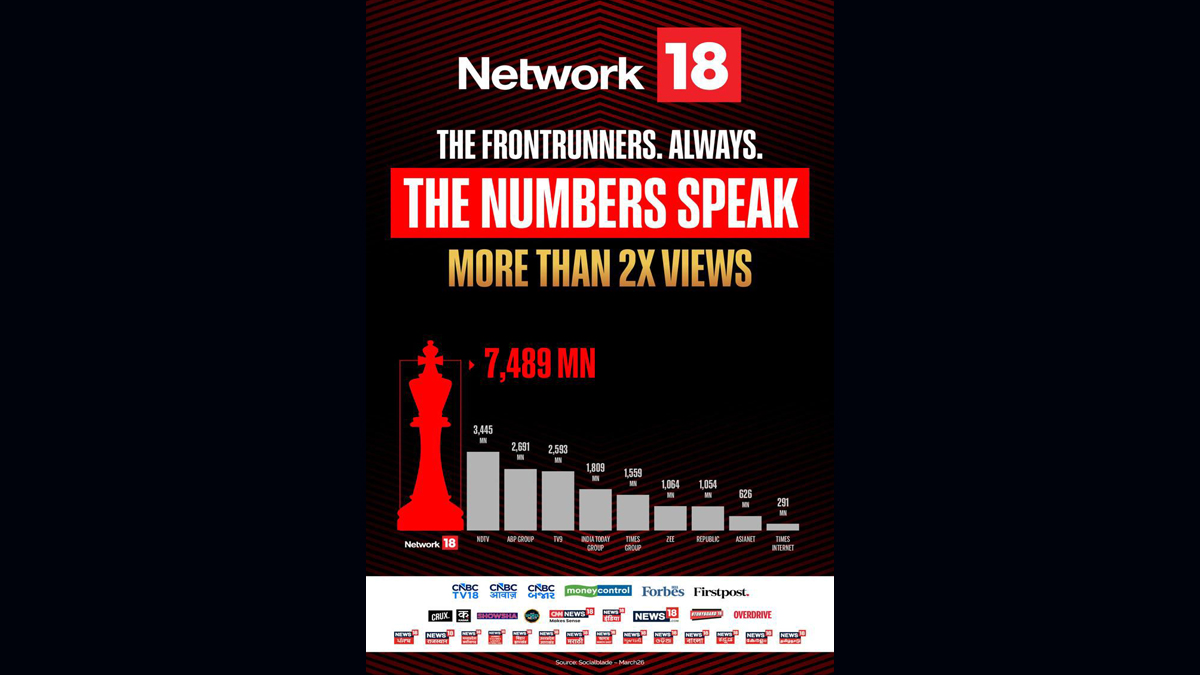
MUMBAI: When the world hit refresh on breaking news, Network18’s channels were already streaming ahead. As geopolitical tensions and war-driven headlines fuelled a surge in global news consumption, the network’s digital playbook delivered big clocking record Youtube viewership across English, Hindi and business news categories in March 2026.
At the forefront was CNN-News18, which emerged as the clear leader in the English news segment with 130 million live and video-on-demand views. The channel edged past competitors such as Times of India (126.5 million), Times Now (101.1 million), India Today (88.2 million) and NDTV (77.5 million), according to Databeings data for March.
In the Hindi news arena, News18 India delivered a commanding performance, racking up a staggering 3,297 million views on YouTube. The channel comfortably outpaced NDTV India, which recorded 3,119 million views, underlining its deep reach and consistent engagement with mass audiences, as per Playboard data.
The network’s dominance wasn’t confined to general news. In the Hindi business segment, CNBC Awaaz topped the charts with 92 million views, narrowly ahead of Zee Business (90 million) and well ahead of ET Now Swadesh (57 million). Meanwhile, its English counterpart CNBC-TV18 posted a strong 58 million views, reinforcing the network’s cross-category strength.
The spike in viewership reflects a broader shift in audience behaviour, with viewers increasingly turning to digital platforms particularly Youtube for real-time updates and in-depth coverage during high-intensity news cycles. For Network18, the numbers signal more than just scale; they underline the effectiveness of a multi-platform strategy that blends speed, credibility and continuous coverage.
In a month where the news never paused, it seems viewers chose to stay tuned where the stream never stopped.






