News Broadcasting
Summit: Dscoop Latex Summit, Shanghai

MUMBAI: Dscoop Latex Summit was hosted in Shanghai as a part of the Annual Shanghai International Ad & Sign Expo which specifically focused on the Sign and Display segment.
The platform was an opportunity for Regional Print Service Providers (PSP's) to learn about- Brands, Emerging Trends in Consumer and Shoppers Space, Trends of World Wide Print and Decoration market, Perspective and Strategies on Employing Powerful Sign & Display and also how to support this eco- system better in Asia Pacific.
Mohit Sharma, Associate Vice President, TracyLocke made a presentation and spoke on 'Emerging Shopper Trends which Re-Define the Retail Landscapes'. To summarise his presentation:-
– How On-Line is impacting the Brick and Mortar Space and new era of Consumerism and Shopper phenomenon are pushing the brands and retailers to the edge.

-How Retail is in the middle of flux and living in defining moments.
– The emergence of new economies and how this new global power equation is shaping the shopper mind space in South West Asia.
– The challenges Brands, Retailers and Marketers are facing to make the experience and brand more relevant and how the strategic alliances and partnerships are effecting the position of the brand.
– Co-Creation, Content and Collaboration are the 3 pillars of Retail Engagement and powerful enough to craft new brand stories.
– Shoppers and Consumers due to digital transparency are getting more sensitive to Eco Sensitive and thus Eco Friendly solutions are becoming imperative for stakeholders ay every point.
– Optimization is not only required for business survivals and competitive edge but accountability taken by shoppers and consumers from the brands. The new generation of Brands and Shopper experience will be laid on the cool quotient which is not style but being green and optimal.
He also showcased a few case studies which brought out the aspect on how to create relevance of brands through using technologies, substrates and products at the Retail Landscapes and creating impactful and powerful experiences
Commenting on Mohit's session at Summit Martin Carballo, Director & GM, Sign & Display, Asia Pacific & Japan, HP, said, "Influencers like you are indeed needed to drive this industry transformation for the sake of the print service providers' business".
Commenting on the experience Mohit Sharma, AVP TracyLocke said, "It was an eye opening and fantastic exposure. A must for the Retail Consultants. HP as a market leader has created a platform on which Print Service Providers, HP and other service providers come together on regional level and discuss the "Emerging Trends" in the Industry and in the flux of events "How Maximize on Opportunities.
Such events provide exposure to various facets of the Industry and gives immense in-depth knowledge of various domains and appraise on the importance of Collaboration. In my various discussions I have made a point that three emerging consumer trends which are impacting and re-defining the retail landscapes and thus creating a flux for the Brands, Marketers and Intermediaries and thus giving rise to new set of opportunities and challenges are – Happiness, Health and Humanity.
Dscoop Seminars
These Dscoop seminars which HP supports are part of an ongoing series of educational efforts on the power and impact of innovative digital print.
(Dscoop (Digital Solutions Cooperative) (global community of graphic arts business owners and technical professionals who use HP Indigo and Scitex equipment) is focused on educating and connecting its members with each other and with HP to improve members' business growth, efficiency and profitability.)







News Broadcasting
Network18 channels lead YouTube news viewership in March 2026
CNN-News18, News18 India and CNBC channels top categories with record views
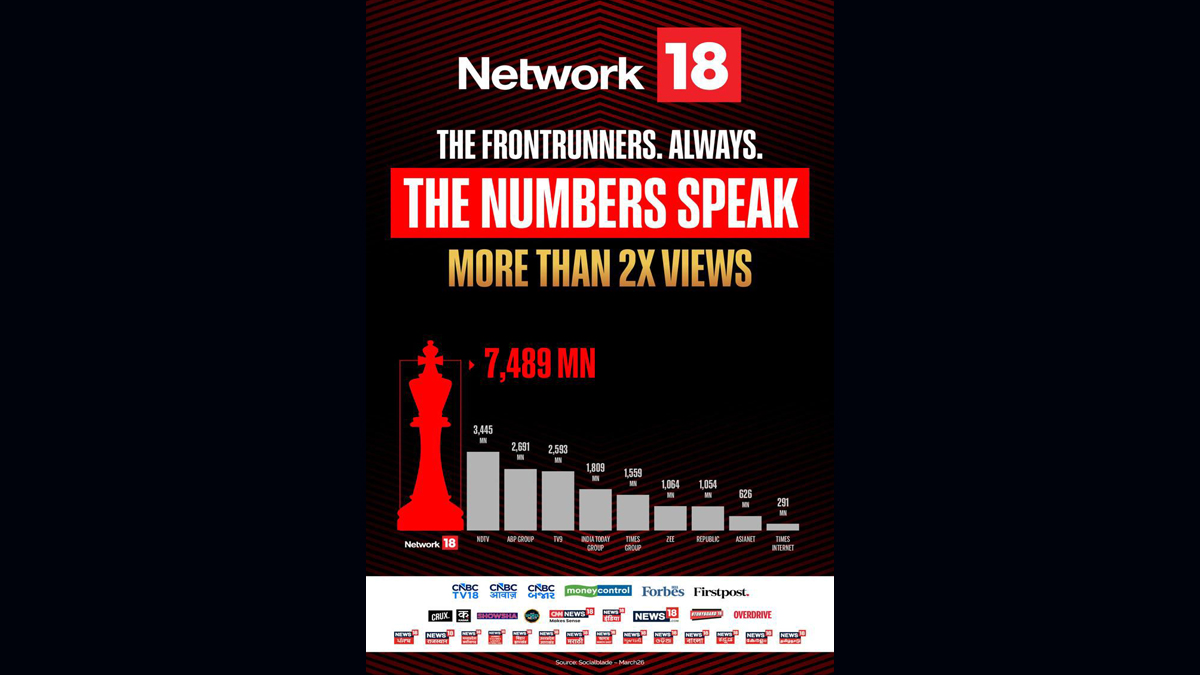
MUMBAI: When the world hit refresh on breaking news, Network18’s channels were already streaming ahead. As geopolitical tensions and war-driven headlines fuelled a surge in global news consumption, the network’s digital playbook delivered big clocking record Youtube viewership across English, Hindi and business news categories in March 2026.
At the forefront was CNN-News18, which emerged as the clear leader in the English news segment with 130 million live and video-on-demand views. The channel edged past competitors such as Times of India (126.5 million), Times Now (101.1 million), India Today (88.2 million) and NDTV (77.5 million), according to Databeings data for March.
In the Hindi news arena, News18 India delivered a commanding performance, racking up a staggering 3,297 million views on YouTube. The channel comfortably outpaced NDTV India, which recorded 3,119 million views, underlining its deep reach and consistent engagement with mass audiences, as per Playboard data.
The network’s dominance wasn’t confined to general news. In the Hindi business segment, CNBC Awaaz topped the charts with 92 million views, narrowly ahead of Zee Business (90 million) and well ahead of ET Now Swadesh (57 million). Meanwhile, its English counterpart CNBC-TV18 posted a strong 58 million views, reinforcing the network’s cross-category strength.
The spike in viewership reflects a broader shift in audience behaviour, with viewers increasingly turning to digital platforms particularly Youtube for real-time updates and in-depth coverage during high-intensity news cycles. For Network18, the numbers signal more than just scale; they underline the effectiveness of a multi-platform strategy that blends speed, credibility and continuous coverage.
In a month where the news never paused, it seems viewers chose to stay tuned where the stream never stopped.






