News Broadcasting
Ses: Continued Robust Performance

MUMBAI: SES S.A. (NYSE Euronext Paris and Luxembourg Stock Exchange: SESG) reports financial results for the nine months and three months ended 30 September 2013.
Romain Bausch, President and CEO, commented:
“SEShas delivered a robust performance in the year to date. We have increased our capacity and are commercialising new market opportunities. Forthcoming launches will further develop this capability and create the conditions for future growth. Our European business, which is almost entirely Video DTH, continues to grow (revenue +5.6%, when excluding analogue). New business and renewals with major customers, including Sky Deutschland and Arqiva, have contributed to an increase in the contract backlog to EUR 7.4 billion. In the International segment (revenue +12.5%) we have added a number of new DTH platforms, in Latin America, Africa, and the Asia-Pacific region. Although the launch schedule continues to be subject to some delays, total revenue growth (excluding analogue) was 5.7%, with considerable momentum from the video business.”
“Despite some delays experienced earlier this year with regard to new satellite launches, we have significantly expanded our capacity with the launch of SES-6 in June and ASTRA 2E in September, and we now expect to launch SES-8 later this month, followed by ASTRA 5B in early December.”

“SES’ 2013 revenue and EBITDA growth guidance at constant FX, of 3-4% and 2.5-3.5% respectively, and 5.5-6.5% excluding analogue, is reiterated.”
“Our performance to date as well as our fleet development underscore SES’ commitment to growing its presence in the developed markets and to accelerate inroads in emerging markets. Our investments are focused on growth opportunities based on differentiated offerings and secured anchor customers in the video business. We are continuing to build DTH neighbourhoods.In the data business, the numerous contracts signed so far this year underscore the complementarity of SES’ geostationary satellite capacity with the High Throughput Satellite (HTS) capabilities of the O3b Networks Mid-Earth Orbit (MEO) constellation.”
“SES is now entering a period in which capital expenditure will reduce significantly, even while additional growth investments are pursued. This, coupled with rising revenue and EBITDA, will deliver strong growth in free cash flow, which may be applied to further profitable investments and acquisitions and/or be returned to shareholders.”







News Broadcasting
Network18 channels lead YouTube news viewership in March 2026
CNN-News18, News18 India and CNBC channels top categories with record views
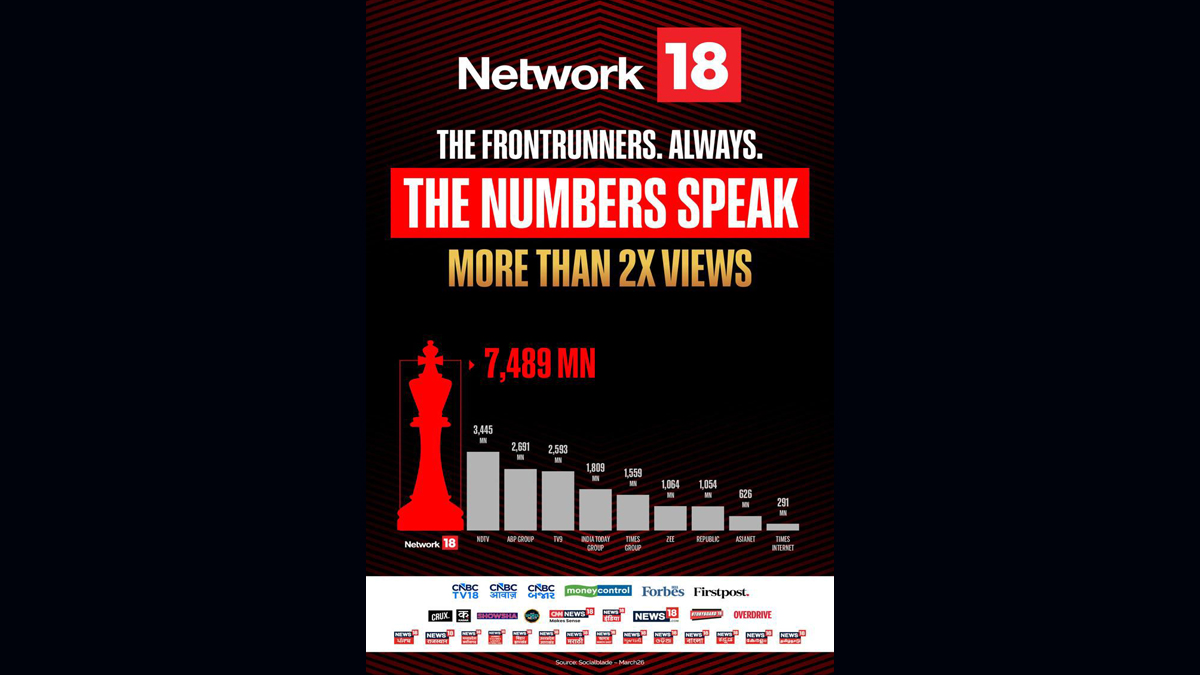
MUMBAI: When the world hit refresh on breaking news, Network18’s channels were already streaming ahead. As geopolitical tensions and war-driven headlines fuelled a surge in global news consumption, the network’s digital playbook delivered big clocking record Youtube viewership across English, Hindi and business news categories in March 2026.
At the forefront was CNN-News18, which emerged as the clear leader in the English news segment with 130 million live and video-on-demand views. The channel edged past competitors such as Times of India (126.5 million), Times Now (101.1 million), India Today (88.2 million) and NDTV (77.5 million), according to Databeings data for March.
In the Hindi news arena, News18 India delivered a commanding performance, racking up a staggering 3,297 million views on YouTube. The channel comfortably outpaced NDTV India, which recorded 3,119 million views, underlining its deep reach and consistent engagement with mass audiences, as per Playboard data.
The network’s dominance wasn’t confined to general news. In the Hindi business segment, CNBC Awaaz topped the charts with 92 million views, narrowly ahead of Zee Business (90 million) and well ahead of ET Now Swadesh (57 million). Meanwhile, its English counterpart CNBC-TV18 posted a strong 58 million views, reinforcing the network’s cross-category strength.
The spike in viewership reflects a broader shift in audience behaviour, with viewers increasingly turning to digital platforms particularly Youtube for real-time updates and in-depth coverage during high-intensity news cycles. For Network18, the numbers signal more than just scale; they underline the effectiveness of a multi-platform strategy that blends speed, credibility and continuous coverage.
In a month where the news never paused, it seems viewers chose to stay tuned where the stream never stopped.






