News Broadcasting
SBI Mutual Fund is the Mutual Fund of the year at CNBC-TV18 – CRISIL Mutual Fund Awards

MUMBAI: In a glittering ceremony, CNBC-TV18, India’s leading Business Medium and CRISIL, India’s premier ratings agency announced the most sought after and valued Mutual Fund Award in the country – ‘CNBC-TV18 – CRISIL Mutual Fund of the Year Award’.
Mark Tucker, Chief Executive of Prudential & Ajay Srinivasan, Chief Executive, Fund Management, Prudential Corporation Asia spoke on the performance of mutual funds across the world, emerging trends, investor reactions and expectations setting the tone for the evening. This was followed by a p anel discussion with Mr Ramesh Damani, Mr Jaikumar, Mr Kela and Mr Naganathan moderated by Udayan Mukherjee.

As the most powerful radar to prosperity, the CNBC TV18 and CRISIL Mutual Fund of the Year awards performance and consistency in wealth creation of enterprising fund houses for the year 2006. These Awards, based on CRISIL’s objective and analytically rigorous CRISIL~CPR methodology, are the ultimate test in performance and consistency on one of the most distinguished platform.
These awards are the Investors most definite guide to the best managed fund house in the country. It brings together the world’s most renowned investment experts and shares their ideas, philosophies and predictions.
The winners in the various categories at the Mutual Fund of the Year were:
|
Category
|
Winner
|
| Large Cap Oriented Equity Funds | DSP Merrill Lynch Opportunities Fund Sundaram BNP Paribas Select Focus |
| Diversified Equity Funds | SBI Magnum Global Fund SBI Magnum Sector Umbrella – Contra Fund Sundaram BNP Paribas Select Midcap |
| ELSS | SBI Magnum Tax Gain Scheme 1993 |
| Income Funds | Principal Income Fund UTI Bond Fund |
| Income Short | Reliance Short Term Fund |
| Balanced Funds | HDFC Prudence Fund SBI Magnum Balanced Fund |
| Liquid Funds | HDFC Cash Management Fund – Savings Plan UTI Liquid cash plan |
| Liquid Funds Institutional | Tata Liquid Fund – SHIP |
| Liquid Funds Super Institutional | UTI Liquid Cash Plan – Institutional Plan |
| Gilt Funds Long | Reliance Gilt Securities Fund – Long Term Plan Templeton India G-Sec Fund – Long Term Plan |
| MIP Aggressive | HDFC Monthly Income Plan – LTP |
| MIP Conservative | Prudential ICICI MIP Plan – Cumulative |
| Floating Rate Funds (Long term) | Principal Floating Rate Fund – Flexible Maturity Plan |
| Floating Rate Funds (Short term) | HDFC Floating Rate Income Fund – Short Term Plan |
| Sectoral –IT | SBI Magnum Sector Umbrella – Infotech Fund |
| Emerging Fund of the Year (diversified equity) | Prudential ICICI Infrastructure Fund |
| Mutual Fund of the Year | SBI Mutual Fund |
In addition to leaders from various fund houses, luminaries from India’s financial services sector including senior regulators, leading economists and analysts witnessed a host of awards being presented to various mutual funds for their consistent performance over time on the CRISIL~CPR performance rankings framework.
Commenting on the methodology Rupa Kudva, ED & Chief Rating Officer,CRISIL, said “The fund house of the year award is given to the mutual fund which performs well in CRISIL’s CPR framework, has a good presence across categories, and wins at least 2 category level awards”
Speaking at the occasion, Mr. Haresh Chawla, CEO, TV18 Group said, “The size of the Mutual fund industry is a burgeoning Rs 3,39,662 crore indicating the popularity enjoyed by Mutual funds amongst investors who want to participate in India’s growth story. Increased popularity in Mutual funds as an investment avenue and a spurt in the number of innovative mutual funds calls for a robust, unbiased and objective evaluation of the annual performances of funds. Since its inception, ‘The CNBC-TV18 – CRISIL Mutual Fund of the Year Award’ has established a benchmark for excellence in the Mutual Fund industry and has over the years, assisted investors to make the right choices in their mutual fund investments.”
Speaking on the initiative, Mr. Ashvin Arora, Director, OptiMix, said, “CNBC Mutual Fund awards is a landmark event in the Indian Mutual Fund Industry, which recognizes and rewards the best managed fund houses on the basis of objective performance criteria laid down by Crisil. As India’s first multi-manager, Optimix identifies best of breed mutual funds and blends them together into separate products, so that optimal combinations of expertise and style are available to the investor. The Optimix process helps the investor with superior, consistent wealth creation. All in all, this is a great fit and we are proud to be associated with the CNBC TV-18-Crisil Mutual Fund Awards 2007. My heartiest congratulations to the winners of this prestigious award.”







News Broadcasting
UDF poised to return to power in Kerala, says Manorama-CVoter survey
Massive opinion poll projects shift in Kerala politics ahead of 2026 Assembly elections.
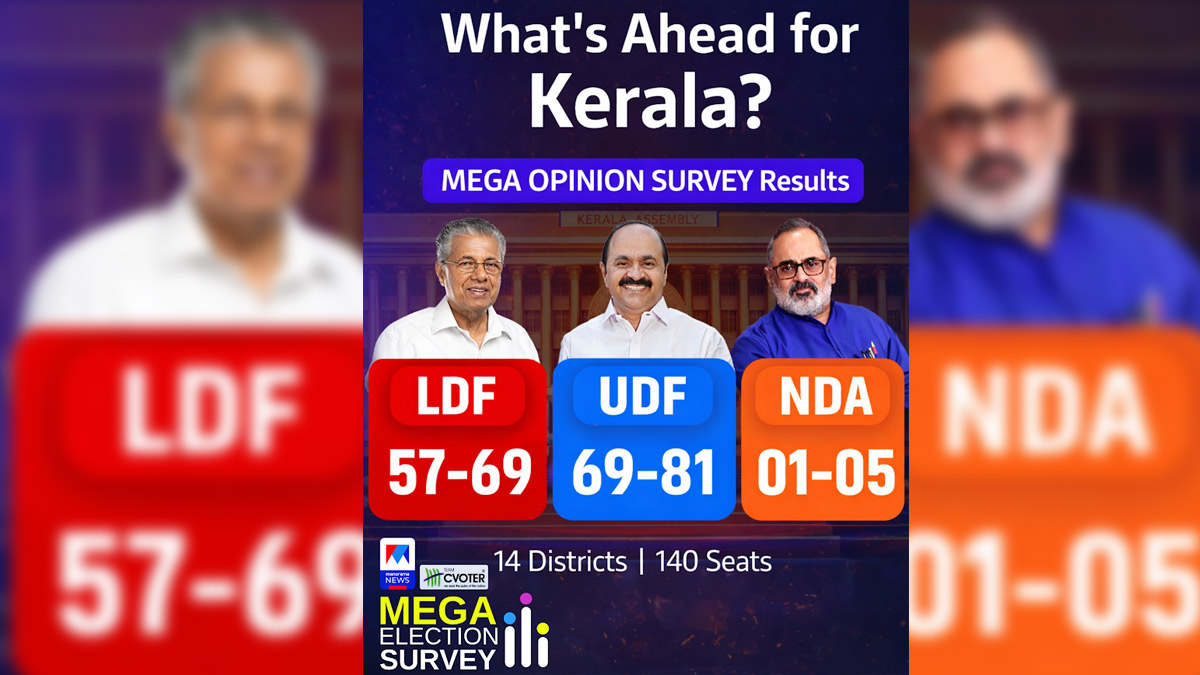
MUMBAI: The winds of change appear to be blowing through Kerala’s political landscape and this time, they seem to favour the United Democratic Front. A comprehensive mega opinion survey conducted by Manorama News in partnership with CVoter projects a potential comeback for the UDF in the upcoming Kerala Legislative Assembly Elections 2026. The survey, covering all 140 constituencies with a massive sample size of nearly 90,000 respondents, predicts the UDF could win between 69 and 81 seats.
The ruling Left Democratic Front (LDF) is expected to secure 57 to 69 seats, a significant drop from the 99 seats it won in the 2021 elections. This would mean the LDF losing 30 to 42 of its sitting seats. Meanwhile, the National Democratic Alliance (NDA), which drew a blank in 2021, is projected to open its account with 1 to 5 seats.
Region-wise, the UDF is expected to make strong gains in Malabar, winning 25 to 34 out of 48 seats, and in Central Kerala, where it could bag 29 to 33 out of 53 seats. In South Kerala, the LDF is likely to retain an edge with 21 to 25 seats, while the UDF may improve to 12 to 16 seats. The NDA could pick up 1 to 3 seats in the southern region.
The survey was conducted between 14 and 26 March 2026, with additional tracker and snap polls carried out from December 2025 to March 2026. A total of 89,693 respondents participated, ensuring representation across all demographics and social segments.
Manorama News has a strong track record of accuracy, with its previous projections closely matching the actual results of the 2019 and 2024 Lok Sabha elections as well as the 2021 Kerala Assembly polls.
In Kerala’s famously fierce political battles, this survey suggests the pendulum may be swinging back. Whether the final verdict matches these numbers or throws up another surprise, one thing is clear, the 2026 Assembly elections are shaping up to be one of the most keenly watched contests in the state’s history.






