News Broadcasting
Reliance MediaWorks studios emerges as a preferred destination

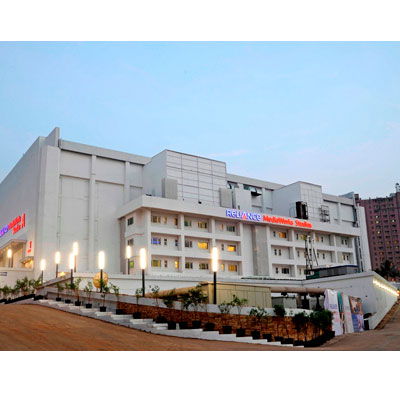
MUMBAI: Reliance MediaWorks studios Mumbai’s Largest and India’s first ‘Hollywood benchmarked’ super silent ‘sync sound’ capable sound stages built to stringent acoustical and structural specifications attracts the entire film television and commercial facility, as a one stop destination for all their production needs. Next years most awaited releases Salman Khan Starrer, Jai Ho and Aamir Khan’s P.K. were amongst of a host of movies shot at the studio.
Commenting on the Reliance MediaWorks studio actor Salman Khan said, “It is fun to work in such a close to nature environment, with utmost peace and best standard of quality, the best thing about working in RMW Studios is that everything is so organized that we do not have to wait for anything, all shooting measures have been taken care of, nicely”.
Commenting about the facilities at the Reliance MediaWorks Studio, Director Mr. Sohail Khan, said, “The RMW studio is a unique experience that makes filming a simple, effortless experience. We shot at the RMW studio for “Jai Ho”, our next production starring Salman Khan, and I am very impressed with the ease in which they were able to manage our shoot. Thank you so much for a stress free and enjoyable shooting schedule. The Reliance MediaWorks studio is a great facility and has great people to work with. I will definitely be back with bigger projects.”

Raj Kumar Hirani, who filmed P.K. starring Aamir Khan at the Reliance MediaWorks studio, commented “We had a great time filming at Reliance MediaWorks Studios, things were made much easier by the access to all the facilities and having everything we needed at our fingertips. I was very impressed with the level of detail and focus on Western standards that went into building your sound stages and the supporting workshops. Way to go Reliance MediaWorks team. The combination of great facilities and friendly, knowledgeable staff made sure the shoot was problem free”.
“The studios have been designed to meet both local and international film needs. “We aspired to create a total world-class facility here to enable producers capture their creative imagination in celluloid. What has been really encouraging is the number of producers and shows that keep coming back to use our facilities which are of real International standards.” Mr. Ashish Chakravorty of Reliance MediaWorks said. He further added that Phases II and III of the studio is gearing up to be operational from FY’14.
The RMW studios offer enviable height options; unmatched data transfer connectivity and sync sound, making it an ideal choice for both film productions and broadcasters. RMW has fully operational 3 Sound Stages (Popularly called Studio 7), and 24 rooms of attached comprehensive production support facilities, to make the most extensive and complex design concepts possible. The RMW studio encompasses multipurpose workshops, art departments, make-up rooms, wardrobe rooms, star rooms, production offices, green rooms and storage spaces form part of the of the studio.
The studios provides uncompromised access to a range of production & post production services for all media including Film and Digital Cameras, Broadcast Multicam Solutions, Automated Lighting Solutions, the finest Film Lab in India, DI Suites, VFX facilities and a world class Dolby Certified Preview Theatre.
The Reliance MediaWorks Studio is on par with international standards. It provides sync-sound i.e. a noise co-efficient less than 30 db, which is not offered by any other Indian studio. It is the largest, fully air-conditioned facility in Mumbai with a clear internal height of 58ft. enabling enormous ‘live load’ bearing capacities and elephant doors which allow full truck access on to the stages. The fire safety and security measures are as per Los Angeles County Fire Department regulations.
The recently concluded IPL “Extra Innings” has used the studio as its home base; Set Max did their direct to edit setups too. Reality shows like, Indian Idol, X-Factor, MTV Coke Studio have used the Reliance MediaWorks sound stages repeatedly over the years.
Feature Films like Agneepath, Lootera, Agent Vinod, Student of the Year, Singham, Dhoom 3 and Ram Leela amongst others have been extensively shot here. On account of the monsoons in Mumbai, Sanjay Leela Bhansali Films had moved their entire outdoor set into the RMW’s studio facility which ensured continuity of the shoot and no delays.






News Broadcasting
Network18 channels lead YouTube news viewership in March 2026
CNN-News18, News18 India and CNBC channels top categories with record views
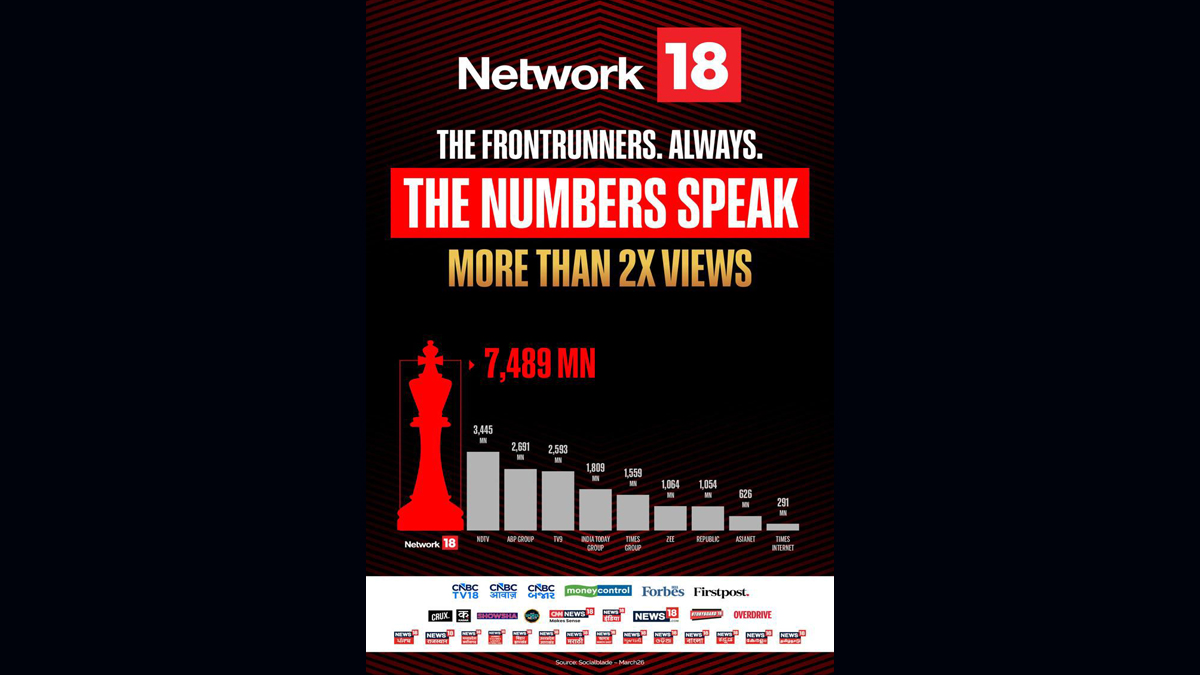
MUMBAI: When the world hit refresh on breaking news, Network18’s channels were already streaming ahead. As geopolitical tensions and war-driven headlines fuelled a surge in global news consumption, the network’s digital playbook delivered big clocking record Youtube viewership across English, Hindi and business news categories in March 2026.
At the forefront was CNN-News18, which emerged as the clear leader in the English news segment with 130 million live and video-on-demand views. The channel edged past competitors such as Times of India (126.5 million), Times Now (101.1 million), India Today (88.2 million) and NDTV (77.5 million), according to Databeings data for March.
In the Hindi news arena, News18 India delivered a commanding performance, racking up a staggering 3,297 million views on YouTube. The channel comfortably outpaced NDTV India, which recorded 3,119 million views, underlining its deep reach and consistent engagement with mass audiences, as per Playboard data.
The network’s dominance wasn’t confined to general news. In the Hindi business segment, CNBC Awaaz topped the charts with 92 million views, narrowly ahead of Zee Business (90 million) and well ahead of ET Now Swadesh (57 million). Meanwhile, its English counterpart CNBC-TV18 posted a strong 58 million views, reinforcing the network’s cross-category strength.
The spike in viewership reflects a broader shift in audience behaviour, with viewers increasingly turning to digital platforms particularly Youtube for real-time updates and in-depth coverage during high-intensity news cycles. For Network18, the numbers signal more than just scale; they underline the effectiveness of a multi-platform strategy that blends speed, credibility and continuous coverage.
In a month where the news never paused, it seems viewers chose to stay tuned where the stream never stopped.






