Hindi
Raymond Weil felicitates Prasoon joshi as part of its Global practice

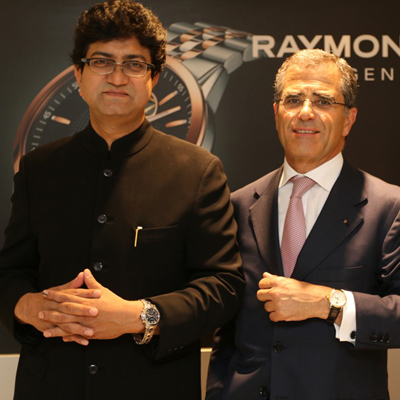
MUMBAI: Well-known for its watchmaking excellence, creative design and high quality standards offered at unequalled price points, the famous independent Swiss watch Brand, RAYMOND WEIL strengthens its presence in Mumbai. As a Brand deeply involved in arts and music from which it draws its literary inspiration, the Swiss Brand felicitates the most celebrated lyricist, screenwriter and advertising guru- Prasoon Joshi -at the RAYMOND WEIL Boutique at Palladium,Mumbai, on May 2nd, 2014 (Today).
Prasoon Joshi is considered a legend in the Indian Bollywood industry and is known for his remarkable contributions in music in various Bollywoodmovies. He has also received the best film fare lyricist award 3 times in his tenure. Prasoon is also a proud recipient of the National award for best lyricist.

In the course of the felicitation, Mr. Olivier Bernheim, President of RAYMOND WEIL said: “We are extremely proud and feeling enthusiastic to celebrate our flourishing presence in Mumbaias we have the most iconic personality of the country with us today.At RAYMOND WEIL, it has always been our endeavour to cherish and share success. We would like to express our appreciation and seize the opportunity to bestow them with sober, yet elegant novelties from RAYMOND WEIL as a mark of appreciation to their contributions so far in the field of music”.
RAYMOND WEIL’s collections reflect both modern innovative design and the traditional values of the Brand while maintaining attractive price positioning. They clearly demonstrate the family understanding of clients’ expectations. Consumers will appreciate the wide range of watches offered by the Brand: the very elegant and classical, fully mechanical maestro collection, with chronograph, balancier or moon phase functions; the historic and noble parsifal collection; the stylish, powerful and sleek nabucco; the urban and contemporary, sober and elegant freelancer; or the full-bodied, opulent yet delicate feminine collection noemia and jasmine.
RAYMOND WEIL
Founded in Geneva in 1976, RAYMOND WEIL is one of the last remaining Swiss independent family-owned and family-operated watchmaking companies. Based in Geneva, home of Switzerland’s most prestigious watchmakers and of the industry’s topmost expertise in component and material supply, the Brand enjoys a unique position in the exclusive world of luxury with a collection of refined timepieces that embody an elegant and contemporary blend of elements inspiring emotions with both customers and partners.
Music has always been at the centre of the RAYMOND WEIL universe. This is borne out by the names of the Brand’s collections — taken from famous operas such as nabucco and parsifal, or with musical connotations, such as maestro or jasmine — and the various musical partnerships RAYMOND WEIL has signed with iconic musical venues, exclusive musical awards ceremonies, live music platforms and music related charities.
Emotions, precision, performance: these are the values common to music and watchmaking that RAYMOND WEIL wishes to share with its clients.




Hindi
Zee5 and Applause Entertainment team up for whodunnit ‘Everybody Loves Sohrab Handa’
Rajat Kapoor directs star-studded murder mystery streaming from 10 April.
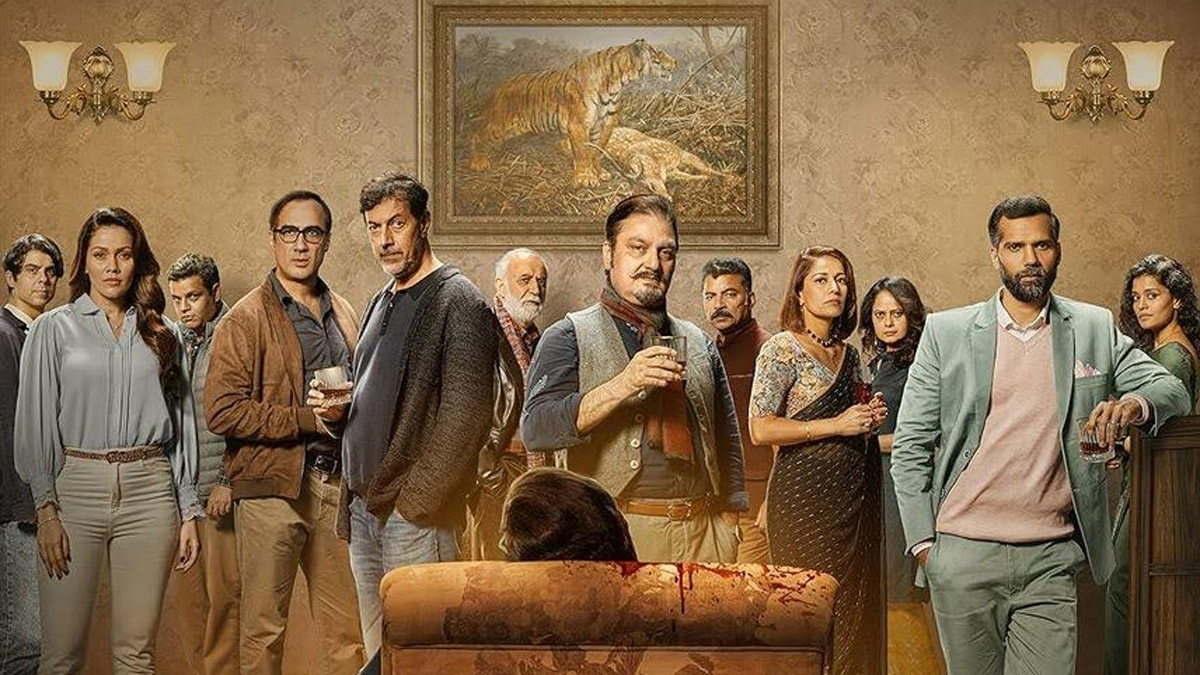
MUMBAI: Zee5 is serving up another killer collaboration and this time, the murder mystery comes with a generous side of dark humour and family dysfunction. The streaming platform has partnered with Applause Entertainment and Mithya Talkies to bring Everybody Loves Sohrab Handa, a fresh, twisted whodunnit written and directed by acclaimed filmmaker and actor Rajat Kapoor. The film will stream exclusively on Hindi Zee5 from 10 April.
The movie reimagines the classic murder mystery genre with a contemporary, darkly comic edge. It revolves around a group of friends and family who smile, drink, and celebrate together until the silence snaps and long-buried secrets spill out. The stellar ensemble cast includes Vinay Pathak, Ranvir Shorey, Waluscha De Sousa, Saurabh Shukla, Chandrachoor Rai, Neil Bhoopalam, Koel Purie, Palomi Ghosh, and Rajat Kapoor himself.
This latest offering continues the successful partnership between Zee5 and Applause Entertainment, which has previously delivered diverse hits such as Mithya, Bloody Brothers, and Jab Khuli Kitaab.
&TV Business Head of hindi Zee5 and chief channel officer Kaveri Das said, “Our collaboration with Applause Entertainment has consistently delivered distinct, high-impact storytelling. Everybody Loves Sohrab Handa is a natural progression, reinforcing our focus on genre-led content with a compelling whodunnit premise and a strong ensemble cast.”
Applause Entertainment business head for movies Sunil Chainani added, “This film adds yet another compelling layer to our slate with Rajat Kapoor’s unmistakable voice.”
Rajat Kapoor shared, “What interested me was not just the mechanics of a whodunnit, but the emotional violence that precedes physical violence. These are people who smile at each other, but there’s so much that is not said.”
The film promises razor-sharp writing, layered performances, and simmering tension, inviting viewers not just to solve the crime but to unravel the complex relationships at its heart.
If you love a good murder mystery served with wit and emotional depth, Everybody Loves Sohrab Handa looks set to be your next addictive watch. Mark your calendars, the whodunnit drops on Hindi Zee5 from 10 April.







