News Broadcasting
Puravankara receives highest accolade at worlds largest Communications Competition


MUMBAI: Puravankara Projects Limited, a premier real-estate developer, has been recognized with a ‘Platinum Award’, the highest accolade, at the 2013 Global Communications Competition sponsored by the League of American Communications Professionals (LACP). This event is the world’s largest communications competition.
The Puravankara entry, the company Annual Report FY 2013, received a ‘Platinum Award’ in the ‘Most Creative‘ category. The report entitled ‘Invest in Life’, reflecting the axiom that a home purchase is an investment of a lifetime, was ranked #10 among the top 100 communication materials of 2013 (The report can be viewed at:
http://www.puravankara.com/pages/Annual_Reports).
The proprietary judging system developed by LACP, evaluated over 1500 entries on the following six criteria: first impression, narrative, visual design, creativity, message clarity and relevance. Puravankara scored 99 out of a maximum 100 points, outperforming several global brands in the process.

The competition was judged by communications professionals affiliated with LACP (Details are available at: http://www.lacp.com/2013spotlight/competition.htm )
Commenting on the award Jackbastian Nazareth, Group CEO, Puravankara Projects said: “Puravankara is honoured to have received the highest commendation at the LACP Global Communication Competition. Recognition at a prestigious global forum validates our organizational focus on international benchmarks and best practices. We view our Annual Report not merely as a statutory document, but also as a strategic brand communication medium. It is a matter of pride for us that we are ranked at #10 among the top 100 Annual reports of 2013. This award reaffirms our commitment to the pursuit of excellence in our operations.”
Christine Kennedy, Managing Director LACP said, “The Puravankara Annual Report 2012-13, proves to be remarkable in light of tremendous competition. More than 1500 entries representing a dozen countries were received, so the competition was exceptionally tough.
Overall, we find this work to be outstanding, earning a total score of 99 out of a maximum 100 points. The first impression presented by this entry is exceptional, while the narrative is outstanding. The visual design is exceptional, tied with a level of creativity that is outstanding. We classify this entry as ranking at #10 among the Top 100 Communications Materials of 2013.” she added.





News Broadcasting
Network18 channels lead YouTube news viewership in March 2026
CNN-News18, News18 India and CNBC channels top categories with record views
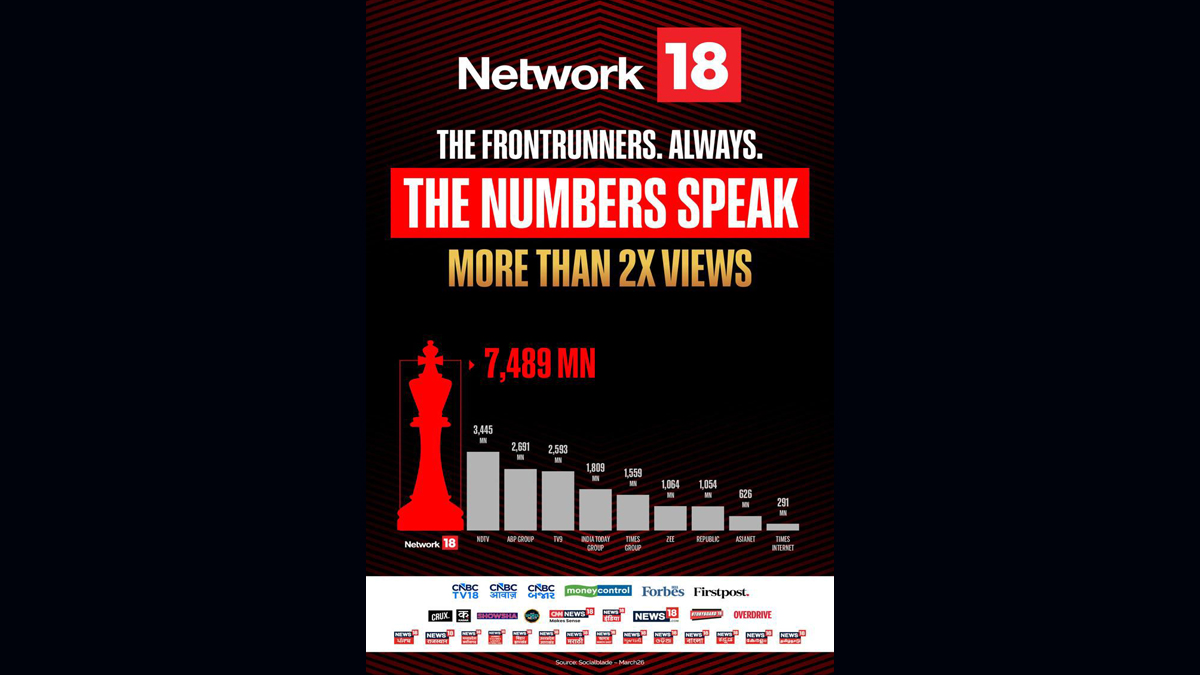
MUMBAI: When the world hit refresh on breaking news, Network18’s channels were already streaming ahead. As geopolitical tensions and war-driven headlines fuelled a surge in global news consumption, the network’s digital playbook delivered big clocking record Youtube viewership across English, Hindi and business news categories in March 2026.
At the forefront was CNN-News18, which emerged as the clear leader in the English news segment with 130 million live and video-on-demand views. The channel edged past competitors such as Times of India (126.5 million), Times Now (101.1 million), India Today (88.2 million) and NDTV (77.5 million), according to Databeings data for March.
In the Hindi news arena, News18 India delivered a commanding performance, racking up a staggering 3,297 million views on YouTube. The channel comfortably outpaced NDTV India, which recorded 3,119 million views, underlining its deep reach and consistent engagement with mass audiences, as per Playboard data.
The network’s dominance wasn’t confined to general news. In the Hindi business segment, CNBC Awaaz topped the charts with 92 million views, narrowly ahead of Zee Business (90 million) and well ahead of ET Now Swadesh (57 million). Meanwhile, its English counterpart CNBC-TV18 posted a strong 58 million views, reinforcing the network’s cross-category strength.
The spike in viewership reflects a broader shift in audience behaviour, with viewers increasingly turning to digital platforms particularly Youtube for real-time updates and in-depth coverage during high-intensity news cycles. For Network18, the numbers signal more than just scale; they underline the effectiveness of a multi-platform strategy that blends speed, credibility and continuous coverage.
In a month where the news never paused, it seems viewers chose to stay tuned where the stream never stopped.






