News Broadcasting
News18 India launches Aaj Ka No.1 campaign – asserts its leadership in Prime-time


MUMBAI: News18 India, Network18’s general Hindi News channels, has in recent time witnessed unprecedented growth. The channel has emerged as the No. 1 channel in the Hindi News genre in the key prime time band – 7-11pm -in Urban India. Starting with Aar Paar at 7pm a fiery debate anchored by Amish Devgan, Hum Toh Poochnge a substantive discussion on the day’s top story at 8pm anchored by Sumit Awasthi and a fast paced & sharp news bulletin with Kishore Ajwani at 9 pm – Sau Baat ki ek Baat, the channel has a power packed line-up of shows which has allowed it to create a niche for itself amongst Hindi News audiences.
The Aaj Ka No.1 campaign intends to celebrate the channel’s success in a highly cluttered category with over a dozen channels vying for eyeballs. It directly takes on the competition and asserts that News18 India has altered the pecking order in the category. The 360 degree campaign which will run across various media including TV, print, social and trade media will clearly seek to project that the momentum in the genre is now with News18 India – the Aaj ka No. 1. The campaign will use a visual device & treatment that is meant to ensure high recall and share of buzz for the same.
Commenting on the campaign Network18, Group Brand Advisor, Rahul Kansal said “News 18 India has grown steadily in the past few months, to emerge as urban India’s leading Hindi News channel in prime-time. We have a line-up of strong anchors who take up issues in a purposeful way with a desire to shed light, not just create sound, (as seems to have become the norm).“








News Broadcasting
Network18 channels lead YouTube news viewership in March 2026
CNN-News18, News18 India and CNBC channels top categories with record views
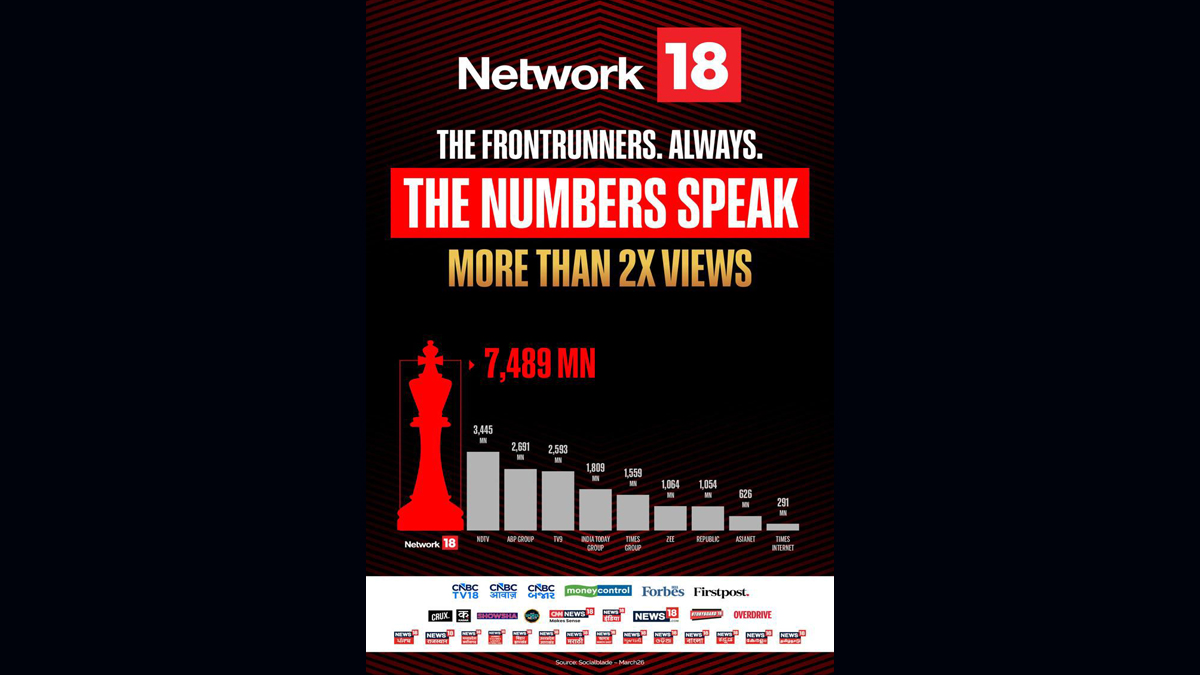
MUMBAI: When the world hit refresh on breaking news, Network18’s channels were already streaming ahead. As geopolitical tensions and war-driven headlines fuelled a surge in global news consumption, the network’s digital playbook delivered big clocking record Youtube viewership across English, Hindi and business news categories in March 2026.
At the forefront was CNN-News18, which emerged as the clear leader in the English news segment with 130 million live and video-on-demand views. The channel edged past competitors such as Times of India (126.5 million), Times Now (101.1 million), India Today (88.2 million) and NDTV (77.5 million), according to Databeings data for March.
In the Hindi news arena, News18 India delivered a commanding performance, racking up a staggering 3,297 million views on YouTube. The channel comfortably outpaced NDTV India, which recorded 3,119 million views, underlining its deep reach and consistent engagement with mass audiences, as per Playboard data.
The network’s dominance wasn’t confined to general news. In the Hindi business segment, CNBC Awaaz topped the charts with 92 million views, narrowly ahead of Zee Business (90 million) and well ahead of ET Now Swadesh (57 million). Meanwhile, its English counterpart CNBC-TV18 posted a strong 58 million views, reinforcing the network’s cross-category strength.
The spike in viewership reflects a broader shift in audience behaviour, with viewers increasingly turning to digital platforms particularly Youtube for real-time updates and in-depth coverage during high-intensity news cycles. For Network18, the numbers signal more than just scale; they underline the effectiveness of a multi-platform strategy that blends speed, credibility and continuous coverage.
In a month where the news never paused, it seems viewers chose to stay tuned where the stream never stopped.






