News Broadcasting
News18 India (Languages) retains its Status as the most read regional news platform

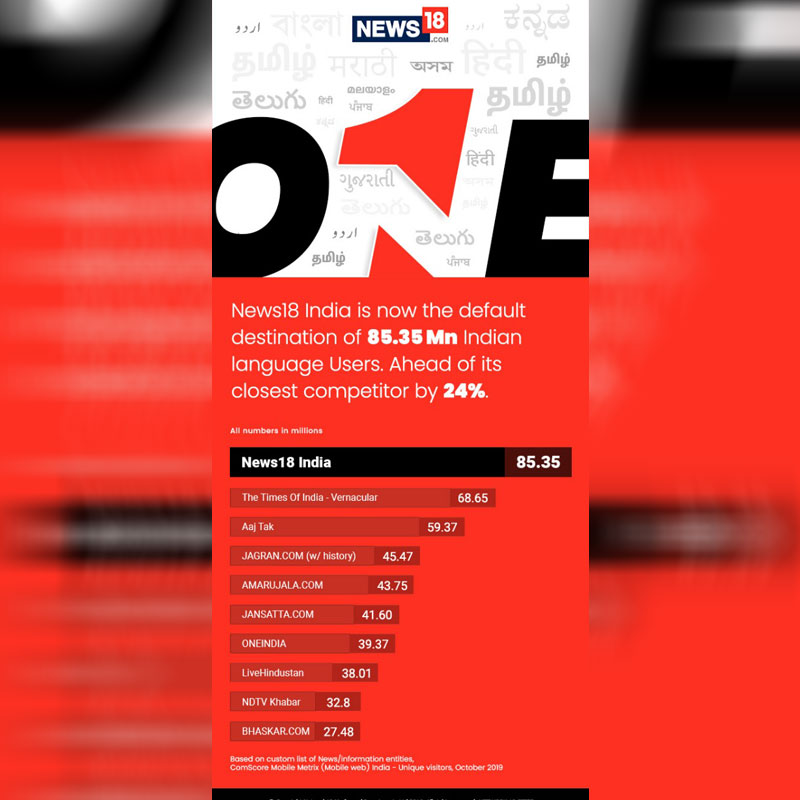
MUMBAI: News18’s leading destination for regional language news, leads over competition third-time in a row amongst multi-vernacular (Indian languages) news/information Sites. As per the recently released Comscore mobile metrix report, News18 India with over 85 million1 unique visitors across mobile web platform has retained its number one rank with an 11.6% increase in its unique visitors count. News18 Bangla2 grabbed the number one position amongst the Bengali news sites, with an incredible 21% month on month growth of unique visitors.
In addition to this, the multi-vernacular verticals of the platform-agnostic news destination maintain its leadership position with a continuous growth of unique visitors in their respective regions. Occupying significant positions on the chart, the websites offer quality content across diverse formats and languages. Covering the length and breadth of the country, News18 seeks to enable its users to consume news in their preferred language at their fingertips by providing news and live TV across 11 languages that include Hindi, Bengali, Marathi, Gujarati, Kannada, Tamil, Malayalam, Telugu, Punjabi, Assamese and Urdu.
Reiterating News18 India’s constant growth and market dominance, the numbers reflect on its dedication to provide audiences with relevant content and offerings that make for a valuable and insightful experience.

Delighted to be amongst the highest rankers in the Comscore report, Network18 Digital COO- General News Mitul Sangani, said, “Personalization of consumption is one of the most important tools that help in building a robust audience relationship. We have been pioneers in providing innovative, original, and diverse content through our well-balanced reach and ace-quality news. In that sense we have personalized news consumption for our audience to their native language that allows them to consume credible content in their own comfort. It has been our constant endeavour to craft engaging services that meet the demands of the ever-evolving audience and we wish to continue with excellence in all our efforts.”






News Broadcasting
Network18 channels lead YouTube news viewership in March 2026
CNN-News18, News18 India and CNBC channels top categories with record views
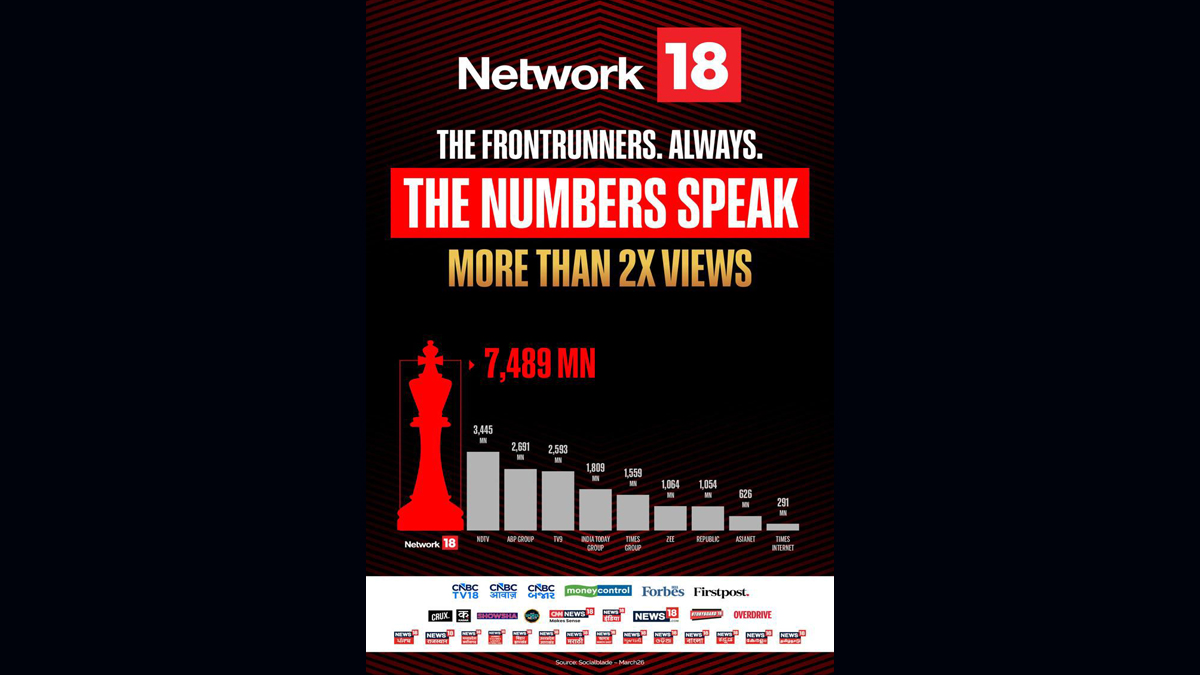
MUMBAI: When the world hit refresh on breaking news, Network18’s channels were already streaming ahead. As geopolitical tensions and war-driven headlines fuelled a surge in global news consumption, the network’s digital playbook delivered big clocking record Youtube viewership across English, Hindi and business news categories in March 2026.
At the forefront was CNN-News18, which emerged as the clear leader in the English news segment with 130 million live and video-on-demand views. The channel edged past competitors such as Times of India (126.5 million), Times Now (101.1 million), India Today (88.2 million) and NDTV (77.5 million), according to Databeings data for March.
In the Hindi news arena, News18 India delivered a commanding performance, racking up a staggering 3,297 million views on YouTube. The channel comfortably outpaced NDTV India, which recorded 3,119 million views, underlining its deep reach and consistent engagement with mass audiences, as per Playboard data.
The network’s dominance wasn’t confined to general news. In the Hindi business segment, CNBC Awaaz topped the charts with 92 million views, narrowly ahead of Zee Business (90 million) and well ahead of ET Now Swadesh (57 million). Meanwhile, its English counterpart CNBC-TV18 posted a strong 58 million views, reinforcing the network’s cross-category strength.
The spike in viewership reflects a broader shift in audience behaviour, with viewers increasingly turning to digital platforms particularly Youtube for real-time updates and in-depth coverage during high-intensity news cycles. For Network18, the numbers signal more than just scale; they underline the effectiveness of a multi-platform strategy that blends speed, credibility and continuous coverage.
In a month where the news never paused, it seems viewers chose to stay tuned where the stream never stopped.






