Hardware
NDTV India Migrates to MPEG-4 Uplink Chain


MUMBAI: New Delhi Television (NDTV), one of India’s most-watched TV news networks, has migrated its satellite uplink infrastructure from MPEG-2 to a complete MPEG-4 multiple-channel-per-carrier (MCPC) chain based on Thomson Video Networks’ advanced encoding, MPEG processing, and transport stream (TS) monitoring equipment. Driven by the award-winning ViBE™ EM4000 premium HD/SD encoder, NetProcessor 9030 MPEG processor, XMS network management system, and Granite Sentinel DTV monitor, the new MCPC chain replaces aging SD MPEG-2 equipment and provides an HD-ready platform to support NDTV’s future technology requirements.
“When we evaluated technology partners for our MPEG-4 migration, Thomson Video Networks was the obvious choice,” said Dinesh Singh, chief technology officer, NDTV Ltd. “As a high-density encoder, the ViBE EM4000 offers eight SD/HD channels in a single rack unit to save space in our existing infrastructure. With our new, state-of-the-art uplink chain, both our customers and operators have seen marked improvement in both performance and picture quality, and we really appreciate Thomson Video Networks’ technology and service support.”

“As one of India’s leading news broadcasters, NDTV is making a big technology leap forward with its MPEG-4 migration,” said Eric Louvet, vice president worldwide sales, Thomson Video Networks. “With our latest-generation, EM4000 octo-channel platform, MPEG-4 encoding will enable NDTV to save significant satellite bandwidth that can be used later for HD programming. Since the EM4000 is HD-ready, migration to HD services is smooth and easy within the existing uplink chain.”
Further information about the ViBE EM4000 and other Thomson Video Networks products is available at www.thomson-networks.com.





Hardware
India clears Rs 1.6 lakh crore semiconductor projects under Semicon India
Ten projects cleared as production begins and design ecosystem gathers pace
NEW DELHI: India’s push to become a global electronics powerhouse is gaining momentum, with the Semicon India Programme driving the creation of a full-fledged semiconductor ecosystem from design to manufacturing.
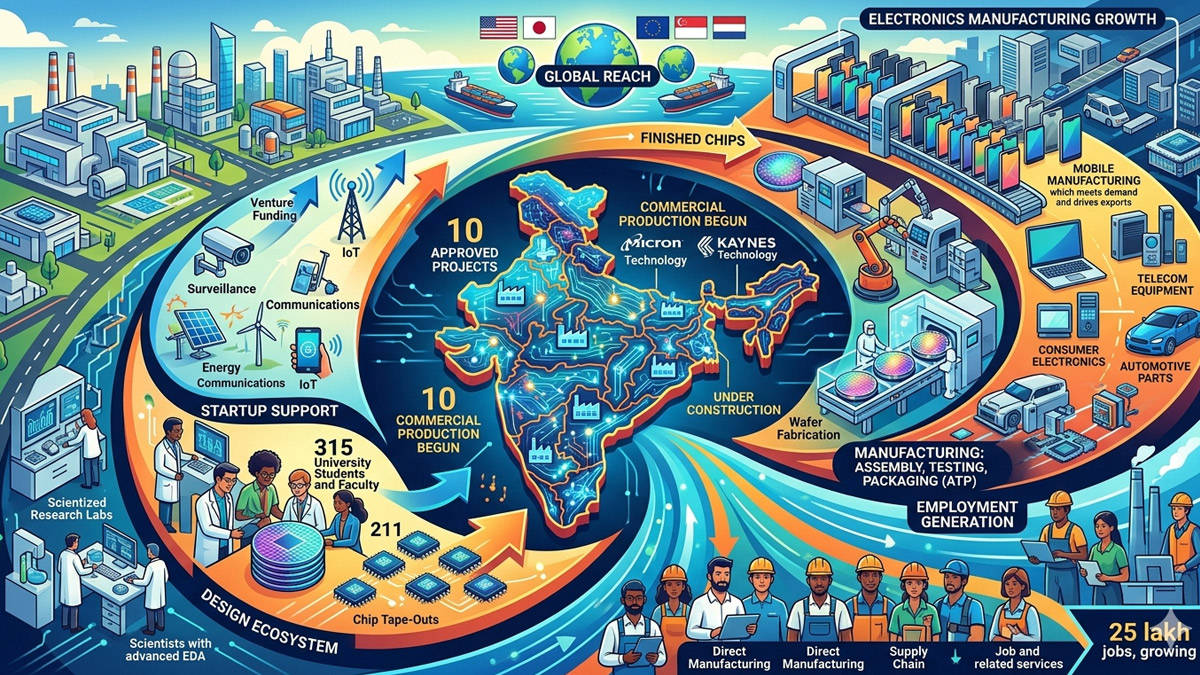
Launched in 2022, the programme aims to build capabilities across the entire value chain, including chip design, fabrication, assembly, testing and packaging. In just four years, the government has approved 10 semiconductor projects with a combined investment commitment of around Rs 1.6 lakh crore.
Two of these facilities have already begun commercial production, including units led by Micron Technology Inc. and Kaynes Technology India Limited. Two more plants are expected to go live later this year, signalling that India’s chip ambitions are moving from blueprint to factory floor.
The broader electronics manufacturing story has also seen sharp growth over the past decade. Production has jumped from roughly Rs 1.9 lakh crore in 2014-15 to about Rs 12 lakh crore in 2024-25, while exports have surged nearly eightfold. Mobile phone manufacturing, once heavily import-dependent, now meets almost all domestic demand and has become a major export driver.
Alongside manufacturing, the government is investing heavily in design capabilities. Through access to advanced chip design tools provided free to 315 universities, students and researchers have clocked over 200 lakh hours of usage. This effort has already resulted in 211 chip tape-outs from 75 institutions.
Support for startups is also picking up pace. Twenty-four chip design projects have been approved, targeting sectors such as surveillance, energy, communications and IoT. Of these, 14 companies have collectively raised over Rs 650 crore in venture funding, while several designs have progressed to fabrication, including at advanced nodes.
To strengthen supply chains, India has also signed semiconductor cooperation agreements with countries including the United States, Japan, the European Union, Singapore and the Netherlands. These partnerships aim to reduce global dependencies while boosting domestic capabilities.
The employment impact is equally significant. The electronics sector now supports an estimated 25 lakh jobs, with mobile manufacturing alone accounting for nearly half. As more semiconductor units come online under the India Semiconductor Mission, indirect job creation across supply chains is expected to rise further.
Sharing these updates in Parliament, Ministry of Electronics and Information Technology minister of state Jitin Prasada underscored the government’s focus on building a resilient, end-to-end semiconductor ecosystem.
With factories taking shape, designs moving to silicon and investments flowing in, India’s semiconductor story is steadily shifting gears from ambition to execution.






