News Broadcasting
Kyoorius Awards Recognizes the Best in Design in India Announces winners for exceptional work in Design & Communication

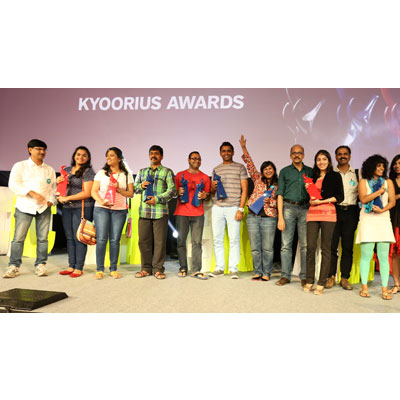
MUMBAI: Kicking off the first edition of Kyoorius Awards, winners for various categories in Design and Communication were announced today, at the 9th annual Kyoorius Designyatra in Goa. These awards were held in partnership with D&AD and the International Advertising Association (India Chapter) and sponsored by ZEE.
Spanning over nine categories including print, packaging, digital, retail and design for good, Kyoorius Awards recognized the frontrunners in each of these streams. Over two very hectic days in Delhi, the judges held intense discussions to pick out the nominees and then the winners. These winners were chosen by an esteemed jury comprising of Elsie Nanji, Gabor Schreier, Jeremy Leslie, Simon Sankarayya, Tanya Singh Khosla, Ton Van Bragt and jury manager, Donal Keenan.
Based on real briefs by real clients, a special section of the awards was dedicated to the works of students as well. Five groups of students were chosen as the winners based on his work across the six categories. The winning student entries earned them a cash prize of INR 50,000/-, one free student pass to the 2014 Kyoorius Designyatra, a Wacom Bamboo tablet along with being featured in the annual awards showcase book.
Below are the details on the winners of the Kyoorius Awards:
At a Glance:

Winners of the Blue Elephant:
CATEGORY NO AND NAME
AWARD TITLE
AGENCY NAME
PROJECT NAME
CATEGORY – 1 – IDENTITY
Branding a Birthing Center
NH1 Design Pvt. Ltd.
Birthplace Healthcare Pvt. Ltd.
CATEGORY – 2 – PACKAGING
Good Paper Project
Leo Burnett Mumbai
Fresno & Bakersfield India Ltd.
“Stories from Channapatna”
Locopoco Design Studio (Entrant: Varnam)
Varnam
CATEGORY – 3 – COMMUNICATION
Save Calligraphy
O&M, New Delhi
Qalamkari Creative Calligraphy Trust
Getty Images Poster
Leo Burnett Mumbai
Getty Images
Chaplin Chapters
BBH India
Movies Now
Ish Watch
Alok Nanda & Company
Filte
CATEGORY – 5 – SPACE
Temple Pavilion Installation
Abin Design Studio
Kishor Sangha Community
CATEGORY – 6 – BOOKS
“Dekho : Conversations on Design in India”
Codesign Brand Consultants Pvt. Ltd.
Codesign Brand Consultants Pvt. Ltd.
Gobble you Up!
Minus9 Design
Tara Books
I Take this Train Too
Alok Nanda & Company
Filter Press
CATEGORY – 8 – CRAFT
“Stories from Channapatna”
Locopoco Design Studio
Varnam
I Take this Train Too
Alok Nanda & Company
Filter Press
Recycled Mechanics
Umbrella Design
Bennett, Coleman & Co. Ltd.
CATEGORY – 9 – GOOD
Save Calligraphy
O&M, New Delhi
Qalamkari Creative Calligraphy Trust
Help Desk
DDB Mudra Group
Aarambh
Hot Wheels Key Chain
O&M, Mumbai
Mattel Toys (India)
Good Paper Project
Leo Burnett
Fresno & Bakersfield India Ltd.
Winners of the Black Elephant:
BEST OF SHOW
AWARD TITLE
AGENCY NAME
PROJECT NAME
Temple Pavilion Installation
Abin Design Studio
Kishor Sangha Community
“Dekho : Conversations on Design in India”
Codesign Brand Consultants Pvt. Ltd.
Codesign Brand Consultants Pvt. Ltd.
Winners of the Red Elephant:
On the awards night, Rajesh Kejriwal, Founder CEO, Kyoorius said, “We had conceptualized this with the aim of being able to recognise exceptional work in the design industry. It was exhilarating to witness Kyoorius Awards take shape, thanks to our esteemed partners D&AD, IAA (India Chapter) and our sponsors ZEE, who came on board to support this initiative.”
The D&AD Yellow Pencil is recognised world over as the most prestigious amongst
creative awards. Tim Lindsay, CEO of D&AD said, “With past experience in the arena of awarding excellent work in the creative stream, we were privileged to support Kyoorius’ efforts in the design industry. Kyoorius Awards were conducted at par with international standards and the delegates and industry peers received an opportunity to view some excellent work done by the winners.”
Kaushik Roy, Immediate Past President — IAA India Chapter said, “With the unprecedented response for the first instalment of Kyoorius awards, we are certain that there is a long association in store between Kyoorius, D&AD and IAA- India Chapter. Together, we have the vision to realize the power of design and it is crucial that we support and award the best creative minds in India.”

News Broadcasting
Network18 channels lead YouTube news viewership in March 2026
CNN-News18, News18 India and CNBC channels top categories with record views
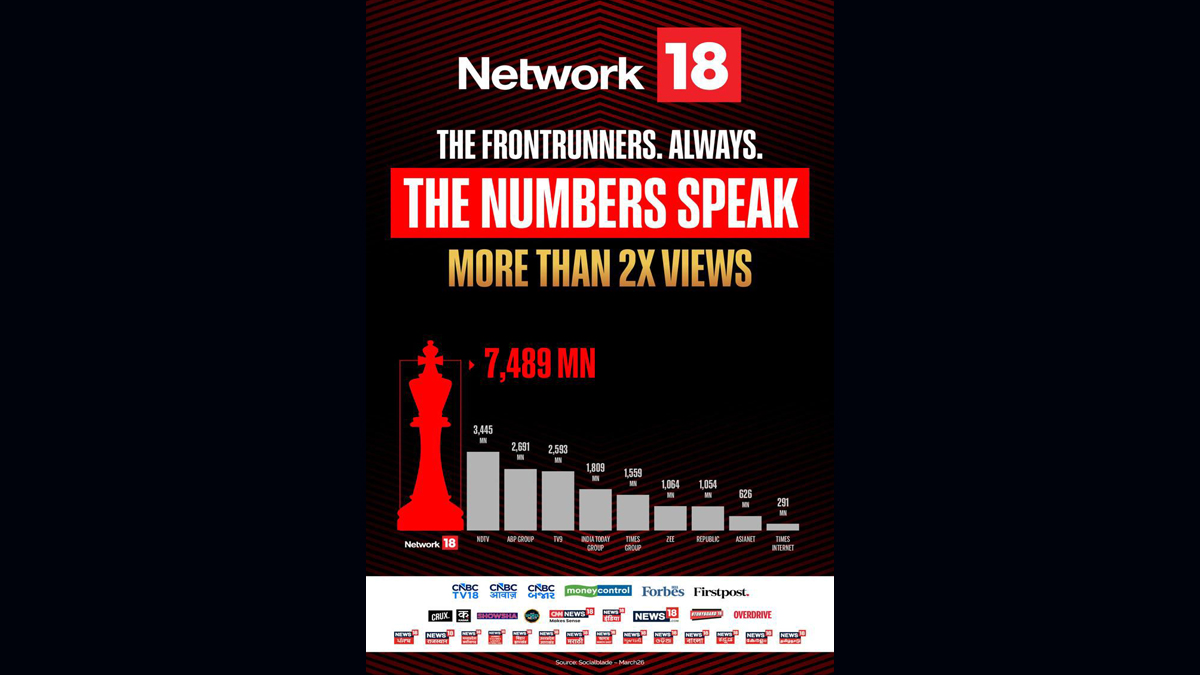
MUMBAI: When the world hit refresh on breaking news, Network18’s channels were already streaming ahead. As geopolitical tensions and war-driven headlines fuelled a surge in global news consumption, the network’s digital playbook delivered big clocking record Youtube viewership across English, Hindi and business news categories in March 2026.
At the forefront was CNN-News18, which emerged as the clear leader in the English news segment with 130 million live and video-on-demand views. The channel edged past competitors such as Times of India (126.5 million), Times Now (101.1 million), India Today (88.2 million) and NDTV (77.5 million), according to Databeings data for March.
In the Hindi news arena, News18 India delivered a commanding performance, racking up a staggering 3,297 million views on YouTube. The channel comfortably outpaced NDTV India, which recorded 3,119 million views, underlining its deep reach and consistent engagement with mass audiences, as per Playboard data.
The network’s dominance wasn’t confined to general news. In the Hindi business segment, CNBC Awaaz topped the charts with 92 million views, narrowly ahead of Zee Business (90 million) and well ahead of ET Now Swadesh (57 million). Meanwhile, its English counterpart CNBC-TV18 posted a strong 58 million views, reinforcing the network’s cross-category strength.
The spike in viewership reflects a broader shift in audience behaviour, with viewers increasingly turning to digital platforms particularly Youtube for real-time updates and in-depth coverage during high-intensity news cycles. For Network18, the numbers signal more than just scale; they underline the effectiveness of a multi-platform strategy that blends speed, credibility and continuous coverage.
In a month where the news never paused, it seems viewers chose to stay tuned where the stream never stopped.






